
Skinside Out
Beauty Ethnicity & Cosmetic Surgery
by
Book Cover & Preview Text
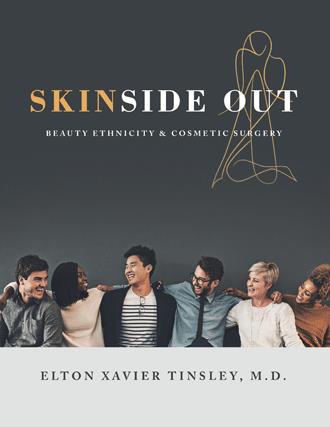
Introduction Every culture defines for itself what beauty is. My greatest grandmother was African, my grandmothers Negro, my mother colored, my sisters Black and my daughters African-American. I have seen, smelt and been touched by beauty. Beauty is not simply Greco-Roman standards superimposed over mathematical symmetry. Nor is it simply, correctly proportioned hips, lips and thighs. This is not about “skin of color” nor “ethnic skin”. This is about Black Skin, and ethnically correct cosmetic surgery in people of African descent. We live, work and play all over the globe. Whether we reside in Chicago, LA, Lagos, London or Nigeria we share a common gene pool. We have outward physical similarities that manifest our inward genetic kinship. Ontogeny recapitulates phylogeny simply means you know us when you see us. Recognize. The sections on skin and skin care are intended to be practical and useful to those who have and those who treat Black skin. You will learn something today that you can use today. Blacks, in America, for example, are far more knowledgeable about hair care than they are about skin care. Society has only recently begun to acknowledge that Black skin not only looks different but is different. There is no mistaking how our skin responds differently to the same influences experienced by others. These influences may be as simple as sun exposure or as complex as skin cancer or trauma and the formation of keloids. These differences have an actual underlying, DNA driven, biochemical basis. Keep in mind that the skin is the largest organ in the human body and all surgery requires contact with the skin. The end result of surgery is affected by the condition of the skin before surgery. Healthy skin looks better and responds better to both surgical and nonsurgical procedures. There are a lot of myths in the Black community. Some of us actually have a fear of surgery, a true aversion to the possibility of pain and we absolutely will not enter into a discussion that involves being “put to sleep” lightly. The sections on cosmetic surgery have several purposes. We will walk through the entire surgical process. We will address and hopefully dispel the common myths and along the way while we identify and define the unique ethnic considerations. We will cover the common procedures; the risks, potential complications and costs associated with each. In addition we will cover the non-surgical procedures, products and services commonly available in medi-spas. Who am I? I am not privileged to write on this topic simply because of my heritage. I am indeed Black. I am also a Plastic surgeon and Black skin researcher. I have been a Plastic Surgeon in private practice for 10 years. I have been a student and researcher of Black skin for 20 years. I have owned and operated the TotalBody™ medi-spa for 9 years. As a native and the only African American plastic surgeon in private practice in the city of Chicago I am also a member of the community. I have learned just as much if not more from the community as I have contributed. In the absence of published data I can say with certainty that there is no advertisement more effective than a satisfied Black woman. Unfortunately Black skin is not taught in American medical schools. Diseases of the skin are taught, but my interest is in treating the common skin conditions that are not diseases that affect normal Black skin. The blemish, for example, is not a disease. I have researched and studied the skin we are in. This book is not about disease it is about the achievement and maintenance of healthy, flawless and beautiful skin in Black folks. And, yes, there will be before and after pictures.
Formats

Book Details
About the Book
Beauty is powerful. Beauty is physical, intellectual, emotional and spiritual. Beauty is obtainable. Skinside Out recognizes that every culture defines for itself what beauty is. Each contributor represents a different culture and cultural perspective. The book was written for those that care for women and those that women care for. It is a valuable reference for health care professionals, salon professionals, doctor moms and regular people. Skinside Out was written for you. Skinside Out is 50 topics covered in 50 chapters. The book answers questions, dispels myths and provides insight to cultural differences, old wives tales differ among Black and Hispanic grandmothers. The German family beauty secrets may be quite different from Asian family traditions. The final chapter, Chapter 51, Sex is for Women explains the science that relates beauty to sex and offers everyone another level.
About the Author
It is with great pleasure that I share this book with you. It’s part art, part science, all fun and definitely useful. Dr. Tinsley is a plastic surgeon and ethnic skin researcher. When he graduated from medical school there was no internet, no pocket sized computers with cameras that allowed phone calls and no effort to accept that there are ethnic differences in skin. Prior to becoming a plastic surgeon he was a general surgeon, a burn surgeon and worked around the country as a trauma surgeon and emergency room physician. As he became more specialized in his practice he observed that different ethnic groups perceive beauty differently. His life work and this book reveal that beauty is not simply mathematical symmetry superimposed on Greco-Roman standards. Not anymore, at least.