
The Best of Professional Pilot's WxBrief
The First Ten Years
by
Book Cover & Preview Text
The decrease in airspeed may not be immediately apparent. Neither is the gradual increase in attitude while the autopilot valiantly tries to maintain the dialed in altitude. It isn’t until the buffeting starts that many pilots realize they’ve built up enough ice to rent out their aircraft as a skating rink. By this time, the deice systems may be of little help and the only option is a more or less frantic attempt to find warmer air - hopefully somewhere well above the terrain.
Despite state-of-the art deicing systems and the availability of deice capabilities at many midsize and smaller airports, icing continues to play a contributing role in a number of aircraft accidents every year. As pilots, we know it’s up there. We may even have a pretty good idea whether we’re likely to encounter icing during the course of our flight, but too often other factors supersede rational thought and commit us to flying into icy conditions.
Unfortunately, in the FAA’s eyes, an accident involving icing is nearly always attributed, at least in part, to pilot error, no matter how significant or unexpected the icing may have been. Even in cases where an aircraft was certified for flight into known icing, investigators often cite icing management errors or poor flight crew judgment for getting into such a situation in the first place. In order to manage icing, or better yet, avoid it, pilots must always keep a weather eye out for favorable icing conditions during planning and flying, especially as cold air gets closer to the ground with the approach of winter. As with most meteorological adversaries, icing is not an incredibly complicated beast, and a little bit of knowledge can go a long way toward staying out of the accident files.
Solid state
Ice is simply one of the 3 states in which water can exist on this planet. In fact, it is one of the very few chemical molecules that exist in all 3 states within the range of temperatures experienced on Earth. The temperatures needed to form, grow and sustain ice are found throughout a large portion of the lower atmosphere. Except in the tropics in summer, the freezing level is quite often found within a few thousand feet of the surface. During the winter and at higher latitudes, that level may even be well below the ground.
Water freezes at 32° F (0° C). This is a physical law. However, not all water will become ice at this temperature. For water to freeze, it needs something to freeze around - a nucleus. Normal water, including most rain water, contains all sorts of impurities that can act as the nucleus, and most water will turn into ice at around the freezing point.
However, if there is nothing for the water to freeze around, it will have to continue cooling to a much lower temperature before it has lost enough energy to begin forming solid bonds within its own structure. This pure water may exist in liquid form to temperatures as low as -40° F (-40° C), but temperatures between 32° and 15° F (0 and -10° C) are more common. It is in this supercooled state that it can be most dangerous to aviation.
In general, supercooled liquid water will have a temperature roughly equivalent to the air surrounding it. Warmer air would impart heat to the water and colder air would take heat from it. Droplets are normally only a few micrometers in diameter and at most may be a few millimeters across. So, except with the largest droplets, a supercooled rain drop will warm pretty rapidly as it falls into above freezing air - a few thousand feet is all it takes. The problem is that, if the temperature of the air supporting the supercooled water is below freezing, an object flying through that air would probably have a similar temperature as well. ...
Formats

Book Details
About the Book
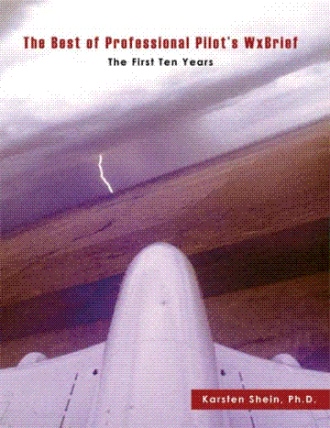
The Best of Professional Pilot’s WxBrief is a compilation of aviation weather articles that have appeared in Professional Pilot magazine over the past decade. With WxBrief, Pro Pilot has taken aviation weather knowledge to the next level—explaining the whys and hows behind some of aviation’s most important weather considerations. The articles in this book are ones that have been selected by Pro Pilot’s readers—aviation professionals—as the best articles of the issues in which they appeared. This book is a must have for any pilot or aviation enthusiast who wants to know a bit more about the weather that all pilots must deal with whenever they take to the skies.
About the Author
Karsten Shein grew up in the suburbs of Chicago and has a passion for flying. He completed the Professional Pilot program at the University of Illinois’ Institute of Aviation and holds a commercial pilot's license with instrument rating. Karsten has a Ph.D. in climatology from Michigan State University and has worked in the UK at the University of East Anglia’s Climate Research Unit, in Washington, DC on NASA’s Global Change Master Directory, as an assistant professor of geography at Shippensburg University in Pennsylvania, and currently works for NOAA’s National Climatic Data Center in North Carolina as a climatologist. Since 1997, Karsten has been writing WxBrief for Professional Pilot, and has been consistently named one of the best writers by the magazine’s readers.