
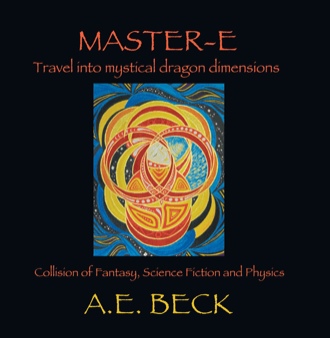
Master-E: Travel into Mystical Dragon Dimensions
Collision of Fantasy, Science Fiction and Physics
by
Book Cover & Preview Text
Preamble
MASTER-E IS … A State of Consciousness of the seeker that evolves over time, gradually approaching awareness of IS-NESS. There is no hurry; rather there is joy in moving into the larger room of awareness of what merely IS.
Wondrous journeys await MZ and his three friends in the realm of Dragons. Inviting death, this teenage fugitive rejects Clarion’s government-mandated “CollectiV” group consciousness. Eleven male-ruled dimensions are hiding out in black holes, preparing to destroy the Great Oneness and gain power over all creation. When MZ is apprised by the E-Masters that his home planet of Clarion has agreed to join in this galactic conspiracy, he must depart Clarion to join friends and embark upon a journey of awareness with courage and resolve. Mystical E-Travelers, via inner nudges, guide MZ onward to journey’s end. MZ knows failure is not an option. Numerous helpers walk with him as the expansion of his heart and mind focus on inner Master-E of the IS-NESS. Opening a window inward, MZ seeks an elusive epiphany: MASTER-E.
A. E. Beck
Formats



Book Details
About the Book
This is the second book of the Master-E trilogy by A. E. Beck. Look for Master-E: Epic Space and Time Travel into Parallel Dimensions: An Entanglement of Fantasy, Science Fiction and Physics, and a soon-to-be released title: Master-E: Seeing, Knowing and Being: Beyond Fantasy, Science Fiction and Physics. Information regarding books by A. E. Beck can be found at the Web site www.gryphlyon.com.
About the Author
The roof of A. E. Beck’s temple is the sky.
The writer is an avid researcher of spiritual and scientific accomplishments of ancient and contemporary people of earth. Sumerians populated city-states around the Lower Tigris and Euphrates rivers as early as 5000 BCE. Sumerians said the primeval sea was the source of creation. Heaven, earth, and planets were suspended within a gaseous atmosphere. This early society created the first known cuneiform written language. Sumerians introduced mathematics, astronomy, and architecture, inspiring the Babylonians to develop the base numerical system and geometry. Greek mystic and mathematician Pythagoras, in 500 BCE, influenced society with his Pythagorean theorem and Pythagorean School.
Early Greeks identified a tiny “uncuttable” material that formed the heavens. They named this material atoms, and determined that matter was composed of atoms. Modern physics defines atoms as being made of electrons and quarks. A quark is described as tiny loops of vibrating energy strings. The source of scientific principles can be traced back to early philosophers of spiritual societies. Physicists in the 1930s began to view rays of light as forming waves that spread out in all directions. Current theories involve expansion of space-time. This is different from the teachings of Tibetan monks, who define space using a diametrically opposed space-time paradigm. The monks see modern physicists’ view of an electron as one point in space as flawed. They concur with a 1930s Nobel laureate’s statement that electrons are wavelike. Physicists define space as having a positive charge. The monks say space is nothingness, which is negative. The monks teach that true reality is outside space-time, where the journey of individual souls to realize god is found.