
Creating Jesus
by
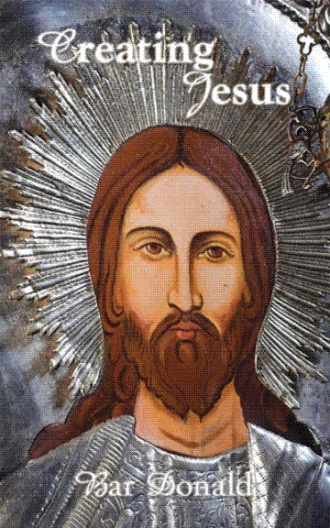
Book Cover & Preview Text
The Problem
The Christian Bible consists of two Books, the Old and the New Testaments, welded together with a metaphorical blowtorch. The New Testament, qua literature, is just bad literature; as ‘history’, it is nearly worthless.
Most, if not all, of the ‘prophecies’, ‘predictions’, and ‘fulfillments’, which supposedly link the two books together, are spurious and secured with the monkey wrench of allegory and sophistry. The historical period in which the action of the New Testament takes place has been so tampered with as to border on the absurd. The ‘history’ is really an anti-Jewish pro-Roman screed meant to win over the gullible masses as the Empire struggled to subdue the Jew and Judaism. Unlike other tribes and nations and peoples within its Mediterranean orbit, the Jew refused to subordinate entirely his Law and customs to Roman governance. He refused to bow down to idols of Caesar and his nation finally refused to accept Gentile sacrifices in the
None of the NT authors really know the geography, topography, or the toponomy of Palestine first hand. Mark, for example, refers to the coasts of Judea by the farther side of Jordan (Judea never included lands beyond the Jordan; the river itself hardly presents a ‘coast’!).
None seem to know the Mosaic Law very well either. In fact, most contributors to this ‘new’ testament were probably anti-Semitic Gentiles writing fifty to a hundred years after their Jesus had walked the earth. Inflecting and permeating the whole corpus is a venomous antipathy towards the Jew and Judaism.
Basic elements of literary composition were unknown to them: setting, plot, characterization in depth are so consistently mangled that overall verisimilitude is practically non-existent. But the authors did employ deliberate and malevolent techniques such as inversion, i.e. take the real fact and turn it upside down, then use caricature, satire, and comedy to flesh out the fabrication in order to achieve their literary goals, which were really in the service, initially, of Imperial Roman propaganda.
Now enter Paul of Tarsus. Paul had never seen or met Jesus of Nazareth in the flesh. But he did claim to have seen and talked with the Lord after His resurrection and ascension into heaven. Paul’s many private visions and revelations, he asserted, gave him the authority to preach the ‘good news’ everywhere with apostle status, in synagogue after synagogue and, supposedly, in one fledgling church after another. The trouble was: no one else, either in
But curiously, the author of the Pauline letters doesn’t seem to know about Jesus’ miracles or John the Baptist or Nazareth, etc. And the author of Acts ostensibly doesn’t seem to have read the Pauline letters very carefully; but we will see that in fact he did, and his main mission was to polish Paul’s image and bury the embarrassing stuff as best he could.
Formats

Book Details
About the Book
Did Paul really come after the Gospels in time? Did the Jewish prophets really predict Jesus? In this fearless new look at the New Testament, the reader will be surprised to learn, among a host of other things, the real origins of baptism and the true character of Pontius Pilate. The new religion may very well have had its beginnings in Roman Imperial propaganda against the Jew and Judaism. Instead of being a saint, Paul may have been a Herodian police agent actively involved in the murder of Palestinian Jews. These and many other conclusions will astound and shock the reader as the 'orthodox' disinformation of two thousand years is laid grotesquely bare.
About the Author
Bar Donald has spent a lifetime wondering at the story of Jesus. His progenitor, Porphyry of Tyre, started him on his long road of discovery both in Palestine and in libraries around the world. He is currently in hiding somewhere in North America.