
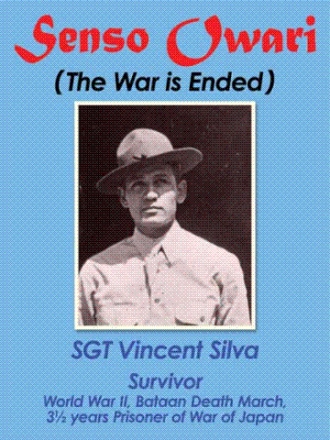
Senso Owari
(The War is Ended)
by
Book Cover & Preview Text
During the last few months before the end of the war, the Japanese guards were easily irritated at anything the POWs did. Many of us were beaten for little or no reason. We later discovered that during this time the war was going badly for them. Their troops were being pushed back and all their conquered territories were being taken by the Allies.
The Japanese plan for home defense was to send all the women and children inland where they, along with the POWs, would be executed. By that time the Japanese had over 69,000 POWs in 158 camps throughout the Pacific. When the invasion of Japan began, all able-bodied Japanese men had orders to defend the homeland and Emperor Hirohito (1901-1989) to the last man. To the Japanese, the act of surrender was to lose face. In their eyes, this was worse than death.
"Senso Owari"
Fortunately, the dropping of the atomic bombs on Hiroshima and Nagasaki prevented the Japanese from completing this plan. The lives of the Japanese population were saved, as well as many prisoners and thousands of Allied fighting men.
For me and eight of my fellow prisoners, the timing could not have been better. One evening after a long day of work, about thirty of us were in the fenced enclosure next to the foundry. We were waiting for the ferry to take us back to camp. Next to us was a barge docked on the river. In this barge we could see bags full of vegetables. The guards had left us to check on the
ferry and we could see no one onboard the barge. Nine of us climbed the fence and boarded the barge. We stuffed our jackets with soybeans. The guards returned and caught us before we had time to climb back to the other side of the
fence. The nine of us were lined up and the guard in charge hit us all in the face. The blow was so hard I thought my jaw was broken. We were taken back to camp and accused of stealing from the Emperor of Japan and trying to escape. Our sentence for this crime was to die by firing squad. The date of our execution was August 15, 1945.
On the morning of August 15, 1945, the Japanese guards stacked their rifles and left. The One Armed Bandit and his first sergeant came into our barracks and ordered us to gather around. He sadly announced to us, “Senso owari, shigato nai.” (“The war is ended, there will be no more work.”)
At first we stood in stunned silence, then as if awakened from death, the entire camp was jumping around with joy. We were hugging each other. We were laughing and crying at the same time. I don’t believe that any one of us ever thought that we would not win the war. Our only question was: Would we live long enough to see the end? We later learned that the actual surrender of the Japanese was on August 9.
Formats

Book Details
About the Book
This is the story of one soldier- what his life was before World War II, what he went through to survive the savage treatment of the Japanese during the Bataan Death March and 31/2 years as a POW, and his struggle to live a normal life when he returned to his wife and daughter after the defeat of and liberation from his Japanese captors. During World War II, one of twenty-five POWs in Europe died as prisoners of the Germans, while one of three POWs in the South Pacific died as prisoners of the Japanese. For the 200th CA (AA) from New Mexico, this number was one of two.
About the Author
SGT Vincent Silva lived through 3 1/2 years of torture and brutality at the hands of the Japanese. When he returned to his family after his liberation he tried to forget the horrors he had experienced. Now over 60 years have passed and he is ready to tell his story.