
The Lay Apostolate By A Layman
by
Book Cover & Preview Text
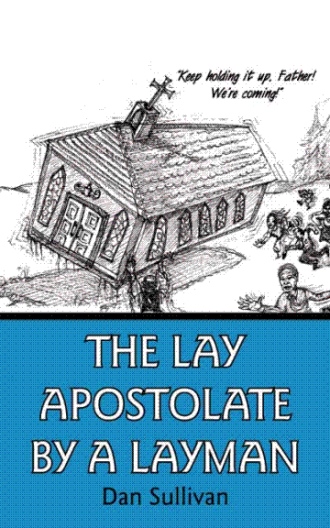
It will come as no revelation to any Catholic today (forty year or older) that our church is in deep trouble. I will cite only one set of statistics to substantiate this statement. In the 1966-67 school year the U.S. Catholic seminary enrollments were 42,767 students. In 1992 this figure had dropped to 6,679. Furthermore, during this same period, the U.S. Catholic population increased by 25%.
Such a situation simply screams for support from the laity. But, this support cannot be just financial, because money can't buy vocations; nor can it be support directed by the hierarchy, because this has never worked in the past. This laity support must come directly from the laity itself, inspired only by lay leadership, set up by lay leadership and controlled by lay leadership. The only way help from the laity will be effective and worthwhile is if it comes from an adult laity, a laity which can think for itself, stand on its own two feet and act as TRUE lay apostles. By TRUE lay apostles I mean lay apostles who trace their vocation directly from God, independent of any clerical exhortation and inspired independently (as part of their baptismal vows) to come to the aid of the church which gave them spiritual birth.
At the moment there does NOT exist any such lay apostolic organization in the church. There simply is no society or group or club or organization, at present, which is specifically qualified to produce TRUE lay apostles.
This book is an attempt to explain why there is no such organization and why there never can be such an organization UNTIL there is a clear understanding of the nature and function of TRUE lay apostles.
Formats

Book Details
About the Book
About the Author
This book might well be considered a UNIVAC (First Computer) for the Lay Apostolate. It departs from all previous treatments of this subject by members of the hierarchy and provides a layman's view of what a vocation to the Lay Apostolate is all about.
Mr Sullivan is no novice in this field. His education from grade school through college has been all Catholic. He started early, winning the medal for Religion three times in grade school (really four times, but the nuns wouldn't give it to him again!) He was in the Sodality for four years in High School and president of the Sodality in his senior year in College. He has a brother a priest, a sister a nun and has the following credentials in parish experience: Holy Name Society (president for two years), Legion of Mary, Knights of Columbus, Weekend Retreats Captain (twenty years), Blue Army of Our Lady of Fatima (over forty years), Young Adults Parish Social Club (founder and president), parish lector and usher.
By far however of all his layman endeavors has been his founding of the Knights of Fatima, Inc. This group of laymen (begun in 1950) has brought the activity of the Lay Apostolate to a new level of accomplishment. It has successfully established in over ten parishes and in two dioceses a religious program promoting First Saturday devotion to Our Lady of Fatima. This program has led to increased attendance at First Saturday Masses by as much as 400%.
Mr. Sullivan has an all-pervading theme to his book, which is that the greatest need for the Church today is an ORGANIZED LAY APOSTOLATE. By this he means a lay organization equivalent to some of the great religious orders, like the Jesuits, or Dominicans or Franciscans, except that this organization would be composed solely of laymen and lay women, not religious. He makes a strong case for the absolute necessity of this independent lay organization (never however down-grading the ultimate authority of the hierarchy), and claims that the greatest beneficiary of such an organization will ultimately be the hierarchy itself and not the laity.