
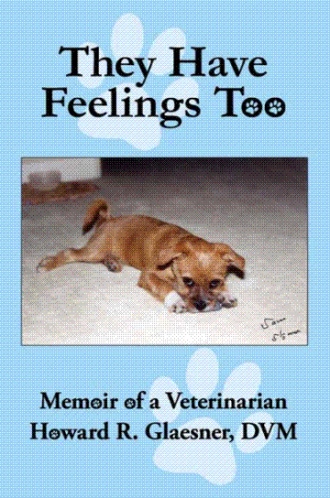
They Have Feelings Too
Memoir of a Veterinarian
by
Book Cover & Preview Text
C H A P T E R 2 4
A Shocking Experience
Electric shock injury rarely occurs in dogs and cats, but when it does, it usually involves a puppy or a kitten chewing on an electric cord. I can still picture the black kitten that was carried in and placed on the exam table by its frantic owner. The kitten was as rigid as a statue standing straight up on all four legs, with her tail pointing up and all her hair standing on end. She was not moving or crying-but a copious amount of saliva was pouring from her mouth as she stared with dilated pupils straight ahead. The client, Mrs. Emma Corder, said she heard the kitten, Mouser, scream and ran to find her standing over a chewed electric lamp wire behind the living room chair. Mrs. Corder said the wire had been chewed in several places but in one place it had been chewed down to the bare copper wire. In order for me to exam Mouser’s mouth, I had to use considerable force to pry her jaws apart. I was able to observe under a tick layer of saliva a burn ulcer across the tongue. The electricity had cooked her tongue as it passed through her body. There were also burns on the lower lips. The electric current had done damage to Mouser’s central nervous system as manifested by the tonic muscular rigidity that lasted thirty minutes. It took that amount of time before the kitten was able to relax the muscles of her legs and jaws and for the erect hair to lie back down. I injected an injectable antibiotic with cortisone to control infection and reduce swelling and with that reduce pain. I kept her over night to give subcutaneous fluids and to observed for any more neurological changes. Mouser went home the following day with instruction to take oral liquid amoxicillin for the tongue ulcer and to be feed baby food until she felt like eating again. It took 10 days before she was eating soft food on her own. Mouser tried chewing on the cord one more time, but her owner smeared some hot chili on the cord to discourage the behavior. Since then, I always warn new owners of puppies and kittens to check all the light and telephone cords daily for signs of teeth marks. If they see any bite marks, they should unplug the cords and apply a bitter substance to the cord until the puppy or kitten grow out of the chewing age.
C H A P T E R 3 4
Monkey in a Blanket
I could hear a slight wheeze, but no crackles that would indicate that she had pneumonia. She had a slight yellow-gray mucus discharge from her nostrils. I made a diagnosis of a cold with slight bronchitis with, a good prognosis. I gave Baby an injection of amoxicillin in spite of the ear piercing screams and her attempts to grab the syringe and give me the injection. I dispensed a cherry flavored liquid amoxicillin antibiotic to be given every eight hours for 10 days. They both returned in 10 days for a checkup with Beth carrying the little one as usual in the pink baby blanket. We had the same struggle to exam Baby, but when I uncovered her, I was able to listen to her chest and exam her nose and she sounded normal. Beth left with a smile and I thought I saw one on Baby’s face, too. I had one other experience with a monkey while I was a senior veterinary student at the
C H A P T E R 4 7
Dangling Eye Ball
They were bred at such a slow rate that for decades only the wealthiest of people possessed one. The requirement conformation for the breed is not to weigh more than 15 lbs. and to stand between 6-9 inches at the shoulder. They usually live to the age of 13-15 years. These dogs have a long fine hair coat that comes in all colors and requires high maintenance or will develop tangles. They have a flat face and a short mouth with a large tongue and soft palate that make them extremely sensitive to heat and anesthetic. Their eyes are susceptible to abrasions and prolapse. Their heads are so large that frequently they must be delivered by Caesarian! I was on call for emergencies one September night when I received a call from our night man, Bill. He said “one of our clients is on the phone. His dog, Bing, a Pekinese was in
Formats

Book Details
About the Book
They Have Feelings Too is a memorable journey into the world of veterinary practice. As a young man fresh out of the United States Navy, Howard Glaesner has a decision to make. What is he going to do with the rest of his life?
Howard takes you through the hallowed university halls and into the Cal Davis's Veterinary stables to give you a glimpse of real life veterinary medicine. What happens when a staff of veterinary student are unknowingly exposed to rabies? Go into the surgery lab for large animals and follow the doctors as they prepare a highly strung black stallion for orthopedic surgery. Learn about the massive hydraulic operating tables and be in attendance as the chief surgeon operates on the stallion to stabilize a knee fracture.
The new graduate with Doctor Of Veterinary Medicine behind his name chooses the specialty of small animal medicine. He finds employment as a staff veterinarian in a busy two man practice in
Howard decides to broaden his experience and moves to a large eight man practice in
The final episode of his career was his own one-man private practice. Howard moves his family to
This book exposes the reader to what really happen behind the doors of a veterinary clinic. If you ever wondered what was happening to your pet during treatment and wanted to be taken step by step through orthopedic surgery, learn how dangerous junk yard dogs are handled, and how rattlesnake bitten dogs saved, then this is a must read.
About the Author
Dr. Glaesner received his undergraduate degree from UCLA and his Doctor of Veterinary Medicine from the