
The Eighth Deadly Sin
by
Book Cover & Preview Text
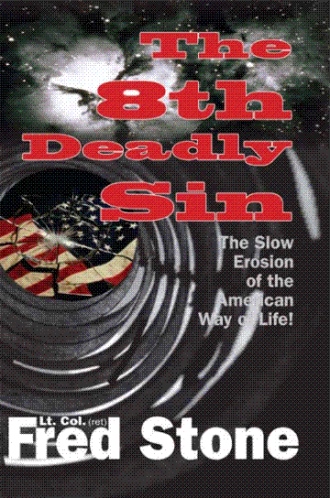
This book began as an essay (chapter 1) to vent my frustrations regarding the failure of our leaders to honestly and objectively analyze the political, economic, and social climate of the United States and Middle East that contributed to 9/11 and the changes, if any, that occurred as a result of the attack. As my inquiry about the “why” of 9/11 led further and further a field, it became clear that some additional written explanation would be necessary, if only to explain these observations to anyone who might read the essay at some later date. Those explanations, together with the original essay, slowly evolved into separate chapters of a book on American domestic and foreign policy failures that contributed to the attack.
Significantly, the failures included a number of characteristics woven into the fabric of our society that repeated themselves so often they formed predictable patterns of a national malaise either encouraged or at least purposely ignored by our nation’s leaders. Chief among them was the public preference for distortions, obfuscation, half-truths, and lies over any truth that called for sacrifice or an adjustment in their standard of living. Our libraries, bookstores, and the Internet have been awash for decades with exceptionally well-researched unclassified information predicting the decline and/or collapse of a variety of renewable and non-renewable resources, benefits, and functions critical to the American lifestyle. Some of those predictions have already come to pass, while, regrettably, others are firming up. (7) The data also describe a slow disintegration of the American family, e.g., stagnant wages, increasing divorce rates, increase sexual abuse and teen pregnancies, higher school dropout rates, and lower academic scores of those completing high school and college.
Taken separately few of the changes will seriously affect our standard of living; life will continue much as before only slightly impacted by the loss, and then only by the working poor, the uninsured, and the unemployed. Taken together, however, they paint a very grim picture, as most of the “end times” are predicted to occur within the same fifteen- to twenty-year “window” and all will occur prior to mid-century. (8) I am convinced that the convergence of these events in a general sense was and is well understood by many of our past and present corporate and political leaders. Yet to date, few have been willing to make the difficult decision to collate the data and present it to the American public as a cogent argument for change together with the consequences that will occur if the changes are not made.
(7) SSI is a prime example of our legislator’s and the American public’s willingness to ignore a known problem. Demographics on the “baby boomers,” born in the years immediately following WW II, and financial projections have for at least thirty years shown very clearly that the program in its present form is doomed to fail. I have written my elected representatives for over twenty-five years citing federal documents that forecast the collapse of SSI. The few responses I received assured me there was no problem. Now, suddenly, our legislators tell us the problem is dire and requires some painful sacrifices. And while I don’t disagree with their current assessment, I can only imagine how much less painful the “fix” would have been had it been implemented a quarter century or more earlier and the SSI surplus resulting from the changes placed in a savings program not accessible to our elected officials slights of hand. A complete analysis of the future of SSI can be found on http://www.usgov.gov. (8)
Formats

Book Details
About the Book
The Eighth Deadly Sin was born of frustration resulting from over fifty years of witnessing citizens of the United States participate, if only benignly, in the slow decay of the American way of life. Our democratic nation that at the end of World War II was the envy of the world and leader in nearly every measurable category has, with the exception of the wealthy, permitted its living standard to stagnate if not decline. Parents ignore the education of their children leaving them unprepared to compete in the workforce. Elected leaders stand by as the health of the citizenry suffers from preventable diseases, some the result of man-made products. They shrug their shoulders as industries are shuttered and jobs move off shore. And while shunning the advice of other nations they wring their hands in angst as the mightiest military force the world has ever known is reduced to garrison duty, not knowing how they should be used to put an end to stateless terrorist organizations that roam the world. Americans are transfixed as the nation morphs from the world’s greatest creditor to the world’s greatest debtor, no longer master of its own destiny but dependent on others to buy its IOUs so that it might continue its unsustainable lifestyle for a few more years. How did it happen and what needs to change if the Today, as an exploding world population competes for a growing list of declining resources, the United States faces its greatest challenge-that of bridging the chasm between the “haves” and “have nots” to bring stability and peace to a world dangerously out of balance.
About the Author
The author, a retired USAF Lieutenant Colonel, command pilot and senior air traffic controller, writes from the perspective of his military experiences and of an average citizen possessing a genuine desire to see the