
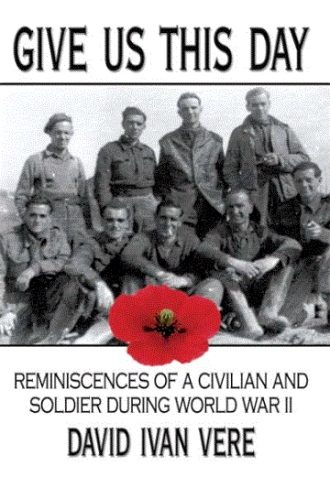
Give Us This Day
by
Book Cover & Preview Text
After the meal was over, we formed up outside and marched back to our quarters where we found the platoon sergeant waiting for us. He introduced himself to us saying, “I am your platoon sergeant, and you will always address me as Sergeant Atterbury. You must always stand to attention when you speak with an NCO or an officer, and you will call him sir!” He continued, “Never speak to an officer unless spoken too. If you wish to speak with an officer, you must first notify an NCO of the matter. Don’t forget to always salute the officers.” Sergeant Atterbury went on. “My job in the next six weeks is to take you through basic infantry training; in small arms, drill and fieldcraft.” The sergeant now looked very seriously at his new intake and continued, “Always pay attention to what I tell you, if you want to keep your name off the village war memorial!” He then went on to say, “You have no rights in the Army. Your only entitlement is to be given three meals a day.” The sergeant continued. “Everything you receive is a privilege, like pay and leave.” He also made reference to a book that he carried with him, titled ‘Kings Rules and Regulations’ that left us in no doubt that we were in the Army now. “Don’t forget,” the sergeant went on, “to listen to the bugle calls in the camp, and recognise the different calls played. Reveille, mess calls, fire picket and lights out are the main calls that should interest you. Lastly, if any man feels unfit for duty, he must first notify an NCO to place his name on sick report for sick parade. Before we go outside for a guided tour of the camp, I can tell you that you will be issued with your Army kit tomorrow and get your civilian clothes posted home.” Before he marched his platoon off, the sergeant put us through our paces with some drill. “I can’t have you going around like a rabble, even when you are still in civilian clothes.” When our drill had improved to his own satisfaction, he marched us off with our first stop at the main gate and the guardhouse. “Make sure that none of you end up in there. Keep out of trouble and obey without question all orders given you.” We moving on, working our way around the camp, and were shown most places that would affect us in our stay there. These including among them, the barber’s shop, armoury, ·22” rifle range, the straw-shed and a building containing a gas chamber, in which eventually we would all have to pass through as part of the training. The tour of the camp over and back outside the billet, the sergeant, with his platoon standing to attention, walked along the backs of the three ranks of men, tapping some of them on the shoulder in passing with a comment made in a quiet voice, “Haircut.” I stood there in complete confidence that he would walk by without touching me on the shoulder. But he did. “Haircut.” My first reaction was to reply to him that I had visited a barber only the day before, but stopped by a visionary glimpse of the dreaded guardhouse for answering the sergeant back.
Formats

Book Details
About the Book
This narrative runs its course through the most momentous years of our nation’s history, when This title for the book, I found most fitting in that when you are living in the uncertainty, that is the battlefield, and faced with your possible demise, you seek solace in your faith. There was also a saying of the infantryman, with a religious connotation - ‘no atheist ever dug a slit trench.’ It is also a tribute to my friends who never returned, or lived to see the peace, and now remembered only by the nation on Armistice Day, or by those who loved them throughout the years and still feel the pain of their passing.
About the Author
David Ivan Vere was born in 1924. After a secondary modern school education, he started work at the age of 14. He worked in the manufacture of electrical measuring instruments till his call up into the Army in 1942, where he served in four separate Infantry Regiments till his discharge in 1947. He then returned to his old company, where he was transferred to the Development & Experimental department, which came under his control in 1965. The department worked in close co-operation with the Royal Aircraft Establishment, Farnborough, on solar cell arrays for spacecraft. He also carried out experimental work for Harwell on reactor thermocouples, and many other projects in the medical field, obtaining patents along the way. He retired in 1989.