
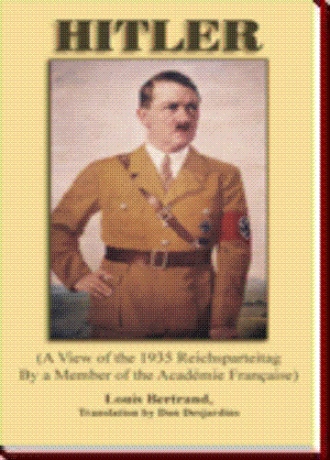
HITLER
(A View of the 1935 Reichsparteitag By a Member of the Academie Francaise)
by
Book Cover & Preview Text
The evening of my arrival, I attended a gala presentation of the Meister-Singers at the Nuremberg Grand Theatre. Hitler was in attendance, surrounded by his general staff, while the room was filled with well-known Reich political figures, invited guests and elite members of the general public. There prevailed a grand simplicity in the dress, the uniforms, and even the female attire. Behavior was exemplary, even somewhat contemplative, as if in a church; everything one might imagine in regard to the
There was a profusion of flags and banners everywhere: in windows, down each street, on public monuments, and along the highways. One might even say there were too many. An orgy of red flags which completely overwhelmed those of the Social-Democrats. So! You want red flags Mr. Socialist and Mr. Communist? We’ll give them to you! You shall be drowned in red; you shall be engulfed to the point of making your head swim!... All the while, it is necessary to acknowledge that the organizers of these rallies knew how to obtain extraordinarily decorative effects from the massing of these flags. In this vein, the most astonishing sight which I contemplated occurred Friday, the 13th September, on the Zeppelinwiese, an event featuring a processional march with 20,000 banners, representing National Socialist groups form every city and province in 8 Translator’s Note: this calls to mind the immortal scene from Leni Rieffenstahl’s “Triumph des Willens,” shot from behind the podium, in the spectator’s stan
Formats

Book Details
About the Book
First published by Arthème Fayard in 1936, this book is an account of Louis Bertrand’s visit to the Reichsparteitag at Nuremberg the previous Fall. Bertrand spent an entire week in Nuremberg, observing both Adolph Hitler and the National Socialist movement. It was a unique occasion to view Hitler up close, to hear him speak and see him in contact with fellow Germans. Bertrand felt such an event should interest a Frenchman to the highest degree, particularly a professional observer such as himself. In writing this book, Bertrand was quick to point out he was not an Hitlerian. He was in Nuremberg for the sole reason to observe and understand: this, he claimed, was the duty of every patriot capable of influencing public opinion. He therefore limited himself to reporting only what he saw and commenting on his impressions. However, these are not the comments of an ordinary person, for Bertrand was a noted biographer with keen insight into human personality. As a member of the Acadèmie Française, he was also one of France’s most prestigious academicians. Bertrand’s observations therefore stand as important testimony regarding political events and a world leader having significant portent for the world’s future.
About the Author
Born at Spincourt, March 20, 1866, Louis Bertrand studied at Bar-le-Duc. He became a grammar-school teacher in Aix-La-Provence, later moving to Bourg-en-Bresse. In 1891, Monsieur Bertrand obtained a chair in Algeria, receiving a Doctor of Letters in 1897 with his thesis “The End of Classicism and the Return to Antiquity In the Second Half of the 18th Century and First Years of the 19th Century in France.” He followed this in 1899 with his first book “The Blood of the Races,” which treated the subject of heredity and the crossing of racial groups in Algeria. Bertrand’s first novels appeared shortly thereafter, including “Don Juan’s Rival” (1903) and “Pépète and Balthazar.” In 1906 Bertrand traveled to the Orient, where he became passionately interested in questions of religion. After several accounts and novels based on his travels, including “Greece of Sun and Countryside” (1908) and “Mademoiselle from Jessincourt” (1911), he published “Saint Augustine” (1913), the first of his religious studies and one which classed him a master of artistic hagiography. During World War I, Bertrand wrote “Sanguis Martyrum,” rallying fellow Frenchmen to the virtues of heroism. Following the war, in 1923, appeared “Louis XIV,” followed by “Saint Teresa” (1924) and “Jean Perbal” in 1925. It was also in 1925 the Académie Francaise recognized Louis Bertrand as one of France’s foremost academicians, electing him a member. “The New Sentimental Education” and “Hippolyte Porte-Couronnes” appeared in 1932. His later years were devoted to history: “History of Spain,” and works on Lorraine and Africa among these. His memoirs were contained in a series of novels under the title “d’Une Destinée,” of which 8 volumes appeared, to be followed by others, when he died on December 6, 1941 at Cap d’Antibes.