
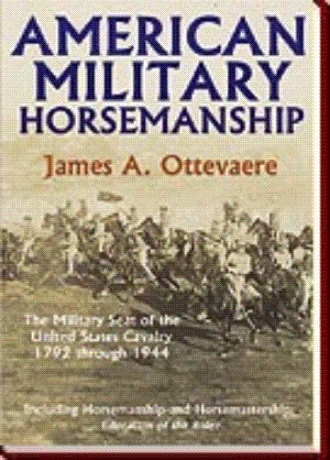
American Military Horsemanship
The Military Riding Seat of the United States Cavalry, 1792 through 1944
by
Book Cover & Preview Text
Compared to the cavalries of
Traditionally, the United States Cavalry officer was groomed at West Point or on the drill fields of State Militias while the trooper was educated and trained “on the job” in regimental camps of instruction and in the field. This “on the job” system had few rules. Training the troopers was left almost entirely to the judgment of each regiment’s officers and noncommissioned officers. Consequently, training methods varied widely from unit to unit. Guidance for this training was usually based upon nothing more than the past education and service experience of the unit’s officers and noncoms. Their textbooks were most often the then current cavalry drill and tactics manuals. For the more conscientious officers, civilian publications and books written by serving and former cavalry officers were often used. Much of the Cavalry’s training literature, both official and unofficial, came from foreign cavalries, generally those of
The result of this somewhat haphazard method of mounted training was predictable. Standards varied from regiment to regiment, as did the quality of the instruction. Horses broke down frequently in the field due to a combination of ill-fitting saddles and sloppy horsemanship by under-educated and poorly trained troopers. Although the United States Cavalry trooper may have been respected for his accomplishments in the field, there was no illusion that he was an accomplished horseman, or for that matter, a very good rider.
The
Formats

Book Details
About the Book
During its time the United States Cavalry grew from a few squadrons of dragoons scattered across a vast frontier to what would become, by the end of the American Civil War, the largest body of mounted troops in the western world. During the post Civil War years the Cavalry would again become a small, but highly affective, mobile force charged with protecting American westward expansion. At the close of the 19th Century the
This term, "military seat" as it is often used today has various descriptions and meanings. The purpose of this book is two-fold, first it is intended to clear away some of the misunderstandings of the "military seat" and to explain its evolution in the context of United States Cavalry history, as it evolved through the end of the horse Cavalry era at the close of World War II. There is also a second, underlying purpose to this book. That is, to present to young riders, inexperienced riders, and accomplished riders, as well, the riding style and teaching methods that shaped United States Cavalry horsemen into the mid-20th Century, a style that would eventually evolve into a uniquely "American" military seat. A riding seat that is often misunderstood, yet is in wide use today and is as useful to modern horsemen as it was to the Cavalrymen of the last century.
About the Author
The author is a long time rider, certified riding instructor and a student of horsemanship. He is the retired Captain and Division Commander of the Macomb County, Michigan Sheriff Department’s Mounted Division. He is also a certified crowd management instructor, a certified mounted police instructor and a certified show judge.
He has been a student of the United States Cavalry and a collector of Cavalry saddlery, horse equipment, uniforms, training materials and artifacts for many years. Items from his extensive collection have been featured in many reference books and periodicals on Cavalry related subjects.
This is his second book. His first book, Simplified Mounted Drill and Crowd Control Formations, for Mounted Police Units, has become a basic text book for many professional and auxiliary mounted police units.
He is the Chairman of the Board of Trustees of the United States Cavalry Association, Library and Archive Foundation, located at Fort Riley Kansas, a founding member of the Michigan Cavalry Brigade association and a charter member of the Society of the Military Horse. He is active in teaching horsemanship, and writing and lecturing on United States Cavalry topics.