
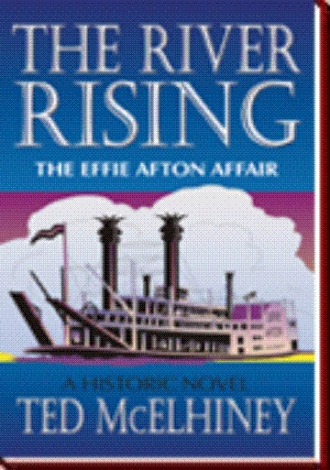
The River Rising
The Effie Afton Affair
by
Book Cover & Preview Text
The big majestic stone home of Colonel Davenport was built on the Illinois bank of the
The Colonel stood on the porch of his home, insisting that the members of his family go without him to the celebration that was planned for that hot July day at the
The Colonel waved to the last of his family, who were heading for the celebration of the American Independence being held at the
He hated missing such a wonderful event with his family, but thought his time better spent reviewing his thoughts and notes concerning the bridge problem. He needed to work on some of his new ideas which he would submit to officials, and to write letters to some of his Washington friends whom he felt he could count on for backing him when the decision of bridge placement came up for finalization. The family would enjoy the celebration, and that was very important to him. He could celebrate later. Hopefully, at the site of the new bridge.
The Colonel turned and went into the house, heading for his parlor. He settled down in his favorite chair, lit his pipe and began to read the newspaper, with an occasional glance up to see the turbulent motion of the
His attention was suddenly interrupted when he heard a faint noise outside.
“Must be some children playing out by the well or it’s just someone drawing water,” he thought.
Returning to his reading again, another noise startled him. Thinking he’d better go check it out, he rose from his chair, and headed toward the door to see what was causing the commotion. As he stepped to the door, he saw a shadowy figure cross in front of the door and he knew by its size it was an adult, and not a child.
“What do you want?” he shouted.
The shadowy figure suddenly filled the doorway. It was no one that the Colonel could immediately identify because the intruder was silhouetted against the blinding sunlight from outside.
Suddenly the door pushed open and three men stood before him. Still no one he could recognize. Nothing extremely unusual, as many people wanting something from the trading center often came to the house.
Three men bolted into the room, shoving him violently. Not a word was said. One discharged his n s, pistol at the Colonel, hitting him in the left thigh. The Colonel fell backward in pain as he tried to reach for his cane. Feeling the hot sticky substance coming from his leg, he knew he was bleeding profusely. He tried to right himself to a position in which he could protect himself. His left side was painful and unstable. The bullet was lodged in his upper left leg and he was unable to stand. One of the intruders looked familiar, but the Colonel was in too much pain to remember who this intruder might be. At first glance something in his mind flashed— “something about the bridge.”
“Could this be someone with a grudge concerning the bridge? Yes,” he surmised as he wrenched in pain.
Thoughts of having survived Indian warfare, the dangers of the Mexican war, and the lonely residence here on the very outskirts of civilization sent visions through his throbbing brain. How could this be happening to him when everything seemed so right and so peaceful now?
After thirty years at this place, he, in the last couple of years, had
Formats

Book Details
About the Book
This writing, although fiction, has a basis in fact. Our story involves the Mississippi River,the events that happened during the 1850s, including the murder of Colonel Davenport; the slave issue; the destruction of the steamer Effie Afton” and the burning of the bridge; the river pilots; the trial; and Abe Lincoln, the lawyer defending the bridge. Some of the characters in the book are the author’s own idea of who they were and how certain historical events might have evolved through their story.
About the Author
Ted McElhiney is no stranger to the
The area where his father grew up was only a few miles from