
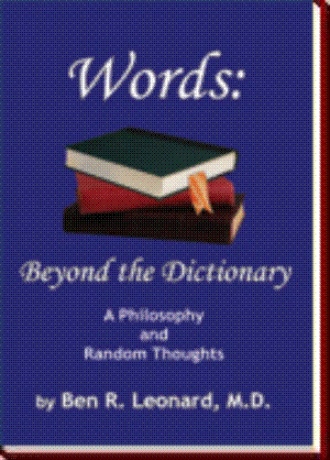
Words: Beyond the Dictionary
A Philosophy and Random Thoughts
by
Book Cover & Preview Text
Charity Dictionary Definition “Benevolent goodwill toward or love of humanity; Kindly liberality and helpfulness esp. toward the needy or suffering; Aid given those in need; A gift for public benevolent purposes.” Beyond the Dictionary Food for the hungry, shelter and bed for the homeless, relief for the pained, comfort for the dying, solace for the distressed – What noble and necessary gifts these are. They not only serve a need, but they also lift the human spirit. So frequently we hear the word “Compassion” bantered about. I sometimes feel offended at the light & easy use of such an important word – without compassion there can be no charity. In fact the two driving forces of charity are love and compassion for all things great & small, animal or human, all the things that nature and man have wrought. Charity is not to be given or taken lightly – Freely, yes; lightly, no. Charity should be left out of the political arena. It cannot be classified Liberal or Conservative, Republican or Democratic, Green or Libertarian. It must be the shared purview of all. There will always be those less fortunate in our world – sometimes of their own making, sometimes through unavoidable misfortune. I have heard the argument that each individual is responsible for his or her own circumstances. I can agree with this only with regard to those who are indolent and unwilling to work, but we must remember there are those who, through no fault of their own, are injured, mentally retarded, hungry, or poor. They need charity. How sad for those who lack charitableness – for those whose greed, avarice, or hate will not allow them to give. They will never feel the beautiful, heady feeling of helping. Happily, charitable is easy to be; charity is easy to give –and the feeling that charity endows both to the giver and the recipient is far more valuable than the gift itself. Charity does indeed, transcend mere humanity – It lifts the human spirit into the sky. Soul Dictionary Definition “Immaterial essence, animating principle, or actuating cause of an individual life; The spiritual principle embodied in human beings, all rational and spiritual beings, or the universe; A person’s total self; Moral and emotional nature; Quality that arouses emotion and sentiment; Spiritual or moral force.” Beyond the Dictionary The dictionary definition just about says it all. But? But whence comes the soul? Who gave us this ethereal quality – this essence of our being? This brings us back to the question, “Is there God?” To deny there is a creator is to deny one’s own existence; so if there is a creator, then why not give him/her/it a name: “God” seems like an acceptable choice. The name “God” is aeonian, used by believers and disbelievers alike. Obviously, the reader does not have to accept my thoughts as fact, but I believe in a creative force, and for the sake of argument, I’ll call it “God.”And I believe God gave each of us a soul just as defined in the dictionary. Did our soul exist before we were born? Was it a quality floating in some spiritual essence waiting for us to be born, or did God just whip it up on the spur of the moment and assign it to our human being? It would seem strange to me if something so unique, something so spiritual [please allow me] could be finite. Please note, I’m not answering – just speculating. What troubles me is the next question. What happens to our soul when we die? I repeat my speculative question: How can our unique soul be finite? Yes, our flesh and blood can be destroyed, can be killed, but our soul? Imagine, if you will, when the Grim Reaper takes your mortal remains, that your soul flies into the ether and continues to function through eternity. What a thought! Is there some form of existence after death? Those of the various religious denominations and sects claim to know. Perhaps they are divinely endowed, but I doubt it – they’re human! Me? I don’t know. I’m human too.
Formats

Book Details
About the Book
This book of essays was started to give family and friends a little insight into Dr. Leonard’s feelings. As it progressed, it became clear that he was philosophizing, advising, opining, and baring his soul. The format is simple. Family and friends were requested to submit words. These words were dictionary defined and analyzed, and then the author’s thoughts put into essays. Dr. Leonard’s thoughts and opinions are interesting, often controversial, and frequently downright fascinating, but most importantly, the reader, in reading and thinking, almost assuredly will learn something about him or herself.
About the Author
Dr. Leonard has been in the practice of Family Medicine for 50 years. This has involved Surgery, Obstetrics, Pediatrics, General Medicine, and Counseling.
He has seen and dealt with thousands of people with a wide range of personalities, he has been an interested observer of humanity and history, and he has been intrigued and concerned with religion and politics.
In his role of observer, thinker, and advisor over these many years he has developed a fascinating philosophy, some intriguing opinions, and some pretty good advice.
You may not agree with everything Dr. Leonard has to say, but it will certainly give you plenty to think about.