
Memories of Afghanistan
by
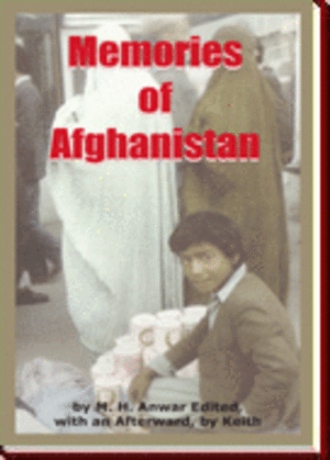
Book Cover & Preview Text
Amir Khan loved to discuss, reason, question and mull over subjects, not only with us, but with other teachers, especially two other religious teachers in the school. In the middle of the school year, he began to invite Musa and me to walk with him after school and on the weekends. As we walked, he would tell us of his pains and pleasures, of his heroes, like Suqarat (Socrates) and Aflatoon (Plato), and of ideas far beyond our comprehension.
“An idea is like a rough, precious gem, freshly mined,” he said once. “It is full of debris. It has to be cleaned, polished, cut and shaped to bring out the sparkle. Plato wrote a whole book about the concept of justice. Socrates spent a lifetime on it.”
Then, for two whole weeks, Amir Khan did not show up in class. Our inquiries at the principal’s office were left unanswered. On the third week, a new religious teacher was appointed, a heavily bearded tyrant who smelled, like most mullahs. He enjoyed beating the students so much that he would invent new excuses so that he could spend more time beating than teaching.
On one occasion, he ordered us to stand and put our hands, palms down, on our desks. He walked around observing our hands and wrote notes as he did so. Then he walked to his desk and read the names of about half the students.
“Those whose names I just read, line up against the wall. Now, it says right here in the holy book,” slapping it with the back of his hand, “that one must be neat and clean at all times. Those against the wall have not trimmed their fingernails. For this, each one will receive a punishment of three blows with a stick on the back of his hand.” The rest of the period was an exercise in cruelty. He had barely finished when the whistle for recess sounded. As the students rushed out of class, one yelled, “Mullah Sahib, you smell.”
“Who said that? Stop.” Mullah raised his hand.
No one paid any attention to him. By the end of the month we all settled into a normal routine of rote study, spiced with occasional bodily injury. Amir Khan became a dim memory, creeping slowly further and further into the past history of the savage tribes dotting the unproductive slopes of the mountains that hugged us on all sides.
But I saw Amir Khan again, almost ten months after he left us. He was sitting on a wooden box in the corner of a shop in the section of a bazaar where condiments were sold. His feet were stretched stiffly in front of him and he was engaged in a lively conversation with the shopkeeper. As I neared him, I noticed that heavy chains hung from his waist and were fastened to large, shiny rings around his feet. A soldier with a gun leaned against the wall. I was almost paralyzed with fear, but kept slowly creeping forward. Amir Khan saw me and, with a wider smile than I had ever seen on his face, stretched both hands to receive me. I kissed his hairy neck and turned my face away to wipe the tears with my shirt sleeve.
“He is one of my students,” he told the shopkeeper. Turning to me, he said, “I have been trying to see you and Musa.”
“What is the problem?” I asked, looking at the chains.
“Oh, these? I have been accused of heresy and the two religious instructors in your school are their witnesses.”
“Who accused you?”
“That powerful English spy, the Hazrat Sahib and his disciples.”
“Aren’t you afraid to talk like this?”
“Afraid I am, my dear, but when the water level is above one’s head, it doesn’t matter how high it is.”
“Where can we find you?”
“I am allowed half a day each week. You may find me here again next week at this time.”
We parted sadly after a short chat over a cup of tea. The following week, Musa and I came back to the shop. It was closed. We waited most of the afternoon, but Amir Khan never came.
About ten days later, on a warm Friday afternoon in another part of town, I saw a crowd gathering and heard a commotion. A loud voice was announcing the sin of heresy of one Amir Khan, a former teacher, for which he would be stoned to death that afternoon. I struggled through the crowd to where Amir Khan was. His head was bent slightly to one side and his hands were tied behind his back with a dirty yellow rope.
I ran to him and tried to talk with him. I was stopped by one of the four soldiers who were guarding him, who prodded me with his gun and tore my sleeve and bruised my arm. The nature of the crime and the punishment was announced repeatedly every half a mile until we arrived at a rocky clearing at the outskirts of town. Nearby was the royal palace surrounded by a moat half-full of odorous water covered with algae. At the site of the execution, a regiment of soldiers was lined up in a semi-circle at the far end. To the left, a dozen mullahs, wearing bulbous white turbans and long shabby beards, were standing. To the right, there were two rather comic characters, one on horseback and one on the ground, looking nervously at each other. They distinctly did not like their assigned jobs.
Amir Khan was brought before the mullahs who asked him some questions, then nodded their heads when he made a request. He walked slowly a few steps, faced Kaaba and prayed in a sitting position for about five minutes. Then he was led inside the circle, soldiers on one side, townspeople on the other, and mullahs sandwiched in between. I forced myself to look straight at Amir Khan’s face. As he looked up at the cloudless sky and lowered his gaze toward the men of God, the mounted soldier raised his saber as the signal to commence the “show.” Stones flew from all sides, some missing and some hitting Amir Khan. I was mesmerized and kept looking at his face. Blood gushed from every side of his head. My knees began to shake. I sat down and vomited my lunch of bread and watermelon. When I looked up again, Amir Khan was no more. Where he had stood, there was now a large mound of stones.
Townspeople began to leave hurriedly for home, running away from their collective monument of guilt. The soldiers marched dolefully toward their barracks near the royal palace. I walked slowly to the mound of stones. A piece of cloth shimmered in the evening breeze. I be
Formats

Book Details
About the Book
“Dr. M. H. Anwar’s fascinating memoir. . . conveys the ferment of protest and struggle which gripped Afghan society in those years. . . . Memories of Afghanistan is worth reading not only for the insights it provides into the revolutionary ferment among intellectuals and working people during the first half of this century, but also for its many warm and vivid portraits of individuals, and for the moments of joy and of pleasure, the friendships and the achievements, which Dr. Anwar recounts.”–
“Memories of Afghanistan is. . . a record of the fragile hopes of a handful of Afghans who sought to fashion their country’s future with the tools of enlightenment and science. Such voices were conspicuously absent when the Loya Jirga–an assemblage of warlords and Islamic fundamentalists under the aegis of American-led occupation forces–met in
About the Author
M. H. Anwar (1914-1993) grew up in the slums of