
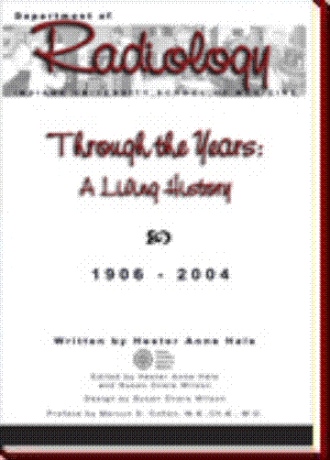
Through the Years: A Living History of the Indiana University School of Medicine Department of Radiology 1906 - 2004
by
Book Cover & Preview Text
Excerpt 1
scholars of distinction and addition of new courses of study in keeping with war experience and the state’s rapid economic progress.” Changing the general teaching program from an intensified wartime emergency operation to a more traditional routine in peacetime called for important readjustments throughout the medical school’s operation. Of primary importance was the re-assembling of a faculty and the return to a traditional nine-month, two-semester teaching schedule.
Earlier, the
After the war, Dr. Campbell began receiving numerous requests for radiology training from doctors who had completed their military service. Dr. Willard Smullen and Dr. Warren Fischer were the first of the I.U. graduates leaving military service to begin residencies. Resident appointments were given to Dr. Smullen in 1945, Dr. Fischer in 1946, and Dr. Jack Loudermilk in 1947, giving the I.U. program a first-, second-, and third-year resident staff. Other residents coming on at this time were Drs. John (Jack) Little, Maurice Manalan, Richard Datzman, James Lorman, and Phillip Lockhart.
The first full-time radiology resident, Dr. Charles Roland, had been appointed in 1942. At the end of World War II, Dr. Campbell obtained certification from the resident review committee and, later, from the Joint Committee on Accreditation of Hospitals for probational approval of a three year radiology residency, making Dr. Roland eligible for examination by the American Board of Radiology. In the X-ray area of the
Since the county hospital was involved in the education of military medical students, the army procurement division immediately had assigned Dr. Echternacht and Dr. Campbell to cover the radiology work at the hospital. Also Dr. Aaron Sullenger, who had been deferred because of a medical disability, took his second year of apprenticeship residency in radiology at
Dr. Campbell’s schedule involved working at I. U. until about 3:00 p.m. and then going over to General Hospital and helping Dr. Sullenger finish the fluoroscopy, therapy, and film interpretation each day. The standard workweek for salaried employees at that time was 44 hours, which included a half-day on Saturday. Some medical school classes were even held on Saturday mornings. Technicians’ schedules were rotated to cover night emergencies and emergencies on Sunday.
In order to avoid having to pay for a registered technician to take emergency X-rays at night and on the weekends, Dr. Campbell hired senior medical students to do this in return for free room and board. It was necessary for him, first of all, to give each of these students a four-
Excerpt 2
Probably the fact that each chairman came into that position from years of experience within the department contributed to his success.
Three popular members of the radiology faculty retired in 1994, each of whom had worked 20 or more years in the I.U. department. Dr. Heun Yune and Dr. Vernon Vix had come to the medical school with Dr. Klatte. Dr. Glenn Moak had been recruited by Dr. Klatte in 1974 and soon became involved in a special medical student teaching program. To their show appreciation to these three valued radiologists, department members honored them with a formal farewell party.
Formats

Book Details
About the Book
Academic radiology at
Today, the Indiana University Department of Radiology is composed of a large, dedicated group of physicians, residents, fellows, technologists and support staff. Using the most technologically advanced equipment available the department provides the highest level of radiologic training, imaging services and patient care.
This is the story of those people who have worked tirelessly to shape the department over the past 98 years. It is because of their ingenuity, dedication to their craft, and love of teaching that the Indiana University Department of Radiology has thrived.
About the Author
Hester Anne Hale is a very successful freelance writer and historian. Her work has been focused on Indianapolis-area organizations. Her career has spanned several decades and includes print journalism, teaching, free-lance writing, and an abiding love of local history.