
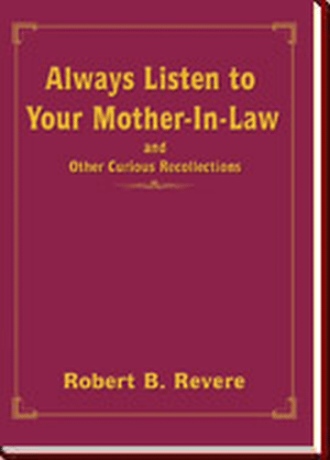
Always Listen to Your Mother-In-Law
and Other Curious Recollections
by
Book Cover & Preview Text
They lived on a farm next to ours. They raised chickens, as we did, but Mr. Potchker believed in diversification and hand-milked about ten cows, of uncertain breed, twice a day. Every afternoon at about
When he opened the gate, they would file into the barn, slipping their heads into stanchions that held them in their places. Their supper would be already in front of them. First there was a heap of delicious grain. Later, before the milking, Mr. Potchker would pull down from the loft above an abundant heap of hay for each cow. They stood there, chewing slowly, grinding their jaws from side to side.
Having arranged for their comfort, Mr. Potchker would go into the house and come back with a pail of warm, soapy water and a clean rag (normally, a discarded pair of his own underpants). He washed their udders and teats very carefully to take off any dirt and manure. Then he would sit down on a stool (always on the right side of the cow), with the silver-colored pail between his legs. The metal pail rang as the milk struck the empty bottom of the pail. He sat with his head against the cow, in a hollow, just where the right thigh and the side of the cow met.
For milking he always wore a skullcap made from the crown of a brown felt hat. His head was the first to feel any motion of the cow’s leg. Hand milkers know that it is not unusual for a cow to put its dirty rear hoof squarely into a pail of milk, unless the milker is alert and able to anticipate and swivel aside with the pail still between his knees. Some cows seem to enjoy this game and wait until the pail is nearly full. If she wins this little contest the only thing that can be done with the milk is to feed it to chickens or pigs, who don’t seem to mind that it was flavored by whatever the cow had stepped in that day.
I was about six. My family did not have cows of our own at the time so I was required to carry home a can of milk on a little wagon (in winter on a sled). So I watched Mr. Potchker milk his cows every night. I found the smell of the warm milk, sweet hay, cow dung, the sound of grinding teeth, the ringing of the milk in the pail to be an irresistible combination. No matter what childhood stress I was feeling at the time, going into that barn at milking time was very soothing.
There were, of course, other sounds and smells, providing a bonus of the contentment: cows pissing in great hissing streams, the plopping noises, the redolent combination that formed in the trough behind the cows. (To this day, whenever I see a small, red barn, I feel like going in once again to re-experience the smells and sounds, for even though it has not been used for many years, the barn will retain some of its odors.)
What also drew me to the Potchker’s barn were the cats. The Potchker family had moved to the
The matriarch had been in full production for about 10 years, when I first came to their barn. By that time battalions of cats swarmed around the farm. They preened in the sunlight; hunted mice in the barn and in the hayfields. Their home was in the pumphouse. The sigh and thump of the old pump, with its loose gear, must have been like the beating of their mother’s heart. Cats and kittens competed for limited space with the pigeons who moaned in the eaves. When work had to be done on the pump and the pumphouse was invaded by people, the cats would move out.. Disconsolate and cold, they would wander in the yard, looking disgustedly at the pigeons, who fed daintily on the manure which the cows had left enroute from barn to pasture. No such repulsive food for them!
Although they shared a common ancestor in the old grand dame, the tom cats of the neighborhood had made generous contributions to the gene pool. There were an ample number of greys, blacks, some with black and white spots. There were even a few ginger colored
Formats

Book Details
About the Book
What would you do if a pig sought sanctuary in your office?
How would you like to step into the middle of a French civil war?
What would you do if your recently-deceased mother in law gave you stock market tips?
How would you react to having your passport blown up in an embassy bombing?
These and other dilemmas are explored in this intriguing book of short stories.
About the Author
Born in 1926, Bob Revere grew up on a farm in rural
Bob Revere’s work experience has ranged from poultry farmer to political science professor. After the war he put himself through college by working in a trucking company. His later experience included trips to the
He has been married to Dr. Virginia L. Revere, they have four children and three grandchildren. They live near