
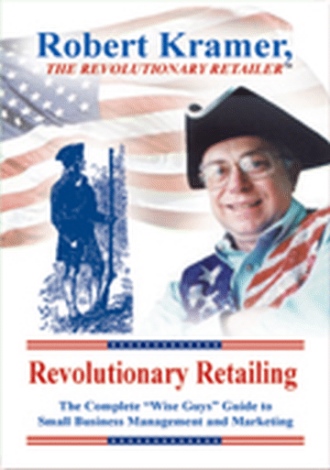
Revolutionary Retailing
The Complete "Wise Guys" Guide to Small Business Management and Marketing
by
Book Cover & Preview Text
BUSINESS STRUCTURE
One
of the first determinations you make in starting a business is how to legally
structure your operation. Will you operate as a proprietorship, a corporation,
a partnership, or a limited liability company?
Making
this decision can be confusing. (If you are confused, you should talk to
your attorney. If you are not
confused, it is because you haven't talked to your attorney yet! Ha! ) I would suggest that you operate as a proprietorship
until such time as you have a valid reason to choose a different structure.
Several possible reasons are discussed below.
When
I took over my father’s business, I continued to run it as a proprietorship for
the first year. I probably would have operated a simple proprietorship for much
longer if it were not for specific legal complications that arose from
operating in a dual mode as both a wholesale distributor and as a retail dealer
for Viking sewing machines. When I separated my wholesale and retail
businesses, I went with the traditional C type corporation, the type used by
the giant corporations of
Most
small businesses which initially incorporate will immediately make the
subchapter S election to have the corporate profits flow directly through to
their IRS 1040 tax return in order to avoid the “double taxation” issues of a
corporation. Once my corporation had adequate working capital, I would pay
myself an annual bonus at the end of the year so that the corporation had very
little taxable income. I was required to pay a minimum taxable dividend to
myself on the stock.
The
characteristic of a corporation that makes it a popular business structure, is also what makes it a headache. As “corpus,”
the Latin root word for body would suggest, you have created a new body. This
new “person” has a new set of special rules of operation and tax reports that
will be required at all governmental levels. Even if it is a single bodied
(owner) body, it is required to meet with itself once a year to pass
resolutions and post them in its minute book. When it wants to open a business
checking account or borrow money, the bank will require a formal signed
“corporate resolution” to do so.
What NOT To Do
Why
would anyone want to take a “simple” business like the sole proprietorship and
turn it into a migraine headache? The
fact is, nothing is simple when it comes to owning or
managing a small business. Only the relative complexities of operating your
business as a corporation allow me to use the word “simple” in referring to a
proprietorship. I do not know the actual data, but I would venture to guess
that most folks who establish their interests as a
corporation, are basing their decision on the myth of “corporate immunity.”
S/he thinks, “If I borrow money to start my business and it fails, I will not
lose my home to the bank.” If you are a start-up business -- or even an existing
business with a sudden need for capital -- you will still be required legally to “personally guarantee” the bank loan.
I
know what you’re thinking. “Well, if I have a huge uninsured loss or liability
judgment made against my business, they will not be able to take my personal
assets to satisfy the judgment.” It is when something like this happens that
business rookies get their first good schooling in the proper way to operate a
sound corporation.
It
is in court where you will learn, as a defendant, from the attorney
representing the plaintiff what the phrase, “piercing the corporate veil”
means. The short definition is it means, “We see right through you and you tried
to cheat the system”-- in other words, that you are “screwed” and will lose
everything.
Formats

Book Details
About the Book
This book is NOT about the
lawsuit filed against my business which cost well over $100,000.00 in legal
fees TO WIN! I just wish I would have
written and read it prior to the lawsuit and saved the $100,000.00 for a nice
cruise or yacht. I just wasn’t thinking!
How much will my experiences save
or earn for you? If after reading this book and USING just two or more of the
hundreds of ideas you can honestly say that you did not find AT LEAST $1,000.00
in value you can return the book for a $50 check made out to YOUR favorite
non-profit charity.
I did very little research to
write this book. I worked from age 7 until I retired at age 50 in the trenches
of a small family owned business to research this book. It is “Bob’s basic
business building battle book” for any business type or size. I have been hired
to help a large variety of entrepreneurs, including owners of professional
practices, to better market and manage their businesses. I repeat this book is
NOT just for retail storeowners. The stories however, are MY EXPERIENCES as
they happened in the world of retail.
About the Author
Since 1987 Bob has shared his
learning experiences as a small business owner to dentists, doctors,
chiropractors, hardware store owners, swimming pool dealers, car dealers, and
accountants from
Bob is a former instructor of
Small Business Management at
Bob’s learning came from
combining his Mensa aptitude with his fighting spirit
emulating the attitude of the colonial soldier to outwit the biggest and
toughest of competitors with his own small chain of stores.