
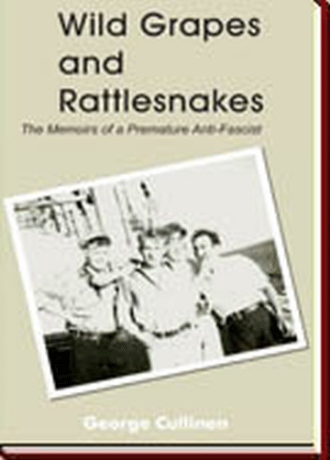
Wild Grapes and Rattlesnakes
The Memoirs of a Premature Anti-Fascist
by
Book Cover & Preview Text
Introduction
Homage to
In
Like many of my comrades, I came
back without any expectations beyond the anticipated pleasure of our seeing
each other again, as we had on various occasions through the years. But this time we were embraced by the people
of
Stepping back onto Spanish soil
and into this jubilant atmosphere, I was flooded by memories and had the
feeling my life had come full circle. I
knew there was one fellow veteran among my American comrades to whom I owed
that life. We met again that first
morning in the lobby of the Hotel Convencion. Like myself, Nate Thornton had been a merchant seaman and waterfront
labor organizer who volunteered to serve with the Abraham Lincoln Brigade, the
American contingent of the International Brigades. Both of us had arrived in
In our hotel lobby all these
years later, I recognized him at once.
This was the man to whom I had owed such an enormous debt of gratitude
my entire life. There were hugs and
backslaps that morning, and I introduced Nate to my
wife Sonia, who was by my side as she has been for more than six decades
now. Looking at Nate,
I could see the passage of years, but the same warmth and spirit still animated
his smile, and for a moment his features defied time and age. He called me, “Whitey,” the nickname my
blonde hair and fair complection had won for me in my
youth. Wishing to acknowledge the debt
at last and thank him properly, I tried to remind Nate
of our battlefield encounter. “You saved my life that day,” I told him.
He was surprised by my words and
looked uncertain for a moment, brows furrowed.
Then he said flatly, “I don’t remember what happened, Whitey. There were so many wounded on that
battlefield.”
“I was in shock,” I recalled,
“and you transported me to a field hospital.”
“I may have,” he said, “but I
have no memory of it.”
In my eyes his memory lapse in no
way diminished his act of courage. If
anything, his not remembering those men like me who he saved only magnified the
selfless humanity of his actions. I told
him, “You’ve always been a hero to me, Nate. All these years you and
Formats

Book Details
About the Book
Wild Grapes and Rattlesnakes chronicles the extraordinary life and
times of George Cullinen, Spanish Civil War veteran,
union organizer and anti-war
activist. Unlike other Spanish Civil War
veterans such as George Orwell and Arthur Koestler, Cullinen’s devotion to the cause of the
Cullinen
recalls his youthful follies growing up in the
About the Author
George Cullinen
was a veteran of the Spanish Civil War and longtime social activist. During his early years as a merchant seaman, Cullinen was a militant rank and file unionist who helped
organize the National Maritime Union.
After fighting in Spain, Cullinen spent
eighteen years at sea; he later survived
the McCarthy witch hunt, and went on to study at New York University, where he
received his BA degree and an MA in cultural anthropology and international
education. With his wife, Sonia Robbins Cullinen, he directed a progressive children’s
preschool. In 1983, he won a Hiroshima
Award for his work as a filmmaker, and with his wife established the Vermont
International Film Festival. Cullinen died on