
When Opportunity Knocks
How to Exploit The Unexpected in Business
by
Book Cover & Preview Text
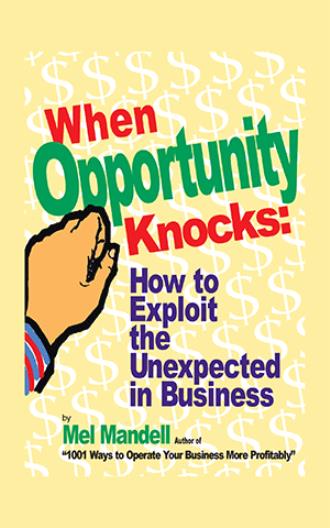
Opportunities can be very
significant because unanticipated business events or brain storms, if exploited
vigorously and expeditiously, can result in...
* Major expansions of sales and
handsome profits,
* Protective diversification,
* Greatly increase share of
market to ensure organizational survival or
* Help their faltering or failing
operations survive when business owners see their problems as challenges
instead of problems.
Being able to exploit
unanticipated events, whether of a business or personal nature, can be
significant for many reasons. Most urgent is survival, finding a way out of or
around a situation that threatens the very existence of one’s business or
employment. In the next chapter, I will detail the way in which Benjamin Eisenstadt, whose business was threatened with failure,
converted what appeared to be imminent extinction into a great opportunity, one
that still thrives over 50 years later.
To my mind the most appealing or
exciting opportunity is one that results in an entirely new product, process or
service, one with several benefits, such as: makes life more attractive for
many; creates an enterprise that employs many; saves energy or some other
increasingly scare commodity; and, hopefully reduces the enormous and
ever-growing imbalance of payments burdening the U.S. economy. The great
example cited is A. G. Decker’s launching of a company that makes portable
power tools, today’s giant, multinational Black & Decker Corporation.
You don’t have to launch a new
business to exploit an opportunity. Most opportunists happily expand an
existing business, the way Henry Ford did by introducing a pick-up truck
version of his epochal Model T.
Few opportunists can match in
sales volume Ford’s inspired reproduction of the pick-up truck. It resulted in
a multi-billion-dollar market in which pick-up trucks, like Ford’s model F150,
outsell the most-popular sedans.
Escape from Dead-end Jobs
There’s another important reason
why opportunities are significant. They are a way for hundreds of thousands if
not millions of people stuck in dead-end jobs, no longer employed or working in
low-paid jobs other than those for which they were trained to realize their
hopes of making it. Unfortunately, job opportunities are shrinking in the U.S.
Those employed can no longer count on ever-rising salaries and more-responsible
jobs. Then there are all those professionals and executives who’ve lost
well-paying jobs as giant companies shed employees, often because they’re
moving departments or entire operations outside the U.S. For these unhappy,
competent people, exploiting an opportunity may be the only way to achieve
their ambitions–and afford to send their children to college.
Most of these would-be
opportunists would be satisfied to create a business that merely grosses a
million dollars a year, but the more energetic and focused among them could
create businesses grossing $20 million a year or more a year. This has been
done over and over again. Why not try to do the same!
An Ancient Trait
Taking advantage of opportunities
is apparently an ancient if not essential trait, one that contributed to the
survival and continued evolution of humans. An example is prehistoric man’s
domestication of the wolf into useful dogs beginning at least 15,000 years ago,
perhaps even earlier; paleontologists have surmised that starving, Asiatic
wolves approached humans cooking around warm camp fires in a submissive manner
and were accepted. (All of the enormous variety of dogs today are descended
from the small, Asiatic wolf
based on studies of their mitochondrial D.N.A. sequences.)
Formats

Book Details
About the Book
“When Opportunity Knocks” is a manual for all those ready and willing to
exploit the opportunities they encounter or create. It will encourage and help
two groups numbering in the millions: owners of small businesses seeking to
expand or diversify; and all the ambitious people stuck in dead-end jobs or
laid off prior to or in the current “joyless recovery” who want to start their
own businesses and become independent.
The book details the great
variety of opportunities and those who exploit them; characteristics of
successful opportunists; blunders to avoid; and how and where to find
profitable opportunities. Ambitious
executives with large companies will find the same information very useful for
advancing their careers.
About the Author
Mel Mandell
is a veteran business journalist, security analyst, consultant and lecturer.
His first book, “Being Safe,” was a Literary Guild selection. After garnering
positive reviews, his fourth book, “1001 Ways to Operate Your Business More
Profitably” (Dow Jones-Irwin), required a second printing. For the second and
third editions of “The Encyclopedia of Management,” he was both an editorial
advisor and contributor.
He was a contributing editor and
popular columnist for World Trade magazine for a dozen years. His articles have
appeared in dozens of business publications, such as Nation’s Business, Dun’s
Review, The Journal of Commerce, Boardroom Reports and the “Business” section of
The New York Times. In course of his long career, he has interviewed many of
the nation’s business leaders, such as Bill Gates.