
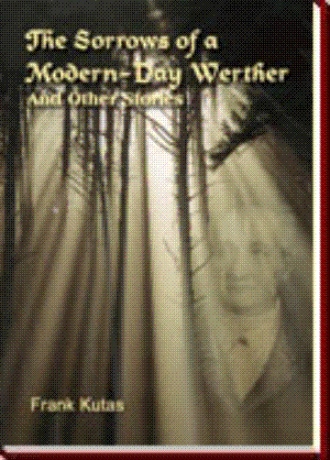
The Sorrows of a Modern-Day Werther
And Other Stories
by
Book Cover & Preview Text
Prelude
In a Budapest high school in 1941, the grade 11 students of a World Literature Class are about to discuss Goethe’s classic short novel: The Sorrows of Young Werther.
The teacher, Mr. Novak, kicks off the debate: "Well class, I assume all of you have carefully read the book. So, let’s get on with it. Who would like to have the first word?"
John, a tall handsome lad, puts up his hand. (He is the son of a widowed mother, who runs a matchmaking agency. In his spare time he functions as the agency’s investigator. The main activity of the outfit consists of matrimonial matters. However, it also arranges short-term liaisons for visiting businessmen. In his capacity as the agency’s investigator, John is a well-known, frequent visitor to the city’s red light district. He makes no bones about taking full advantage of his position, and often brags about his sexual escapades with ‘the girls’. Not surprisingly, he has a down to earth, non-romantic view of the female of the species.)
He begins: "Well, Mr. Novak, this book was a great disappointment for me. It’s stupid, sentimental, and idiotic. How can a great mind like Goethe come up with such nonsense? I can’t imagine a sane man killing himself for being jilted by a stupid broad."
At this point George interrupts: "Mr. Novak, please don’t let this whore chasing pimp rant about a topic he doesn’t have a clue about."
The teacher: "George, watch your language, and don’t interrupt. John has the floor. John, proceed."
John: "Thank you Mr. Novak, but I have nothing to say after that rude interruption by the virgin boy."
The teacher: "OK, George, it’s your turn now, but no more name calling. I suppose you have a somewhat different view."
George: "John got it right in one respect. This novel doesn’t have much of a plot. But it doesn’t really need one. It has one point, which it makes brilliantly: the divine feeling which distinguishes us from lower animals, the feeling which so powerfully overwhelmed young Werther: the love of a woman. In his world of filth and depravity, John couldn’t begin to understand Werther. He has never been in love, he never suffered the pangs of unrequited love."
The Beginning
The tidal wave created by the Hungarian uprising of 1956 washed me ashore in Canada.
Now it was September 1959 and my English was progressing well, but it still wasn’t good enough to be reclassified on my job as an economist. I was still being paid as a senior clerk. What I needed now was a private tutor, but of course I couldn’t afford one.
For help I turned to the International Institute of Metropolitan Toronto, a non-profit organization (now defunct) to assist immigrants. It also served as a convenient clearing house for the idle rich to find appreciative subjects for their volunteer community work. The official I turned to looked at her roster of volunteers and, after a brief flipping of the cards, stopped at one and said: "This one might be suitable, but she wants German lessons in return." There it was, my lucky strike. My German at the time was still in serviceable condition. After I informed her of this fact in a somewhat exaggerated fashion, she picked up the phone to let the volunteer know that she had found the German-English combination. When she handed me the receiver to make the arrangements with my new tutor, I was struck by a pleasant, but quite firm female voice. As I was driving to her place a few days later, the firmness of her voice kept ringing in my ears, and I envisioned a rather masculine and probably quite plain looking amazon.
As I was nearing my destination, I found myself in a fashionable neighbourhood, then parked my rusty Volkswagen Beetle in the driveway of a spacious home, exuding upper middle class affluence and elegance. In the house a stunningly attractive young woman greeted me. The British would refer to her as a woman of breeding. In the parlance of North American college campuses one would say she had the looks, she had the personality. All in all, she was out of this world. I was truly overwhelmed. One would expect that when a young man is overwhelmed by the enchanting personality of a young woman, it would have an inhibiting, almost paralyzing effect on him. For me, perhaps this was the case for a few minutes. But before our first lesson ended, she made me feel completely at ease. The awkward feeling of inferiority on account of my less than fluent English, which I so often experienced with others, evaporated in her presence. For those, who never had to go through the travail of having to learn a foreign language for survival, it may be informative to know that the miserable creature with his broken English not only looks stupid, after a while he feels stupid. At times, in my utter frustration, I felt compelled to say, "Please, believe me, there is a language which I speak as fluently as you speak English." With Louise I never felt the need to use this cry of despair.
Second Lesson
Last Saturday I mentioned that I leave the selection of topics for your homework essays to you. I would like to somewhat modify it, if I may. I know so little of the war, this horrendous event of our century. I think I should know more about it. I was five when it began and eleven when it ended. Since you were fifteen when it started and twenty-one at its conclusion and were in the thick of it in devastated Europe, you can be my living witness to history, if you are willing. In the middle of it, in 1942, you were eighteen, so you, being an able bodied male, you must have served in the Hungarian armed forces. Was it the air force? The infantry? It couldn’t have been the navy, since Hungary is a land locked country.
Well, Louise, I will have to disappoint you on this one, because I didn’t serve in the Hungarian army at all. I’ve never been a soldier. But I was exposed to horrendous wartime events in Europe, which I would be happy to share with you. Perhaps I will write my first essay about my most dramatic war story.
That would be great. So, you will mail it on Monday. I will be looking forward to reading it on Wednesday. By the way, how come you didn’t serve in the army during the war?
It’s very simple. I didn’t have to bear arms at eighteen, because my native Hungary is a civilised country. Even more so than some great Western democracies.
What do you mean?
Don’t be so surprised. Hungary may be a small country, but it has some great virtues.
Such as?
Let me put it this way. While the United States and the United Kingdom send their young to be slaughtered on the battlefield at the tender age of eighteen, Hungary does it to them only when they are a little more mature twenty-one.
Formats

Book Details
About the Book
Judging from the few pages you sent, you''''ve written a very good book.
- Carol Goar, The
At first it may appear, that this unknown writer has a colossal gall to give his first novel the title so closely resembling that of the famous classic by the eighteenth century German literary giant.
But of course, he does not claim that he even remotely approaches Goethe’s eloquence and elegance. In fairness, however, it should be noted that this book is not likely to be subject to the criticism Goethe’s short novel suffered on account of being short on content. The fact, that the tragic hero of this book is a 35 year old economist, who lived through turbulent times (while Goethe’s Werther is a 23 year old poet) provided the author with ample material, which he seems to have put to good use.
About the Author
Frank Kutas is a retired economist. He fled his native Hungary after the 1956 revolution. He spent a year is Switzerland, then settled in Canada. He lives in Toronto.
This is his first novel. Over the years a number of his essays have appeared in print.