
Across Europe by Kangaroo
A Three-Month Odyssey through Europe
by
Book Cover & Preview Text
(Page 6) The weather of England in May is mercurial at best. The mornings are misty, and tendrils of fog tease the old buildings and blossoming flower gardens, the breeze wet and chilly. By ten o’clock the sun peeps through the clouds and soon elbows its way through. Emerging into the warming day, an umbrella or rain coat may seem totally inappropriate. That is pure enchantment and entrapment. The rain and wind suddenly sweep the streets, the crowds of people spiked with arms hailing taxis, then as suddenly, the gods would relent and the sun shyly returns. Off come the raincoats, the umbrellas closing like Venus fly traps over dinner, and the outdoor café tables fill once more. The prospect of looking the emerging tourist, bulky with cameras and carry-all bags, raincoat haphazardly slung across shoulders or hips, water bottle and umbrella hung by harness, or stuffed into overburdened pockets, is not pleasant to contemplate. It is, however, but survival. The Britisher is not overly far from his office, home, or the protection of store or bus. The tourist is a tramp, carrying everything he needs and uses everywhere he goes, until his day’s journey is completed, and he falls exhausted, replete, and thankfully into the safety of his, we sincerely hope, comfortable and congenial hotel room
(Page 10) The Grange Hotel & Restaurant is a trim, sturdy 200 year old country house with attractive formal gardens, peacefully situated one mile from Sherborne. It is actually in a little village called Orborne. The silence of the countryside was eery and the lowering clouds and spates of rain deepened a strange sense of quiet expectancy. I watched a small herd of milk cows crossing the country road from one pasture to another. The herder in his soft cap and rubber boots looked at me momentarily before passing out of sight behind a stone wall. He could have been a herder from days before my birth, a still vision of enduring England, and I am not sure I really saw him at all.
(Page 28) Calais is just the right size. One can walk anywhere, or take short bus rides to where the locals live and market, and yet it has all the activity one could want: fortifications, castles, museums, Medieval churches, gardens, theaters, casinos, restaurants, music, and le especialite´ du France, Moules Frites. Moules are black mussels and frites are the ubiquitous twice cooked string cut potatoes known as French Fries everywhere in the U.S., and chips in England. I have eaten them in the Far East, North and South America, Oceania, and Europe, but it is only France that has the secret of that dish. But the Moules, c’est magnifique! For FF35 - 40 you have the choice of Moules Provencal or Moules aux creme des herbes. They are both a basketful of black mussels steamed with olive oil, garlic, wine and herbs, tomatoes added to the provencal, and cream to the other. There are more than one person can eat, especially when good rustic bread is served to sop up that exquisite juice. Accompanying this are the fried potatoes, light, delicate, firm and meaty. Too often, I left the potatoes barely eaten because I was satiated by the mussels and bread. This dish is the mana and nectar of France the eating of which is sufficient motive for going there. It is served everywhere, but the Channel mussels are found in its cold waters and are marketed just outside some of the restaurants. The French rarely eat any food with their hands, except bread. Even their famous fried potatoes are eaten with knife and fork. Moules can be messy, the savory sauce clinging to the shells as you pry the tender white and yellow meat from the shell. After observing a number of fellow diners, we learned that by using an empty shell as a miniature tong you can easily and cleanly convey the tasty morsel to your mouth. You can even, as I observed one fastidious diner, hold the full shell with one tong, and pluck the meat out with the other. Voila! Don’t forget to tuck a napkin under your chin.
(Page 44) We should address the subject of "Nos amis, le chien." Dogs are an important part of French life. They are everywhere and constitute family. We never saw a stray dog, nor a dog not controlled by a leash. Many were cuddled in the arms of demure and caring females. This means, of course, that they also constitute part of the clientele of any restaurant, and to U.S. eyes, this is mighty strange. The larger dogs lay quietly by their owners during dining, while others sit straight up at the table and are fed tidbits that are eaten with impeccable manners. My audible slurping, lip-smacking, flesh-rending feeding frenzy was often interrupted by the steady stare of a nearby poodle who obviously disapproved of my manners. French poodles, in particular, can cock a snoot with the best of them when we barbarians pass by. Despite canine conduct, which is admirable, one unfavorable result of so many dogs is that their excreta is everywhere in evidence. In grassy areas, one has to be careful where one sits or prepares to picnic, and in the city streets, where one steps. This is apparently a wide-spread problem as there are signs addressing this particular issue, but every notice is extremely apologetic regarding any restriction of dog freedom, addressing the animals as "nos amis, le chien." I imagine a dog abuser would be right up there with Vlad, the Impaler.
(Page 78) There is a fascinating little museum in the Tel castle, Muzeum Vysoiny, Tel. The admission cost is US$0.57 (yes, the decimal point is correctly placed) a person. There are artifacts of various historical periods of the surroundings areas, original furnishings of homes both opulent and frugal, collections of photographs of WWI and WWII eras, and surviving articles illustrating life, work, and death through Czech history. Most fascinating of all, is a massive and extraordinary glass enclosed panorama of the nativity scene. The attendant, an elderly man who speaks no English, will gladly turn on the display. The hand pump is now operated by electricity but still wheezes and thumps in an alarming manner. When operating, the scene comes to life with dancing human figures, animals working and grazing, men working at their village tasks, soldiers marching, mills cranking away, wood mills sawing, bakers baking, children playing, people eating, and in the middle of it all, a nativity scene complete with angels hovering and star descending. We stood enthralled for nearly an hour watching this complex village scene reenacted. Just as we thought we had observed every detail, one of us would point out another that we had missed. The piety and the sense of outrageous humor with which the scene was presented thumps yet today in my memory. It is encounters like this that convince me that the world was originally populated with crazed Irishmen or, if not, we are all the same people regardless of what part of the world we occupy at the moment.
(Page 95) The launch chugged slowly into another village slipping up to a slender pier where waited several people. Some of the launch passengers debarked, including the mother and baby, and others embarked. So far, the trip was peaceful and lulling. Through the video viewer I spotted a small boat with two persons potting along. The boat looked like one of those rental electric boats that usually spend time cruising near the shore. This boat was out far into the lake. (Page 96) The viewfinder also showed that the sheer cliff background behind the boat was beginning to become obscured with cloud. The entire quarter of the lake was becoming lost in cloud and sheets of rain and it was rapidly bearing down upon us
Formats

Book Details
About the Book
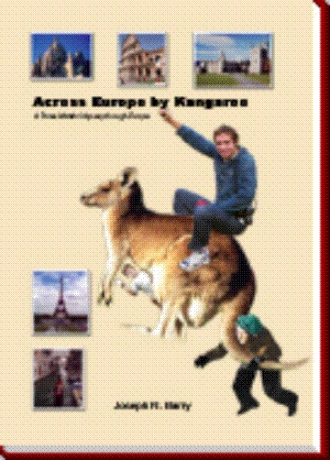
Across Europe by Kangaroo was definitely not written by a member of the travel industry. It is a detailed description of what an ordinary working class American family encounters as they strike off on their own to see Europe. The tale is very funny at times, an invitation to empathy at others, and sometimes an object of head-shaking, lip-pursing, disapproval from readers who believe it could have been done better. This is not a guidebook to tourist attractions. It is a very human chronicle of the kind of discovery that seldom is experienced by institutional travelers. There is a lot of information about what to do, and not do; and, believe it, the author confesses to doing much of the latter. Nonetheless, he relates an entirely different perspective of touring than is usually offered. Regardless of your opinion of the author’s travel planning, you will not escape the feeling that riding in the Kangaroo with this family would be a lot of fun.
About the Author
Joseph Barry entered the U.S. Marine Corps in 1955 and served in Japan and Okinawa. While he served abroad, the era of Rock and Roll and the hippie culture captured his generation. After attempting to reintegrate, he returned to the Orient as an itinerant student, writer, and wanderer in search of an elusive desire. He met that desire on a boat to the Philippines and married her. She and their son are his companions in the tale Across Europe by Kangaroo. Joseph graduated Cum Laude from the American University in Mexico. He taught high school History and Spanish in rural Florida. Joseph finally retired as a U.S. Customs Inspector. Currently, travel and writing is his passion.