
Patriots Will
Surviving the Great Depression and World War II Combat
by
Book Cover & Preview Text
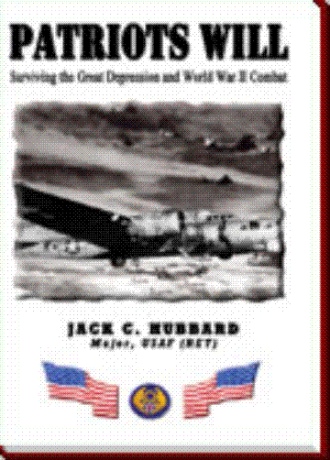
Early morning on 8 May 1944, I left the briefing room shaking my head in disbelief! We were scheduled to fly another mission from our base in England to Berlin! I was feeling a little gun-shy at the prospects. This would be my fifth time over the heavily defended Nazi capitol; a dangerous place to be at any time with over 1,600 anti aircraft guns firing away at Allied intruders. Our group took off with 30 bombers. The problems of flying in poor weather were never better illustrated throughout the history of the 306th Bomb Group than on this day. Five aircraft soon aborted the mission when they were unable to maintain formation while climbing to their briefed altitude. A newcomer to the group, Lt. Smith, was one of these five. He dropped behind at 9:59 a.m. but later rejoined the formation. He then dropped back another time and was never seen again. It was later learned the entire crew had been killed. At 10:42 a.m., about one-half hour before reaching Berlin, the single worst tragedy in loss of 306th aircraft not due to enemy action happened. Persistent contrails (vapor trails) made visibility difficult even though it was a brilliant sunny day at this cold and crisp altitude. Lt. Lambert, 369th Bomb Squadron was apparently caught in propeller wash from aircraft in front of him, quickly causing the aircraft to drop on top of another B-17. A rapid sequence of shocking events followed. Lambert’s left wing panel flew off and his aircraft seemed to make a loop around the fuselage of the plane piloted by Lt. Jacob, 367th Bomb Squadron, completely knocking off the tail section which separated and plummeted in to the wing of a third plane flown by Lt. Schlect, 369th. We watched in horror as all three aircraft in smoke and flames fell helplessly to their doom. Miraculously four of the 30 crewmembers aboard the three planes survived this awful mid-air collision. Our whole crew was emotionally shaken after witnessing several catastrophes. But sorrow was immediately replaced with concern for our own survival as we rapidly approached our target. We dropped our bombs at 11:11 a.m. My bombardier sounded that all familiar "Bombs away" over our interphone system. I quickly opened the door from the radio compartment of the bomb bay to see if all of the bombs had actually dropped. To my surprise and dismay, one of the ten 500-pound bombs still hung in the bomb rack that was parallel to the catwalk. It was my duty to kick it out of the airplane! There was no military training manual explaining the procedure for kicking bombs out of a B-17 flying five miles above Mother Earth during such terrifying conditions. Presumably I was expected to depend upon ‘Yankee’ ingenuity to come to the rescue in such on-the-job training situations. Leaving the target as soon as possible, my pilot started evasive action attempting to avoid the horrendous amount of flak exploding all around us. I had to act quickly! I grabbed the portable oxygen bottle (aircraft was not pressurized) and started moving toward the bomb. Holding on to metal vertical struts, I inched my way along the narrow catwalk not much wider than my boot. The ground, over 20,000 feet below, was visible through the open bomb bay doors. There was nothing but space on both sides of me. Fortunately, I only had time for a quick look at the ground below. The bitter cold wind whipped through the bomb bay as the swerving, gyrating, unsteady plane continued along its way, unsure of its destiny. The sound of flak shells exploding close by was earsplitting. Steel shrapnel burst in various sized pieces flying in every direction. Some hit our aircraft. It sounded like heavy drops of rain on a tin roof in a bad thunderstorm. They belched huge puffs of black smoke so thick it looked as though you could easily walk on top of them. This was not conducive to my balancing act on the bomb bay catwalk because time was of the essence. Reaching the bomb, I gave it a hard kick. Nothing happened. It didn’t budge with the next kick! Ice was forming rapidly on my oxygen mask. I was miserably cold and could feel my strength waning. It was now or never! Mustering my strength for what could be my last effort, I began kicking furiously. Finally, the bomb dropped. Probably in some farmer’s field. I scampered back to the radio room and announced on the interphone "Bomb bay all clear." After stowing the oxygen bottle I returned to my seat. Resting a few minutes to get my breath and warm up, I glanced at the top of my radio receiver in front of me. My eyes settled on my parachute. In my haste to get to the bomb I had forgotten to put it on! Indescribable feelings washed over me, including that of pure terror. I would have perished had I fallen through the bomb bay. Just after bombing, Lt. Matichka, 367th, left the group in no apparent trouble. He did not return to base. Later we learned he had engine trouble and had to feather #1 engine. Shortly thereafter #4 engine began detonating and vibrating excessively. There was only 500 gallons of gas left. knowing he couldn’t make it back to England, Lt. Matichka headed for Sweden. He almost made it. Approaching the coast, he ran out of fuel. He had to ditch the aircraft in the North Sea about one half of a mile from shore. Fortunately it was shallow water. They were interned in neutral Sweden for the remainder of the war. How lucky can you get! No enemy aircraft attacked our Group but hit those to the left and ahead of us. Our fighter escort support was excellent with no gaps reported. Ack Ack fire was moderate with both barrage and tracking inaccurate. Still, it was a very bad day for the 306th, losing five crews and bombers. The next day, the U.S. military newspaper, Stars and Stripes, headlined "Reich’s Skies See Fierce Battles – U. S. Losses 49, Nazis’ 110." The article stated "Thousands of American and Allied planes stormed across Europe yesterday in their incessant campaign to cripple German resistance before the Allied invaders strike and the Red Army launches its final offensive from the east. American heavy bombers, numbering up to 1,000 and escorted by the like number of fighters, battled through furious Nazi fighter resistance to give Berlin its second daylight bombing in 24 hours and to bomb the rail and aircraft manufacturing center of Brunswick", etc. We returned safely to our base but that sad day will be forever etched in my memory. It was heart breaking losing five crews of brave, courageous young men on one mission. They were the heroes! I was more than happy to have completed my 19th mission without a mishap. Only six more to go and then home! I was a veteran. An old timer. New crews looked up to me with both awe and respect. Mainly because I had completed most of my missions.
Formats

Book Details
About the Book
PATRIOT’S WILL
---------------- Jerry Hilmes, Lieutenant General, US Army (Retired)
Jack Hubbard has written a fascinating story of his experiences in World War II as a Canadian soldier and as an American airman. Great reading for all!
---------------- George M. Johnson, Major General, USAF (Retired)
I have had the distinct pleasure of reading PATRIOT’S WILL so ably written by Major Hubbard. I strongly urge all readers who are interested in the history of one of the great combat units of World War II, the Eighth Air Force, to read this most graphic combat report written by one of its memorable officers.
---------------- Allard G. Slim Russell, Captain, U.S. Navy (Ret)
About the Author
By the time Jack Hubbard graduated from the U.S. Army Officer Candidate School in 1947, he had already proudly served five years at war in the enlisted ranks of the Canadian 12th Army Tank Battalion, 32nd Military Police Company of the U.S. Army, and the 306th Bomb Group of the U .S. Army Air Corps, flying 24 B-17 missions over Nazi Germany. He witnessed "history in the making." Those were impressionable years that further piqued his lifelong interest in history. He pursued this field as his major at the University of Maryland. After twenty years service he retired from the Air Force. He and his wife, Karen, live in Bradenton, Florida where they enjoy the beaches, beauty and cultural advantages of the area.