
China Business
20/20 Insight
by
Book Cover & Preview Text
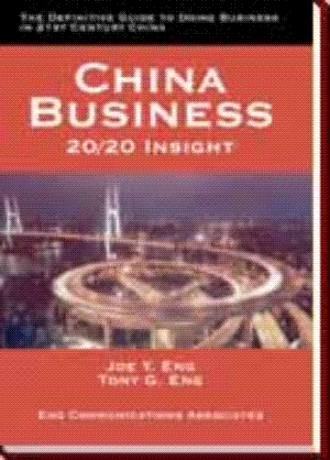
Since China opened its doors to the outside world in 1978, foreign governments and businesses alike have rekindled their interest in the most populous country in the world. In the late 1800s, foreigners, including the U.S., forcefully pried open the China market. The subsequent arrival of allied forces in the Chinese capital of Beijing soon led to anti-foreign movements in China and resulted in the economic and military defeat of the Chinese. Today, a different China has emerged -- one that is more populous, battled tested, and confident. In the development of its societal system, China has exhibited a large appetite for foreign goods, services and investments, especially those from the U.S. Amid the drive for globalization, U.S. government and many American businesses consider China a strategic market that cannot be ignored. This attitude takes on a greater significance as economic progress and national security become intertwined. For American businesses that have their eyes set on China, the most crucial step lies in acknowledging and learning a new paradigm. To succeed in China, American businesses must accept that special skills, strong commitment and coordinated execution are necessary. Execution must be preceded by due diligence that is based on reality and not data alone. For instance, the large population, rising disposable income levels and increased consumption would indicate that there is a huge market in China for credit card payment systems. The reality is that Chinese are still dependent upon cash payment systems with low credit card usage. Similarly, highway development, increased productivity, consumption and investment in capital assets would indicate a huge market for automobiles. Yet, the bicycle remains the dominant mode of transportation. Some corporate executives believe the China market can be penetrated in the same way as the domestic market by transposing their U.S. business processes into their China operations. Expanding from a model of domestic success and using the same language, business logic and goods distribution systems, many executives believe they have a clear path to prosperity. Tragically, this approach is flawed from the start. Imagining applying American football strategies to a Chinese soccer game! Others believe that dedicating huge financial and technological resources to the China market will guarantee success, only to learn later that such a practice alone cannot make their China operation sustainable. American corporate executives are trained to operate in a transaction-based business environment that is driven by corporate strategies and technical knowledge. Such an approach is substantially at variance with the relationship-based China business model which is shaped human and cultural considerations. We believe that, to prosper in the China market, American corporate executives and other stakeholders must not only change their mindset toward doing business in China, they must modify their attitude as well. They need to venture from the safety of their "proven formula of business practice" at home and approach the China market with a fresh perspective. This mental transformation will lend new meanings to activities such as market research, strategic planning, budgeting, program implementation, customer relations, training and succession planning. Only when Americans involved in China business are convinced of the need to make mindset and attitude adjustments will they to able to capitalize on the real opportunities and successfully apply the knowledge they have acquired toward China investments. There is no shortage of books written about China. However, most of these books focus on one or two topics such as politics, economics, law, culture and business etiquette. Our holistic approach creates a "consolidated knowledge center" for people involved in China business ventures. By understanding the total environment in which China business operates, American business executives will be able to improvise with confidence – a critically important skill in growing China business. In contrast, failing to grasp the "total Chinese picture" will cause American corporate executives to make China business decisions that are "out of context," and such decisions could be blindsided by developments in other areas of the Chinese society. By addressing all the basic elements of China business, this book serves as a "coordinating mechanism" by which executives from various professional backgrounds can get themselves "on the same page." We organize China Business 20/20 Insight into four parts and 15 chapters, as follows: Part I: The Background (Chapters 1-2) provides an introduction to China and describes the business opportunities which exist there today. It sets the stage for the exploration and development of the China business. Part II: The Context (Chapters 3-9) describes the environment within which China business operates. It examines Chinese history and the political, economic, legal, financial and business systems, and e-commerce that drive the China business today. These chapters help readers frame China business in the proper context. Part III: The Challenge (Chapters 10-11) discusses China business in terms of the obstacles to be addressed and overcome. It also contains a comparative assessment of the Chinese business executives and their American counterparts. Part IV: The Response (Chapters 12-15) defines the strategies and tactics American companies need in working the China market successfully. It contains the requisite knowledge and skills for the China business and defines the relationship between the home office and American expatriates. There are several rules to remember when doing business in China: Rule 1. Don’t Take Anything For Granted In The China Market – Learn to challenge assumptions, assess issues under different lights, and value verification. Rule 2. Spend As Much Time With People As On Laws and Technologies – Human relationships can make or break your business in China. Rule 3. Be Capable Of Operating In A State of Dichotomy – Seeing opportunities in crises, addressing competition through collaboration, and leading by following the market. Rule 4. Confront Ambiguity And Uncertainty With A Positive Attitude – Take advantage of the changing political, socio-economic, legal and financial environments in growing your China business. Rule 5. Do Not Underestimate The Power Of The Chinese Government - Learn to Work with the Chinese bureaucracy by being patient and creating win-win strategies. Rule 6. Repeal The Rules Of Domestic Corporate Practice – They are barriers to doing business in China. Rule 7. See China From Both 50,000 Feet And On The Ground – Strategic planning and operational details are equally important. Rule 8. Change The Chinese By Changing Yourself – A new mental paradigm is crucial to China business success. Insets are generously used throughout this book and they contain statistics, quotations and articles designed to exemplify the points made. The insets are intended to raise the readers’ awareness of the issues at hand and to drive home the differences between the American and China busines
Formats

Book Details
About the Book
China Business 20/20 Insight
Stakeholders (corporate executives, expatriates, employees, and board members) will better appreciate the nature of the business undertaking by addressing such issues as:
- The linkages between politics and commerce
- The unique brand of Chinese economic policies
- The immature yet evolving Chinese legal framework
- The role of government in banking and corporate finance
- The capabilities and constraints of electronic commerce
- The different forms of business organizations
- The cultural framework of China business communications
- The mindset and attitude of Chinese business executives
--.and so forth.
With knowledge of the China business environment, all stakeholders will be more cognizant of the rationale for the China strategy, resource allocation, corporate alignment, and vertical and horizontal coordination. This will result in more effective decision making, stronger employee buy-in, heightened investor empathy, more credible corporate governance and better corporate performance.
About the Author
Joe Y. Eng is President of Eng Communications Associates. As a corporate trainer, coach and business consultant, he has over thirty years of experience with American Fortune 500 companies and Chinese corporations. A native speaker of Mandarin and Cantonese, he received his undergraduate and graduate degrees from the University of California at Berkeley.
Tony G. Eng is Research Director at Eng Communications Associates. He has worked for Gateway Computers, Amplicon Financial and Netcel 360 in sales, marketing and business development. He received his undergraduate degree from the University of California at Los Angeles. tony@usasiaexpert.com