
Calculus Without Limits:
An Algebraic–Geometric Construction of the Derivative
by
Book Cover & Preview Text
Formats

Book Details
About the Book
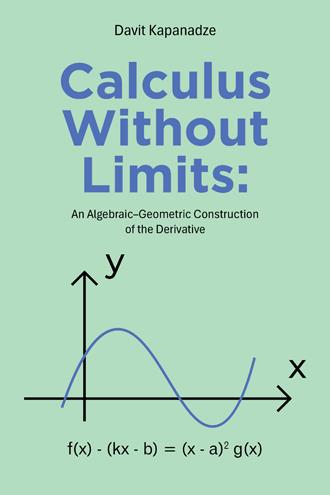
This paper presents an algebraic and geometric–functional approach to introducing the derivative for elementary functions without using limits. The derivative is defined as a functional correspondence between the abscissa of a point on the graph of a function and the slope of the unique tangent line drawn at that point (the X–K correspondence). The method is developed systematically starting from single-variable polynomial functions by introducing the notions of multiple roots and tangency through an algebraic condition of repeated intersection. On this foundation, the derivative function is constructed and key differentiation rules are established, including the sum, product, quotient, and composite function rules. The approach is then extended to rational power functions, exponential functions, logarithmic functions with an arbitrary base, and trigonometric functions, yielding the same derivative formulas as in classical analysis. Finally, the increment of a function and the differential are interpreted geometrically via the tangent line, and the classical limit definition of the derivative arises as an analytical formalization of this geometric differential. The results demonstrate both mathematical consistency and strong pedagogical potential for secondary and undergraduate instruction.
About the Author
Davit Kapanadze is a Doctor of Pedagogical Sciences and a researcher in mathematics education from Georgia. His scientific work focuses on the conceptual foundations and teaching of differential calculus. He is the author of numerous scientific and pedagogical publications, including school textbooks and research papers devoted to the methodology of teaching mathematics. In this monograph he develops an algebraic–geometric approach to the construction of the derivative, in which the concept is introduced through the criterion of tangency rather than through the limit as the initial definition.