
Don’t Be Silly You Don’t Run
A story of overcoming self-doubt to achieve what first seemed impossible.
by
Book Cover & Preview Text
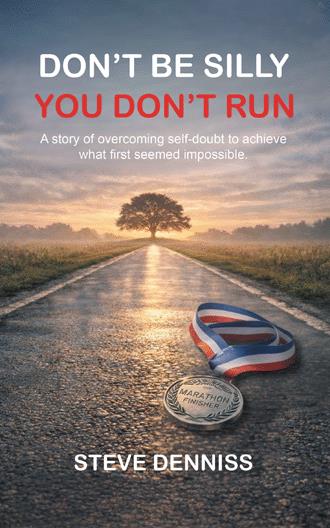
Crossing the finish line of the Brighton Marathon in 2018—clocking in just shy of four and a half hours—wasn’t merely a tick on my bucket list; it felt like the crowning moment of nearly eight years marked by dogged determination, a fair share of heartache, and the unwavering encouragement of friends and family. As I stumbled, somewhere between elation and exhaustion, across that line, I was immediately engulfed by a wave of emotions that I hadn’t anticipated. There was pride, of course, but also a profound sense of disbelief that refused to dissipate. My legs were trembling, my chest heaving with ragged breaths, yet I was buoyed by a surge of joy that seemed to lift me above the aches and blisters. Even as the sweat stung my eyes and the cheers of the crowd in the background washed over me, I found myself blinking back tears—tears not just of relief at having finished, but of gratitude for every faltering step and every small victory along the way. In that moment, I thought back to the start of the journey in 2010. The idea that I could ever attempt, let alone complete, a marathon seemed laughable then—an absurd daydream for someone who had spent years on the sidelines of physical activity. The notion of finishing, and with a sprint (well, a determined shuffle that felt like a sprint to me), smashing my target time by over fifteen minutes, was the stuff of wild fantasy. To be perfectly honest, even the concept of having a ‘target time’ would have been laughable in those early days. Merely surviving the distance, dragging myself across the finish, would have been a miracle. Yet here I was, clutching my finisher’s medal, proof in my hand that I had done something that once felt entirely out of reach. It’s almost impossible to trace the path from that starting point—a man uncertain, battered by self-doubt, and haunted by the spectre of middle age—to the finish line of the Brighton marathon. How does one go from nothing to becoming, if not a great marathon runner, at least an adequate one, especially when time and age seem stacked against you? The truth is, my story isn’t a neat, linear progression; it’s a series of missteps, stumbles, and unexpected turns. Like so many transformative journeys, it began almost by accident—serendipity, disguised as a casual invitation. [Photo 2:Brighton Marathon] In the wake of my divorce, my life took on a new, unfamiliar shape. I suddenly found myself with time—precious, solitary hours that both weighed heavily and shimmered with possibility. There was a longing to rediscover parts of myself I’d set aside, and to forge new connections with my children, who were, by then, finding their own footing in the world. The urge to fill this newfound space with meaningful experiences led me to try different things: ice skating (at which I was barely competent), and running—an activity that, on the surface, seemed less perilous to my pride, though no less fraught with hazards for my sense of self. The running truly began when my son Jacob, with the innocence of youth and none of the baggage I carried, invited me to the gym as his guest. That simple question—“Dad, why don’t you come to the gym with me?”—was the sonic trigger that set the entire avalanche in motion. I can still recall my own hesitation: the self-consciousness, the fear of looking foolish, the certainty that I was out of my depth. But beneath that fear was a flicker of hope, the idea that perhaps this could be a way forward, a chance to bridge the gap between the man I was and the one I aspired to be. Of course, I didn’t travel this road alone. My family’s encouragement, the camaraderie of running partners, the subtle but significant pride in my mother’s eyes, and the unwavering support of my wife all stitched together a safety net that caught me in moments of despair. After remarrying, I discovered in my wife not only a steadfast partner but the greatest source of encouragement I could have wished for. Despite her deeply held belief that all runners are mad, she became my best coach and confidant, offering unwavering support on days when motivation deserted me and celebrating every small victory as if it were her own. Her patience was limitless—she listened to my endless tales of training woes and triumphs, always ready with a reassuring word or a practical suggestion to help me through rough patches. Her quiet determination matched my own, grounding me when my self-doubt threatened to overwhelm. Most of all, her warmth, humour and belief in my abilities transformed what could have been a solitary struggle into a shared journey. Even when we thought circumstances might pull us in different directions we found a way back to each other and discovered the truth that we are better together than apart. In every sense, she brought out a better version of me, making each success feel all the more meaningful because it was ours to celebrate together. For me running became more than an activity it became a philosophy. Every setback—each injury, every humiliating run when finishing seemed impossible—was tempered by the realisation that I was part of something bigger, a shared tradition of striving, faltering, and rising to try again. perseverance can outlast the harshest doubts. Running became not just an act of physical endurance, but a way of life—a testament to the belief that, no matter how late you start or how improbable your dreams, there is always a path forward. In the end, perhaps the greatest lesson I learned is that transformation seldom happens in grand, cinematic leaps; it unfolds in the quiet moments of struggle and the accumulation of small, stubborn acts of hope. As you read this book see it as an ongoing journey with milestones, some still to be reached.
Formats

Book Details
About the Book
He wasn’t born a runner. In fact, for years the very idea felt ridiculous – until one decision, one awkward first attempt, and one stubborn step at a time began to change everything. What starts as a private battle with doubt grows into a journey shaped by injury, community, laughter, and the quiet determination to keep showing up. Along the way come unforgettable races, unexpected kindness from strangers, and finish lines that mean far more than a time on the clock. From early fears of being seen, to the roar of London crowds, this is a story about proving something to yourself – again and again – and discovering that resilience isn’t a dramatic moment, but a thousand small choices. If you’ve ever thought “I can’t”, this book is a reminder that progress is possible, at any age, and that the finish line is just another beginning.
About the Author
Steve lives in Halifax West Yorkshire. He is an active member of the Halifax Harriers Athletics Club. In his professional life he is an Engineer with over 40 years’ experience implementing iconic projects around the world winning awards and the respect of his peers. He has devoted the last 5 years as an ambassador for Science and Engineering in schools, colleges and Universities. He is the founder of acornITy established to help young entrepreneurs to realise their dreams. He took up running at the age of 50 at a personal crossroads and over the next sixteen years against all expectations, through mental and physical motivation has run 5 marathons including 3 London. He is an award-winning amateur musician and part time music teacher, he holds a Private Pilot’s licence and is a self-confessed space geek, owning multiple astronomical telescopes. He is an avid reader of science, history and psychology. He is a husband, father and grandfather, and servant to one cat.