
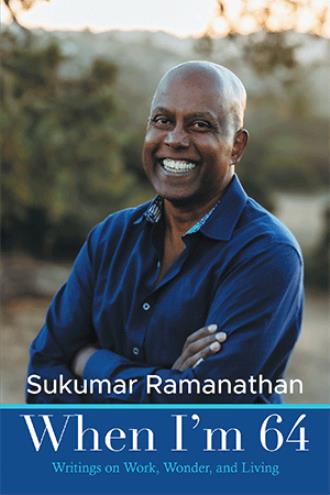
When I’m 64
Writings on Work, Wonder, and Living
by
Book Cover & Preview Text
“And here, in ’99, you worked for Medicine San…what do they do again?” “It’s a medical relief organization. Missions run by volunteers. It was founded in France.” “Ohhhkay. Kind of a gap year, then?” The silence hangs heavy in the air. I can feel his confusion. There is no intersection of sets between “aid worker” and “software salesperson.” “You could say that.” “Quite a change. What was it like?” It was 1999 and I lived in San Francisco. The NASDAQ, to everyone’s disbelief, had kept surging beyond anything that seemed rational. To work in tech was to suspend disbelief. Friends of mine, two brothers, started a little website from their basement and 18 months in, got an unsolicited offer of purchase for six million dollars. Another friend was given free use of a Porsche for a year for having referred three new employees to his startup. Cottages in my Noe Valley neighborhood were selling at twice their ask. CNET had started a show that covered only IPOs; there were so many of them. Books in the stores screamed Dow 36000, all problems solved with technology, happiness forever. I had opened an options trading account at Schwab a few years earlier after noticing that all tech stocks only seemed to go upwards and to the right. The CBOE had just introduced LEAPS which were long-term options, and at this early stage, these securities were sparsely traded and often mispriced. Their price was set based on the history of older, much less volatile stocks in the S&P, and made no allowance for the fact that there was this one part of the market where an Internet stock often rose 10 dollars in a day. As long as the insanity continued, it made sense to be aggressively long. My simple-minded strategy was: “Buy LEAPs on rapidly rising tech stock; wait for position to multiply; sell one-third of the position; buy LEAPs on another rapidly rising tech stock; rinse and repeat.” When my income from trading exceeded my income from my job, I quit my company to trade full-time. And then I met a woman. Her name was Latha Palaniappan, and she had just moved from Ann Arbor to San Francisco to pursue a residency in internal medicine. I knew so little about her field of study that on our first date, when she told me that she was a resident, I wondered why that was a big deal since I was a resident of San Francisco as well. She worked 80-hour weeks, staggering home late each night from work only to begin early the next day. I, meanwhile, traded options between 6:30 and 7:00 each morning and then knocked off to get a coffee and spend the rest of the day reading. I joked with her that I was the only person in San Francisco awake at 11 each night to go out with her when she punched out from the hospital. She felt that most people in tech were high on some kind of fairy dust, fast-talking hucksters selling increasingly surreal visions to one another. I tried earnestly to educate her on why it was different this time, that the Internet was going to make the whole world one, free of the tyranny of distance and time, and that the epicenter of all this seismic change was located a few miles from where she and I lived. Her challenge was more direct. Was I willing to step outside the bubble, away from the lavish parties and the boat rides in the Bay? What did she mean? Leave the Bay Area? No. More. Leave California. Leave the US. Go somewhere where people were in need, to help them with healthcare and food and housing. Where? She didn’t know. But she did know of a volunteer organization that could help answer the question. It was called Médecins Sans Frontières (MSF). Doctors without Borders. The shortest known time interval in the world is that between Latha making a decision and that decision becoming reality. So it was that I found myself in an interview room in Los Angeles with MSF. They knew right off the bat that they wanted her, of course. Doctor. Capable. Enthusiastic. Freshly trained. Done with all her rotations. They didn’t know what the hell to do with me. Computer science? Who needed help with code in a relief camp? Technology sales. Workstation marketing. Options trading. Was I kidding? I pointed weakly to my degree in engineering. Granted, I had never used it to make or deliver anything. But I was trainable. And the only way for them to get her to join was to take us as a pair. It was both or neither. They told me that one of the few possible fits was for the job of logistician. This role required somebody who could do all the setup for a medical team. Putting up tents and clinics. Digging toilets. Refurbishing damaged buildings. Warehousing food. Organizing a cold chain for vaccines. Setting up an antenna for radio communication. It sounded wildly interesting. We were told that they staffed field missions with group dynamics in mind. Every single person in a team had to carry their weight. No allowances or special treatment for being part of a couple. In most cases, only one person at a time needed to be spotted as they got done with their term. There was rarely a time when two new members swapped in for two returning ones. The only exception was during emergency situations when they had to get a lot of boots on the ground immediately. Places like Srebrenica or Kigali. “Whatever it took,” we said. We flew to New York for training, to the town of Stony Point on the Hudson River. The instructors seemed remarkably young and remarkably experienced. One had done five year-long missions in a row. Another had gone back repeatedly to Sudan and the Sahel. We were taught the right mix of cement, sand and water to make concrete. How to dispose of sharps. How to run barbed wire to protect an encampment. How to defuse tense encounters by proving that you were there purely for medical relief and not for any political end.
Formats

Book Details
About the Book
When I’m 64 collects three decades of writing from Sukumar Ramanathan, a man who approached life with extraordinary curiosity and an uncommon gift for noticing what others overlooked. From his ringside seat covering the 1996 Atlanta Olympics to his insights on building businesses in Silicon Valley, from essays on becoming American to monthly roundups of the best books, restaurants, and ideas worth sharing, Suku’s writing reveals someone deeply engaged with the world around him. These pages capture a mind that moved effortlessly between Olympic history and poetry, economics and art, technology and the quiet dignity of everyday human effort. Whether describing the intensity of competition, the absurdity of corporate life, or the grace of perseverance, Suku wrote with rare attentiveness to detail and meaning. This book is a portrait of a life lived with intention—one built through daily acts of curiosity, kindness, and reflection. Through his words, Suku invites us all to look a little more closely, laugh a little more freely, and live a little more fully.
About the Author
Sukumar Ramanathan (1961–2025) was a mechanical engineer, Silicon Valley executive, and devoted father and husband. He was a friend to many, with a natural gift for making those around him feel heard and valued. Born in India and educated at the National Institute of Technology, Tiruchirappalli, Suku built a distinguished career at companies including Sun Microsystems, LinkedIn, Amazon Web Services, Stripe, Anaplan, and Parafin. But his professional success was only part of who he was. Suku lived with his eyes wide open. He built a life of daily rituals and deep relationships. He traveled to 75 countries across seven continents. He expertly curated books, films, and restaurants. He was a connoisseur of jams and fried chicken sandwiches. He explained technical topics with delight, from packet switching to track-and-field strategies to the nuances of SaaS economics. With his wife Latha, he created a home in Menlo Park filled with books, music, and laughter, raising three children—Rekha, Radha, and Rohan—with the example that curiosity, kindness, and integrity matter more than accolades. He coached soccer, took calls from young entrepreneurs, and had time for anyone who reached out. Suku’s writing reveals his extraordinary ability to draw connections across disciplines, his gift for noticing beauty and absurdity in equal measure, and his belief that excellence is about showing up fully—with integrity, humility, and care. He passed away in July 2025, just months before what would have been his 64th birthday