
God’s Reality
Beyond Perception
by
Book Cover & Preview Text
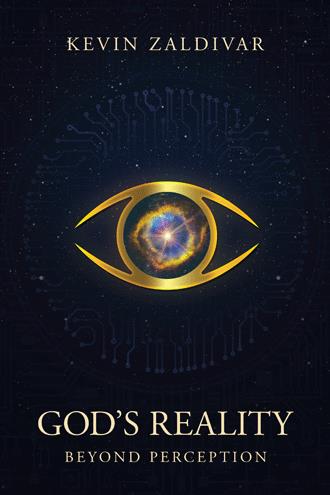
It is the glory of God to conceal a matter; to search out a matter is the glory of kings. (Proverbs 25:2, NIV) Science is our shared language for modeling the natural world. Did we invent mathematics and geometry, or did we uncover structure that was already there? We invented the symbols; we discovered the patterns. You can tell because the patterns push back: they let us make specific bets on reality and then verify them. From a wobble in Uranus’s orbit, math pointed to an unseen planet (Neptune) before anyone saw it. Maxwell’s equations implied radio waves, and there they were. Einstein’s relativity said starlight would bend around the sun; it did, and today GPS depends on those corrections. Mendeleev’s periodic table left blank squares that later filled with real elements. We can argue about what these patterns mean, but the fact that they’re there, and reliably so, is common ground. When the sky is blue, when telescopes reveal new worlds, when genomes and microscopes show our kinship with other primates, we are not dealing with illusions but with disclosures – features of a world meant to be known. God does not bypass the order He established; He works through it, through the symmetries and regularities that give rise to cause and effect. God may be described in many ways, but not as capricious or anti-rational; Scripture presents Him as reason itself – the Logos. We’ll return to that in Part II. So science is not a rival to faith but a way of paying attention – a disciplined listening to a world that keeps answering in consistent, intelligible ways. For since the creation of the world God’s invisible qualities—his eternal power and divine nature—have been clearly seen, being understood from what has been made, so that people are without excuse. (Romans 1:20, NIV) If Christian faith were blind belief, why would Scripture say God’s “invisible qualities” can be understood from what has been made? The claim is that God’s presence stands before us – not hidden behind the next telescope upgrade, as if He were a distant super-being or a diffused mist in space. We shouldn’t look for God in the shrinking margins of our ignorance, but in the very intelligibility, order, and beauty of the world; the earth and its rocks, the stars and their staggering distances, the properties of light, the laws that hold. From the smallest particles to the largest galaxies, patterns and symmetries recur, themes echo across scales like a single orchestral score unfolding through many movements. Reality doesn’t just exist; it rhymes with itself. So the task isn’t to pit faith against measurement, but to hold them together in a coherent search for truth that welcomes all of us – one humanity – under the same sky. Curiosity is not a sin; it’s human. Wonder, questioning, and investigation are forms of attention. Christian faith should not shut that down; it should invite it. As a Christian, I believe it's not enough to merely read Scripture, we must understand it with context and care. A verse lifted from its setting can mislead, and many passages carry layers we’ll explore. And yet, it’s easy for some believers to reject scientific findings with a single word: faith. Worse, some dismiss science without scriptural understanding, leaning instead on opinions shaped by incomplete or distorted views of Christianity. Faith thrives best when it breathes the same air as honest inquiry. Scripture doesn’t ask us to turn off our minds; it calls us to seek wisely. And the New Testament echoes it: Always be prepared to give an answer to everyone who asks you to give the reason for the hope that you have. (1 Peter 3:15, NIV) In other words, belief is not a substitute for questions, it is a mandate to ask them well. Science is the disciplined form of that mandate. When we decode the genetic alphabet, chart the evolution of galaxies, or model the physics of a black hole, we are not trespassing on sacred ground; we are reading the footnotes of creation. The danger lies not in science but in the “God-of-the-gaps” reflex that plugs God into every blank space on the chalkboard. That impulse numbs the will to explore, and it dilutes both theology and technology. If the church dismisses advancements in science purely on the grounds of a literal proof-text (we’ll examine several cases), it builds a wall between faith and reason – and, over time, fuels fresh skepticism on religious beliefs. Conversely, when believers enter the lab with humility and rigor, they honor a God whose design is intricate enough to reward a lifetime of study. History’s great scientists devoted their lives to listening to the world and unveiling its order – work that has healed, fed, and connected billions: germ theory and virology → vaccines and antibiotics; quantum & solid-state physics → semiconductors; orbital mechanics and rocketry → satellites; relativity and atomic clocks → GPS, achievements that have, at times, earned Nobel Prizes. Our task is not to denounce such achievements from a distance, but to examine them carefully, learn from them, and build on them. The world is changing quickly on the heels of technology. In the coming era of abundant knowledge – the so-called Age of Intelligence – we will unravel many mysteries and solve many problems; our calling is to ask well and to pursue answers with disciplined wonder. Every new law of nature we uncover is not a threat to belief; but another note in the music of the universe, one that invites all to listen more closely.
Formats

Book Details
About the Book
What if the mind and the universe are linked in ways we’ve largely forgotten? What if the spiritual convictions of our ancient ancestors, echoed across civilizations and in Scripture’s earliest testimony, point to a deeper order of reality, eclipsed by modern materialism? Here we stand at the dawn of humanity’s most transformative invention: an artificial mind beside us, built in our image, able to answer anything we ask, optimizing whatever we reward. It is no longer science fiction. It is here, and it will soon test every major belief system on Earth, religious and secular. As a spiritual species, are we ready for a world where machines solve our problems, run our businesses, and deliver breakthroughs faster than culture can absorb them? In God’s Reality, AI practitioner and faith-and-reason writer Kevin Zaldivar opens a new mode of Bible study. He confronts the hardest flashpoints in apologetics, from cosmic origins and evolution to free will, good and evil, and end-times prophecy, and reframes them within a single coherent story, clear-eyed about what science can and cannot claim. The book journeys from consciousness and the inner life to the frontiers of physics, time and eternity, the Bible’s accounts of miracles, angels, and theophanies, and today’s AI moment with its promise and peril. Blending modern science and philosophy with ancient wisdom, God’s Reality calls readers to a renewed way of seeing and becoming, inviting a faith that can be intellectually honest and spiritually alive. Perhaps the quest isn’t to prove God, but to recognize what has been in plain sight all along. For since the creation of the world God’s invisible qualities—his eternal power and divine nature—have been clearly seen, being understood from what has been made, so that people are without excuse. (Romans 1:20, NIV)
About the Author
Kevin Zaldivar is a Gen Z Christian who studies the Bible through a logical lens alongside the natural world that science reveals, sharing what he learns about meaning, purpose, mind, and the universe. An AI practitioner, he helps readers ask better questions and build a coherent, hopeful view of reality.