

You’re Always Being Interviewed
How to be Intentionally Extraordinary
by
Book Cover & Preview Text
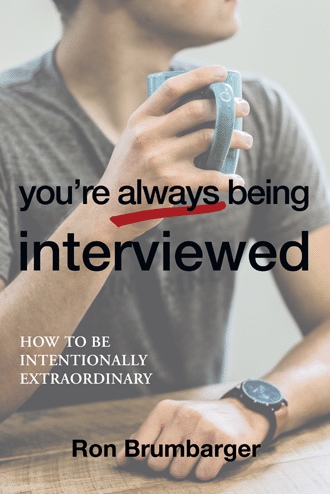
First off: contrary to what the title might lead you to believe, this book is not about interviewing. It’s about how to be interviewed without actually being interviewed.
That is probably (scratch that, definitely) confusing, so let me clear it up. I subscribe to the motto, “When you least expect it, expect it.” Your actions and attitudes when you’re not “on” for a potential employer indicate who you really are. Employers and mentors – whom I like to call “Talent Spotters” – know this. Talent Spotters know the best indicator as to who you really are and how you will actually perform under their employment isn’t always evident during an official interview. The ‘you’ presented in casual conversation, in your character when interacting with others, in your general manner of conduct is -- when you least expect it.
In my many years of experience as a Talent Spotter, I have come to learn the incredible importance of a first impression. Sometimes, you only get one shot to show another person who you really are, and it’s vital that the ‘you’ they see is marked by strong character.
In this book, you will find a plethora of stories from my own experience of working with and meeting individuals – for whom I have used their real first name - who positively exemplified what it means to be intentionally extraordinary. Conversely, I will tell you some stories about people who, well, just missed the boat. As you encounter these somewhat confounding stories, I encourage you to place yourself alongside me and experience these scenarios first-hand. I will try to bring some levity and memorability to these stories. These examples – for whom I have used fictional names – I affectionately refer to as my Cast of “Knuckleheads.” These stories, while amusing (and sometimes baffling), are also somewhat disconcerting, as it’s troubling to think that people really act in such a way. And in case you’re wondering, yes -- all these stories are true!
The Knuckleheads do an excellent job of demonstrating what it means to destroy relational capital or blow an opportunity. Let me take a minute to explain this idea of “relational capital.” Whenever you interact with others, especially in a business or networking setting, you build “relational capital accounts.” When you demonstrate to someone your strong character, trustworthiness or overall competence, you are making deposits into your relational capital account with that person. If your account balance is high with another person, it enables you to have confidence when asking for favors, and the other person knows that yours is a relationship worthy of an investment. This is the entire premise for why you’re always being interviewed. Your interactions with another person automatically increase your relational capital account with them, or reduce your previously-stored balance.
Your relational capital account not only matters to the person with whom you share the account, but it also matters to everyone within their circles. If I ask a previous employer of yours whom I know and trust – someone who has a high relational account balance with me – whether or not I should hire you, what will they say? The state of your relational capital account with them directly impacts the state of your relational capital account with me.
While all of this might sound pretty serious, writing this book has been exciting. I have enjoyed chronicling these stories for you. While writing, I had numerous opportunities to share my enthusiasm with friends. I quickly noticed a somewhat disturbing trend – fidgeting! My friends would fidget and primp while I described my book. Some even changed their eating habits knowing this book was in process for fear of being a story in this book! They were worried I was interviewing them. Okay, I admit, in some cases that was true, but most often not so much. Earlier this summer I attended an outdoor graduation party with many of my friends. I had the opportunity to share my excitement about this book with a dear friend named Kate. Kate is a poised and well-spoken young lady and a very busy mom of three young girls. She was wearing flip flops. (I share this detail only because it becomes important, as you’ll soon see.) As we sat talking about how much we appreciated the young graduate, Kate was pretty relaxed. There was a natural pause in the conversation, so I mentioned I was writing this book. Kate, in her naturally eloquent fashion, asked what the book was about, the title, etc. As I proceeded to describe this book, I noticed Kate rolling her toes under her flip flops and fidgeting a bit. Knowing Kate pretty well, I simply furrowed one brow and tilted my head while looking at her. She promptly stated, “I didn’t have time to paint my toes this morning before the party and I mistakenly wore flip flops…”
Sorry my book title made you uncomfortable, Kate. I do hope the nail polish gift basket I gave you helps minimize future fidgeting. Here’s to many more graduation parties together without any pretense. Thanks for making for a great introductory story in my book.
In all seriousness, several friends have asked me if I was concerned about my friends “expecting it” when we meet. I sure hope not as that’s not my goal for this book. So, when we as friends are hanging out for coffee or watching a football game, chill… please!
This book is not about being judgmental and critical of every action. I’m not always judging other people, especially my friends – I promise! This is a story book, recounting years and years as a Talent Spotter. I have met so many intentionally extraordinary people and, well, too many mistakes repeated too many times, all resulting in stories you must read. I feel a duty to share these stories and basic tenets so you can too stand out from the pack.
Formats

Book Details
About the Book
You’re Always Being Interviewed.
Is not just the title of this book – it’s a mantra to be incorporated into your everyday life. Whether you like it or not, your reputation and personal brand are constantly in development and demonstrated by your character, relationships, habits and etiquette. Drawing on his many years as a Talent Spotter, Ron Brumbarger reveals why it’s vital you demonstrate strong character, even during interactions you believe are inconsequential. He shares numerous stories of intentionally extraordinary individuals who made a positive and long-lasting impression – and how they did it – as well as stories of those who missed the boat.
Learn more about the book at http://yourealwaysbeinginterviewed.com
Ron explains the concept of “relational capital” and why it’s of utmost importance in all relationships. Discover the benefits of exhibiting poise, grace, and discipline with this guide to being intentionally extraordinary at all times and in all things.
About the Author
Ron Brumbarger is passionate about mentoring and teaching youth and young professionals -- a calling he’s sought to fulfill through founding the award-winning Apprentice University, starting many schools and educational programs, speaking at numerous universities, and being a homeschool dad. He’s the founder of numerous businesses, including the Indiana-based technology firm Bitwise Solutions, where he’s served as president and CEO since its establishment more than twenty-five years ago. He enjoys traveling and RV road trips with his wife, Cindy, and their sons, Tanner and Hudson.