
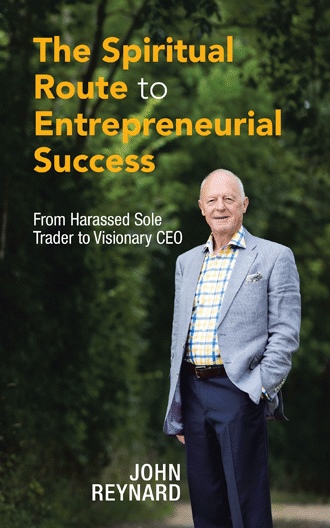
The Spiritual Route to Entrepreneurial Success
From Harassed Sole Trader to Visionary CEO
by
Book Cover & Preview Text
THE POWER OF INTUITION What is Intuition? Intuition enables us to see behind statistics and forecasts, make useful predictions in spite of incomplete information and take original decisions that bring about win-win solutions. Successful entrepreneurs recognise its potential and take heed of it. Intuition is an inner voice that we all possess. It is an astute counsellor that nudges us forward in our lives. It comes with an uplifting feeling and is never manipulative. It is the voice of our Higher Selves and it unlocks creativity, makes life smoother, more fun, and sometimes defies logic, at least initially. Intuition comes to us spontaneously, often as a feeling or even a voice. It is clearest when we are quiet and centred within ourselves, but it can also come to us during moments of extreme stress. It can be scary, especially at first, because it stretches us and takes us beyond our comfort zones. It is complementary to logic and is not a replacement. It always pays to understand the facts before applying our intuition and making important decisions. In today’s world, we have become excessively dependent on our analytical minds, and all too often we ignore our intuition. We grow up in families where we learn to override our instincts and do what is expected. Our inner spark is suffocated and we become disinterested and apathetic. Intuition can never be lost, however – quite the opposite. It can be fully activated at any age. As with all skills, the more you tune in to your intuition, the better you get at recognising it and the more confident you become in following it. Ultimately, you notice that people pay more attention to you and pick up on your ideas. You enjoy being authentic, and although some may initially resist what you have to say, they usually come around over time. The Importance of Intuition Sue and I were once encouraged by a business adviser whom we very much respected to meet a firm of specialist tax consultants from a different part of the country. He believed they were offering something quite innovative, and it would be in our interests to hear what they had to say. We went to the meeting with an open mind. The two partners of the firm arrived, a lady and gentleman, and they convincingly presented their case. They put forward an attractive offer: by using their services, we would save significant amounts of tax. Our adviser stressed that he had already worked with this particular firm, and in his opinion, they were entirely reputable. As a prerequisite to engaging them, we had to sign a non-disclosure agreement (NDA). The reason for this was that they had such a unique service that they wanted to ensure it remained confidential and would not be passed on to any of their competitors. However, there was one short paragraph in it that did not make sense. I pointed this out, and it was corrected, but I did wonder how such a crucial and presumably well-used document could contain such a flaw. Everything they said was entirely logical, and the offer was certainly enticing, but there was something in the lady’s tone of voice that did not sit well with me. I could not fault anything she said, but intuitively I felt uneasy in her presence. Combined with the previous error in the NDA, I thought I would look into the matter further. I knew other professionals in the part of the country where the tax consultants were based, and I called them to enquire whether they knew the lady. They certainly did – and they were very explicit about why we should not work with her under any circumstances. That was sufficient for me, and we discontinued the contact. Two years later, I heard that the firm had been dissolved. The lady had been exposed for conducting sharp practices and had disappeared, leaving all sorts of debris behind her. I dread to think of the chaos we would have got ourselves into had we engaged them. At minimum, we would have suffered a distressing and time-consuming tax investigation. Normally I would not have questioned the initial recommendation we received because it was from a trusted source, but my intuition guided me otherwise. Our intuition knows so much more than we do, and it is always seeking to guide us. It adds another dimension to our decision making, and the more we cultivate and tune into it, the more helpful it is. Many poor decisions are based on appearances and partial facts, especially if there is an easy win involved. Whenever we face a decision with which we feel uncomfortable, we need to check in with our intuition and ask more questions until we are happy with what we are doing, find another way, or pull out. How to Develop Intuition When we consciously decide to recognise our intuition, it willingly and increasingly communicates to us; by allowing it space and giving it focus, we strengthen it. We nurture our intuition by regularly absorbing ourselves in activities that take us completely away from our routine thinking, out of our heads, and into our bodies. For me, this is through meditation. For others, it might be walking or running in nature, horse riding, or dancing to music. The main criterion is that it be pleasurable and regular; it is too easy to get busy and make excuses. It is when we get back to our true selves and feel relaxed and centred that we allow space for our intuition to come through.
Formats

Book Details
About the Book
This book is for entrepreneurs who are open to looking at their businesses, and their lives, differently. It is for those who have a passion for entrepreneurship, seek to prosper and want to build their dreams in accordance with their highest thinking and beliefs. It is about how to realise one’s full potential through self-empowerment, co-creation and alignment with one’s Higher Self. We are familiar with the likes of Sir Richard Branson but for every entrepreneur who has made a million, there are thousands who struggle for years and never get beyond the state of harassed sole trader. Such was my own case - until I ceased separating my spiritual life from my business life. After years of feast and famine, I created a consistently successful business that not only ran independently of me, but became one of the fastest growing in Europe and most profitable in our sector. This is the story of how my situation changed, once I committed to integrating my spirituality into my business.
About the Author
John Reynard is a coach, speaker and author and has recently established ‘The School of Spiritual Entrepreneurship’. The purpose of the School is to assist entrepreneurs to: reach for the best in themselves break through internal resistance trust and follow their intuition make decisions in alignment with their Higher Self A mix of courses and coaching is offered to those entrepreneurs: with a small team who struggle to find the time to think clearly and objectively who are more established and who want to grow to a size where their company runs independently from them For further details see: www.theschoolofspiritualentrepreneurship.com.