
Visits to the Imperial Court
by
Book Cover & Preview Text
On one occasion I encountered what seemed to me the genuine, heady taste of social success which I felt I had earned on my own. This was when I was seated next to the son of the house, Prince Peter of Oldenburg. In fact, this was the only time I did not feel that dinner (the kind of dinner when I had to sit straight as a statue) had lasted too long. I knew a great deal about Prince Peter. I even knew how old he was, because he had been a classmate of my father’s at the Pravovedenie Law School. Father had told me a great many stories about his student days, and the Prince figured in some of them. I also remembered the way Father had described Prince Peter as a boy in his teens—reserved, even withdrawn, but a good friend, kindling quickly to any student nonsense that promised a good laugh. He did, in fact, look withdrawn. His face was pallid and narrow, and although he was tall and well-built, he looked as though some screws in his body needed tightening. For a while he talked to the grown-up lady on his left and I began to think he might not pay any attention to me at all. But he soon turned to me and asked me how I was enjoying my stay here. “I am enjoying it very much, Your Highness, thank you.” “And have you been to Pavlovsk? Peterhof? Gatchina?” “Oh, yes, Your Highness.” “And are you by any chance related to my classmate at Pravovedenie?” “That’s my father.” And I broke into a proud smile. “And do you know what I remember? I remember how he and another student helped you drag a friend of yours through a window when he was late getting in one night.” The Prince suddenly gave a guffaw. “What else do you remember?” And I was encouraged to say, with just a suggestion of teasing in my voice, “Oh a great deal!” “Well, go ahead! Tell me.” By the time I had related Father’s anecdotes, the Prince’s eyes were shining. He was adding various details to my story and obviously feeling as much entertained as I was. Just before we arose from the table he said, no longer laughing but looking at me as if from far away where his memory had taken him, “Yes, that was long ago. That was life, real life,” he said. But this had been an exceptionally nice dinner. All the other dinners were much too long and too alike and later merged into one moderately agreeable haze. I was not even sure when it was that the cow barn was built right next to the splendid dining room, that year or later. Had it been there from the start, without my knowing about it? No, it must have been built in one of the intervals between my annual visits to Aunt Anna. It is true that the cow barn had not spoiled the dining room at all. The door which led to it was kept closed, and the dining room, with its mirror-like expanse of parquet floor, reflected the same line of waiters, although their liveries had changed to more subdued ones, no longer Louis XIV. Still, the new doorway cut in one of the walls now opened on an assembly of cud-chewing cows. When Aunt Anna first told me about it, I thought that I had heard her wrong. How could this be? I had seen many cow barns in the country, but not in towns, and they were always situated as far as possible from where people lived. But no, I had not misunderstood, and one afternoon she took me for a tour of it. It was a very modern type of cow barn indeed, for about thirty cows each standing in a separate stall. The stalls were shaped like boxes in an opera theater. They were not upholstered in blue velvet as at the Maryinsky Opera House, nor in red velvet as in our Kazan Opera, but they were made of sparklingly clean, polished wood. I was especially struck by the neat, cone-shaped piles of manure which lay in the corner of each stall and felt that the cows were not too comfortable in the orderliness and cleanliness of their surroundings. But who could tell? Perhaps they were. Then Aunt Anna explained to me why this construction had been necessary. The Grand Duchess had lately been prey to a virulent form of bronchitis, and at the time some well-known foreign physician had discovered that the odor of fresh manure did miracles for people with weak lungs. However, I did not see any special accommodations in that modern cow barn where the Duchess could rest comfortably enough to inhale the restorative odors. So I asked, “And where will the Grand Duchess sit?” Aunt Anna pressed her lips together. I never did get a satisfactory answer. Looking back on it I suspect that perhaps this cow barn was something that everyone in this enchanted world missed and reached out to grasp; the real life which they were not allowed to live. My stay here at Tsarskoye Selo might not have been real either but for my growing devotion to Aunt Anna. What I had felt all along since that first luncheon was that this was not the real life we led at home, but a temporary “guest life,” the kind that could be cut out, like a glossy picture out of a foreign magazine, and might as well be glued down in someone else’s photographic album.
Formats

Book Details
About the Book
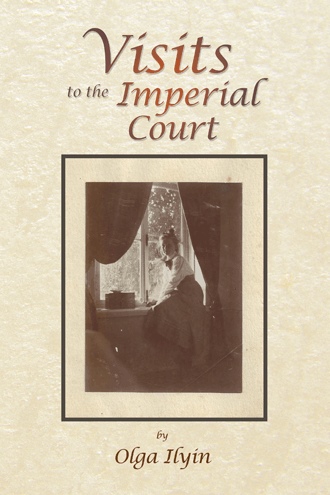
Olga Ilyin (Lita) recounts her experiences as a young girl being brought up frugally in the midst of family plenty. After her mother died, she was cared for by her father’s sister, the idealistic Aunt Katya. Aunt Anna, her mother’s sister, a career lady-in-waiting at the Russian Imperial Court in St. Petersburg, loved to invite Lita for longish summer visits. To Lita, the court was a brilliant, elegant, delightful world. Yet even she felt this world to be somehow flawed, even unreal. The flaw was incarnated in the demonic Gregory Rasputin, whom Olga encountered several times. Her description of Rasputin and his behavior is a small but no doubt valuable contribution to history; but in this novelized memoir, Rasputin also becomes an essential symbolic element in the author’s story of her own spiritual crisis, as World War I casts its heavy shadow, and as the Expulsion from Paradise nears.
About the Author
Olga Ilyin, (nicknamed Lita, née Boratynski), grew up in pre-revolutionary Russia in a liberal-minded, talented family. She had a serious gift for poetry, which in Russia is a popular fine art to this day. She was tutored in the sciences and liberal arts, and spoke French as fluently as Russian. Her studies at the University of Kazan were interrupted by WWI and the Revolution. This idyllic phase of her life ended when as a volunteer nurse she tended wounded soldiers. In 1917, she married Kiril Ilyin, a cavalry officer. A year later, as the civil war began, Kiril volunteered for service with the anti-communist “Whites.” Their son, Boris, was born just as the Reds stormed their previously freed city of Kazan, and nine days later, Olga and her child became homeless refugees. After a harrowing four years of separation, the three were miraculously reunited outside the USSR and in 1923 were able to come to America. There, a second son was born, just as the Great Depression began and Kiril was diagnosed with terminal tuberculosis. Miraculously he survived. Meanwhile, to support the family, Olga started a dress salon and turned her talents to designing clothing. Although her poetic gift had disappeared during all the stress she had experienced, she successfully turned to writing autobiographical novels. She died in 1991, leaving some unpublished memoires, including Visits to the Imperial Court.