
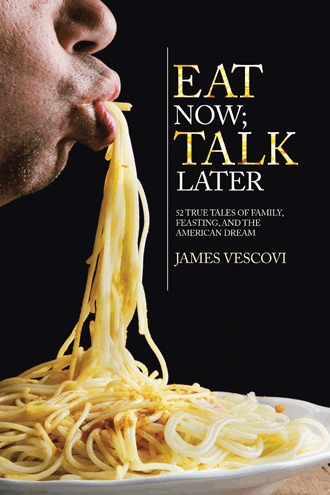
Eat Now; Talk Later
52 True Tales of Family, Feasting, and the American Experience
by
Book Cover & Preview Text
“He’s my uncle.” She nodded. “I know him–not very well, mind you, but I know who he is. There are so few people around here that we all know one another. Domenico Vescovi, yes.” Once again, her eyes fell on my father, and the car filled with silence. Minutes later they entered Fugazzolo, a small cluster of houses perched on a mountainside. The woman pointed out her house and my father headed towards it. As he downshifted the gears, she sighed and said, “I really don’t mean to pry into your business, but if I don’t ask you this question I will never forgive myself.” They pulled up in front of her door, and the car jerked to a halt. By now, my father had had enough of this mystery. He wanted to know who she was and what all the scrutiny was about. He laughed and said, “Please, ask.” She took a deep breath. “Well, you say that Domenico Vescovi is your uncle?” “Yes.” “Would you by any chance have been acquainted with his brother, the one who emigrated to the United States, Antonio Vescovi?” “Of course I would,” said my father, with a smile, “he is my father.” She pointed a bony finger at him and said, “And I should have been your mother!” For a moment, my father felt as if she were making some kind of a joke, but, no, she had taken his hands into hers. Her eyes were twinkling. “Si, e vero,” she said. “It’s true. “Allora, Milano puo aspettare. Milano can wait,” she added. “Viene a casa, prendiamo un caffe. Come in for some coffee.” Like a number of women in those hills sixty years earlier, this woman had had eyes for Tony. He was strong and handsome, she said, and he had a beautiful singing voice. After coming home from World War I, he left for America. The signora waited three years for him to return then married someone else My father laughed all the way back to Milano. The woman lived on one side of Antonio’s village, while my grandmother had lived far on the other. He must have been a busy man, riding his bike back and forth between sweethearts. A few weeks later, my father had lunch with his parents. He waited for Desolina to clear the dishes and go to the kitchen. Then he said, “So, Pa, I was in Italy and met someone who asked me to pass along her greetings.” “Yeah?” Tony said, without much interest, “Qui?” Hearing about my father’s visits to Italy was bittersweet for him. Now eighty, there was a part of him that felt antiquated and out of place in America, but returning to the old country would have dredged up too many sad memories of the farm and the struggles and the face of his blessed mother. My father said the woman’s name. Tony’s jaw started to drop, but he fought it back up. With his hand, he chopped the air, signaling that all conversation should cease. He put an index finger to his lips and motioned to the front door. They threw on their coats and went outside Anything Tony had done with this woman, whether respectable or not, would have occurred long ago, but he wasn’t taking chances. Desolina was a very possessive woman. It was a warm spring day, and they walked slowly down the sidewalk while my father recounted the tale. Tony’s Fedora was perched on his head, its brim angled low. Had you faced him with your back to the sun, a shadow would’ve covered his face. The story ended. Tony halted. He turned. He raised the brim of his hat. His eyes met my father’s. “É ancora bella?” he asked. “Is she still good-looking?” And from this story came many others about Tony and Desolina, including some that I myself had carefully collected. It would be impossible to tell the story of my grandparents through a traditional biography. They were not famous and did nothing that we might deem extraordinary, like invent a successful product or argue a seminal case before the U.S. Supreme Court. Instead, like most of us, they lived quiet, anonymous lives. Yet, how do we tell others about our great grandmother who lived in a sod hut on the plains of South Dakota, or our Uncle Buck, who took part in the arrest of a famous bank robber? Most often, it is through stories. For example, how did that woman in the sod hut in Nebraska feed her children during the winter after her husband died of pneumonia? What were your Uncle Buck's thoughts when walked out of his hotel in Hurley, Wisconsin, in 1935, and saw John Dillinger seated in a car scrutinizing the local bank? Or, in the case of my grandmother, an Italian immigrant who ate only Italian food her entire life, what was it like to watch her try McDonald’s Quarter Pounders, fries, and shakes when she was past ninety? Or to sit with my grandfather who, when he had to be hospitalized in 1991, pulled $1,000 in cash from under his pajamas to pay the bill? I heard and experienced dozens of stories like these, which I shared among family, friends, and colleagues—even strangers. Largely, listeners enjoyed them—laughed, teared up, or shook their heads in wonder—because these tales had a universal quality about them. What person, no matter how anonymously he or she lived, does not yield unique tales that tell us about character, history--in short, about what it is to be human. I hope you enjoy these stories. More importantly, I hope they help you recall reminiscences of your own grandparents, second cousins, and crazy aunts that you can pass down through your own families.
Formats

Book Details
About the Book
Prepare yourself for a feast consumed in delicious bites. This collection of stories can be read before bed, on a lunch hour, or waiting in line. They can even be shared with friends who complain they have enough to read. Together they ask the question, "How do you make modern life run smoothly for parents or grandparents who grew up in an era when oxen were used for plowing, children left school after third grade to tend chickens, and meat was eaten only twice a year? When Tony and Desolina Vescovi arrived in America, they collided with the 20th century. Born around 1900, they were stumped by telephones, banks, fast food, TV wrestling, and supermarkets. It was up to their only child, a son, to serve as their shepherd, and it wasn’t easy For example, how to explain that his job was taking him and his family 700 miles away when, in their day, sons stayed put to work the family farm? Or that it wasn’t wise to hide $10,000 in the bedroom? Or that the ice cream they just tried and enjoyed is called ‘Chubby Hubby’? This collection of 52 bite-size stories offers a twist on the American immigrant tale and is a testament to love, loyalty, and frequent half-truths.
About the Author
James Vescovi's work has appeared in The New York Times, Creative Nonfiction, The Georgetown Review, and Calliope. He is coauthor of The USS Essex and the Birth of the American Navy.