

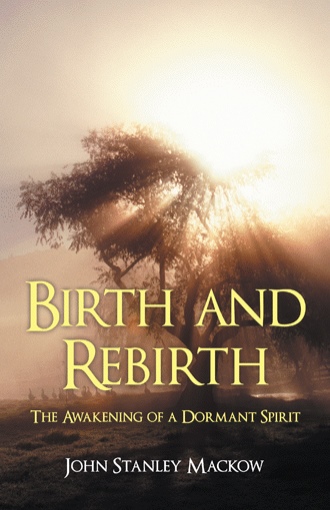
Birth and Rebirth
The Awakening of a Dormant Spirit
by
Book Cover & Preview Text
Chapter 1 excerpt:
Hope is the bedrock of a true spiritual search, and it is the degree that we need lasting happiness that drives our search along. We seek to be like the child in his blissful ignorance, but without the ignorance, for if we revel in the light of a complete, integral knowledge, we stand sovereign and are impermeable to any tribulation. The pursuit of knowledge is nothing more than a pursuit of itself—at the end of the day, we simply wish to know who we really are and how we fit into the messy scheme that is the outside world. The great religions say that God is one and that God is all, and if we are a part of the all (we must be or else we wouldn’t be a part of anything), then (assuming what religions say is true) somehow we must be related to God. Desire in its strife seeks to possess outwardly what it already contains within itself. Knowledge and happiness are our nature because we are made in the image of God. God is all knowledge, all bliss; we are all knowledge, all bliss. What we seek is in actuality more than a childlike wonder, amusement, and innocence. We really seek to know God as He exists in the world and as He exists in us. Finding God, we behold joyfully in Him all the vast workings He Himself has set in motion. With God’s blessing, we view the world with an even greater wonder, broader amusement, and purer innocence; we find peace, we find happiness, and we develop an even more profound respect for the mystery that is He and His Creation. Everything we seek otherwise with an aim toward complete fulfillment we seek because of our ignorance of Him, and as such, we suffer.
We most definitely and obviously are bound to the world. We breathe its air, as do we eat food that is produced by not just our planet alone, but also with the help of the sun. The sun is far away; other stars are much farther removed. But not all of us realize that the very material we are all made of is ultimately stardust. Though we are made up of the same basic stuff, we still come to view the universe and all its inhabiting bodies as things separate from ourselves, as things outside what are determined to be our immediate boundaries. By the working of a dividing mind, we differentiate ourselves from everything else and consider ourselves to be limited beings; absorbed into this notion of fragmentation, we find that we are separate and apart from our Creator. It is both a logical and practical impossibility that desire, born of this limitation, can ever be perfectly satisfied even in its most complete attainment of limited things. Desire hounds us and gives us no rest, and it will continue to do so until we unveil what always is, always has been, and always will be: the simple yet elusive Truth of Being. We are all very well acquainted with the trying circumstances of material living, and we ardently attempt to alleviate them by extolling economic growth and consumerism, by seeking diversions and entertainment, by expanding our egos through professional, athletic, artistic, or academic development, but, not knowing our origins, not knowing from what and toward what we proceed, we have no true idea what all our actions amount to. We do not know the Truth of the universe, and we do not know the Truth of our individual selves. Consequently, we haplessly flounder and stagger in life. We have no purpose, and whatever guise of happiness we might assume is dealt a decisively swift blow by the heavy loads we all must bear and the costly mistakes we invariably perpetrate. We are lost, but we are not hopelessly lost, for hope exists. That hope points directly at God, for only in God do we find true happiness, and only with God’s grace can we solve all our individual and social problems. With all our hearts, with all our strength, and with all our souls we must each seek God.
Chapter 4 excerpt:
Creation or no creation, there is always pure Existence. God is Existence, that one Unity at once transcending all that appears, withdrawn and uninvolved in time and space, and being all that appears, the support and necessity for anything that might take shape, the very substance of all that will build itself into any form. From the One comes the Many, just as one fertilized egg in the womb grows and differentiates into many specialized parts and organs. The Many still remains as One, for the differentiated components and organs sum to one body. That One, however, is transcendent, just as the material property of the body is transcended by the vital energy and the conscious presence residing in it, and then further as the individual person is transcended by a community identity, a national identity, or a common humanity. Not limited in any way, the One is neither modified by its parts nor by their aggregate composition, just as the physical formations of life do not alter (but are included in) the general chemical make-up of the planet. Though one and the same, the differences in aspect and appearance among the varieties of things are nonetheless very real—they proceed and are a modification from the Reality, but it is ultimately only that same Reality that is the source and the constitution of everything. There are many different electronic gadgets and appliances, but operating through them is only one electricity. There are many shapes of glasses and cups, as there are various flavored teas and coffees, but it is one water that takes the form of every glass and cup and is necessary to brew every tea and coffee. All the cups, glass, electric circuitry, organic material—anything and everything in our material world—can be broken down into elements, those elements into hydrogen atoms, those atoms into electrically charged or neutral subatomic particles, and even then we can draw further down into a mysterious working, a rapid, perpetual appearance and disappearance of self-canceling quanta, all supported by an even more mysterious substratum that pervades everything but also seems to be beyond everything, seems perceptible but lies beyond the reach of the senses, must be comprehensible but will not be squeezed or fitted into a concept or idea. There are waterfalls, lakes, rivers, rain and snow, sleet and hail, glaciers upon mountaintops and icebergs floating in the sea, but all proceeds from the ocean, and all must return to the ocean, just as we all come from God and are called to return to Him. God created so that He might expand and extend His bliss and omnipresence into the multitudinous expressions of form in limited consciousness, and so that through man, one day, that limited consciousness might rediscover itself in its true God-like state of eternal joy and immortality, even while involved in the play of matter. This is the secret of Creation and its evolution: the direct realization of God as the transcendent Truth with the subsequent uplifting of our human selves—for us to ascend to those heights of Spirit and for that supreme authority to then descend and depose the tyrannical reign of human frailties and limitation—is the real purpose and aim of our existence.
Formats

Book Details
About the Book
How can I deal with the harsh realities of this world?
How do I find meaning and achieve balance in my life?
Who is God? Can He be found? And how do I go about seeking Him?
Birth and Rebirth: The Awakening of a Dormant Spirit revolves around timeless and universal themes: the nature of the human experience and the reason for human struggle; the realization of humankind’s highest aspirations; the final goal towards which all religions aim. Taking a philosophical approach, the book critically analyzes the root of human suffering, examines the merits and demerits of both science and religion (as they are commonly practiced), and proposes a method through which each individual human being can overcome his or her obstacles and can move forward in life with confidence and enthusiasm.
About the Author
Born in Chicago, John Stanley Mackow studied astronautics at the US Air Force Academy and served as an acquisitions officer in the US Air Force. He left active duty to devote himself more completely to his various studies and practice of meditation. John currently lives in the greater Los Angeles area.