

Inevitable
by
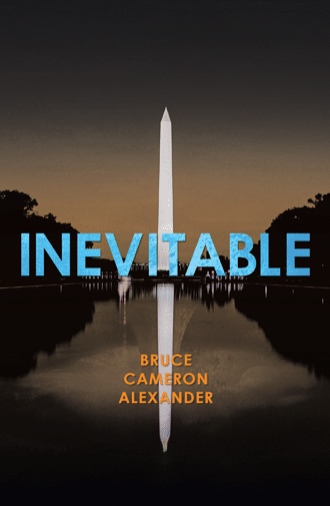
Book Cover & Preview Text
The heater's hiss filled the small space like water coming to boil. The inner space smelled of propane and was thick with humidity. Ben began to thaw. Looking around, it struck him how absurd it was that Stefan was even here, in the Presidential retreat, comfortable and warm in the dead cold, and to all appearances alone. With each encounter, rather than becoming less mysterious, everything about the man's very existence confounded him. Perhaps that was why he couldn't resist affection for the old man, an affection that grew with each meeting. He loved puzzles.
Stefan reached to the inside pocket of his snowsuit and produced a gold flask with a tooled leather boot, an ornate silver crest embossed just below the neck. He unscrewed the cap, and offered the flask to Ben.
Ben's hesitation squeezed a chuckle from Stefan, who put the flask to his lips and took a swig, grimaced, then said, "It is just my favorite brandy, Ben." He again offered the flask to Ben, who took it this time with a slight smile. Stefan said, "Your reforms are not popular, you know."
"Even with the protests, it's the price of safety," Ben said. "Though I feel, at times, that we may have over-reacted. I’m still shocked I was re-elected.” He took a swallow, made the face, handed back the flask. “Even so, the grumbling gets louder by the day. We tighten our control in Colorado, and unrest breaks out in Maine. People just don’t understand the nature of the problem. The scope. Things can’t be fixed overnight. Everyone is struggling.” He paused. It was his turn to look askance. “Well, not everyone, I suppose.”
“It is a matter of perspective. Without the benefit of an experienced perspective such as ours, who could understand the realities of statecraft? Even for experienced hands on the helm, it is not an exact science. One must read the waters, so to speak. Even so, you never know what lurks beneath the swells. In reality, events such as New York can be advantageous when dealing with populations."
It was Ben's turn to chuckle. "How so?"
The age seemed to melt from Stefan's shoulders. He straightened a bit. His voice gained strength and tenor. It lost the familiar quaver. Ben could imagine Stefan in days past: a force; a soldier of harmony. Soldiers were sometimes called upon to do the unthinkable. “The ranks of your military have swelled, have they not? Your global position is strong?” “It was either that or the work camps for most. Refugees from New York had to go somewhere, and the problem wasn’t confined there. In the six months post-NYC, we had ten million displaced people spread across as many States. Relocating them to existing facilities was the easy part.
“As it is, it does give us a logistical advantage overseas, yes. Though—public reaction being what it is—it’s a double-edged sword. The cleanup generated an industry of its own, which alleviated the worst of the economic fallout, and the camps are very profitable. The additional work camps were completed none too soon. It could have been much worse. Rioting and chaos were kept to a minimum. Thank you, Stefan.”
“You are welcome, Ben. I am glad I could help. The incentive was there. Convincing the appropriate enterprises that profit could be made was the only hurdle. They simply followed the carrot.”
“I still feel a bit like a jailor.”
Stefan’s rumbling chuckle amused him.
“That line between mercenary and saint is thin, Ben. It hinges on whether or not those you suppress can then become allies. Take a page from the Romans: The Roman legions conquered one nation after the next, leaving a garrison to recruit from the defeated. This worked well, for the most part, but often the garrisons themselves were recruited from other vanquished nations, and discipline was a problem. Spread yourself too thin and the army you have trained turns against you in the wake of your neglect.
“Keep your friends close, as they say. Though that is only possible if sufficient resources are available. Feed the wolf of your choosing, to borrow from your native folklore.
"I digress. My point is that, in domestic affairs, we have many examples from history. An enemy, or a perceived enemy, galvanizes support even for an unpopular ruler. It must be someone or something that the majority of the population reviles or fears . . . or can be persuaded to. Then, all one need do is offer a solution to the problem.” Stefan spread his hands in a grand gesture. “Violà! You are a hero. The people love you. The skeletons in your closet are overlooked.
“Who was the most reviled man of the 21st century? Who dealt him justice? The man who accomplished that was a hero. Alternatively, the enemy can be an ideology, a nation, an entire people. It all depends on need, opportunity, and the desired solution. Look to history, Ben. Choose your own path or have it chosen for you."
Ben nodded slowly, purposefully, a slight smile bending his face. "You're an interesting man, Stefan."
Stefan's own smile, hiding in a sea of age, lit his face. "Thank you, Ben.” He passed him the flask. “So are you.”
Ben needed Stefan. The fallout from the NYC Incident—actual and metaphorical—had put the country on the edge of the abyss. Had it not been for Stefan’s aid and advice over the intervening months.... Ben had the finest talents in the world at his disposal, but Stefan’s experience was unique. It had been key to surviving the aftermath of NYC. Work camps had solved two issues in a stroke: millions of displaced citizens, and an economy reeling from a deathblow. And the camps were profitable, too. The result rendered the details of their first meeting irrelevant. The greatest alliances in history had begun on shaky ground.
Two short years could be a lifetime.
Formats

Book Details
About the Book
The United States is plunged into an authoritarian frenzy following a terrorist act that leaves lower Manhattan in ruin. James Woodward is a man of integrity with no interest in fanning flames, yet a single act of civil disobedience unravels his perfect life, and he is drawn to join the ever-growing mass of American refuges.
He soon discovers he is far from alone in his exile. Risking assassination, he joins a group determined to prevent the United States from devolving into a totalitarian state. Outcasts in a dystopian nightmare, they are caught in a struggle between unknown benefactors determined to aid their cause and others determined to see their idealistic efforts destroyed.
When a quiet protest ends in a bloodbath, the survivors turn to James’s mysterious organization for support. With the help of hidden allies, they travel to Washington, D.C., where James and his friends seek peace but instead find a showdown in the shadow of the Washington Monument. Will the power of freedom save America, or will a paranoid government murder anyone who stands in its way?
About the Author
Bruce Cameron Alexander enjoys writing fiction that inspires the reader to think deeply about present reality and its effect on the future. His lifelong interest in science and the human condition has imbued his writing with thought-provoking, futuristic possibilities. He currently resides in Oregon.