

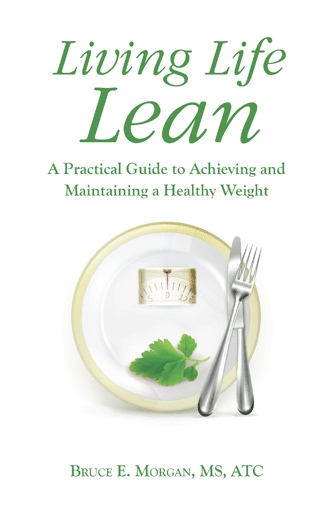
Living Life Lean
A Practical Guide to Achieving and Maintaining a Healthy Weight
by
Book Cover & Preview Text
Chapter 2
Food Is Not the Enemy
I promise that it is not necessary to eat like a cave dweller, become a vegan (although restraining your saturated fat consumption is a worthy goal), limit yourself to cabbage soup or grapefruit, or cleanse your colon with coffee. Diets that have as their basis excessively restrictive nutritional practices or that encourage bizarre medical procedures as a means of weight loss should at the very least cause one to exercise careful consideration before enrolling. Weight loss is a process; it is not a science experiment. Are there foods that one would be wise to avoid? Absolutely. However, if eliminating those foods from your diet would make you miserable in the process, then ways must be found to include them, if perhaps only in a limited way.
Food selection is a very personal thing and is influenced by many factors, including cultural and religious preferences, upbringing, individual taste, availability and cost to name but a few. Whatever it is that motivates one to select a particular food item, the item itself has no evil intent. The most sinful appearing cupcake is after all inert, asking neither to be eaten nor ignored. Our antagonist is not food but rather how we respond to it. As cartoonist Walt Kelly observed, “We have met the enemy and he is us”.
Chapter 4
Choose to Move
Where weight loss is concerned, exercise and calorie restriction are two sides of the same coin. It would be difficult to achieve sustained weight loss without combining elements of both. Up to this point, we have discussed implementing a program whereby we look to shed pounds through diet manipulation alone. As the numbers indicated, such a program is at best a tough row to hoe. The long and laborious task of dropping a few pounds a month has potential of leaving some dieters demoralized, and why not? Given what for many must be perceived as a huge personal sacrifice in the form of restricted food intake, one would hope to realize results that are more significant. Adding exercise to the process would certainly aid in that cause. Exercise is the only legitimate way in which you can, in effect, up the ante by increasing the number of calories you expend.
For those whose weight remains constant, there is an equilibrium maintained between the calories consumed and the calories expended. In order to lose weight, we must offset that equilibrium by pushing it in the direction of calorie deficit. We have begun to do so by limiting our intake, but in order to make the deficit steeper still, we must ratchet up activity. I admit that life, as it is presently lead with its many conveniences, makes it possible for a large number of us to avoid unnecessary toil.
Chapter 6
The Truth Shall Set You Free
In the darkness that is ignorance, fraud and misinformation flourish. Within this context, the ignorance I refer to is not equivalent to stupidity, but is a product of a lack of familiarity or experience with a particular subject. Because even the brightest among us cannot be knowledgeable on all subjects, it is at times necessary to seek opinions from those more informed than we. For better or worse, this is how we learn about the outside world.
For those aged forty and older, think about those questions you asked of your parents and teachers; questions that if asked of your father in particular, were often answered with, “Ask your mother”. Many of life’s greatest conundrums were left unanswered by the sources we depended upon. Fortunately, in the fullness of time, we discovered the answers for ourselves – girls don’t have cooties and the moon is not made of swiss cheese. Today, whatever our age, whatever our question, the answer is but a few keystrokes away. However, like our questions of old, the answers are only as good as the veracity of the source providing them.
With regard to matters of fact, a single unassailable correct answer would be the only appropriate response. If asked who was the sixteenth President of the United States? The answer will always be Abraham Lincoln. There can be no correct alternative response. We cannot say the same of questions for which no single true answer is known. In such cases, the answers proffered will always involve some amount of theorizing, hypothesizing, and, yes, a measure of guessing, regardless how emphatically stated. It is important, therefore, that we become proficient at separating fact from opinion.
Chapter 8
Back to You
In the preceding few chapters, we veered off course slightly by glancing at some issues that may not be directly related to your situation. Unless you’re a retired athlete, one about to retire, or the parent of a child dealing with its own troubles related to weight, you may have found little value in the information presented. However, behind the specific populations discussed is the underlying theme of energy balance.
Remembering that I am but one of thousands who have written on the subject, how does my position square with those expressed by others? I hope it will not surprise you to learn there is no unanimity of opinion. In fact, with respect to calorie restriction, some argue loudly against it as a weight loss strategy. Those who do, claim it has a poor track record where sustained weight loss is concerned. They contend that starving yourself during one meal may cause you to overcompensate at the next. If true, I would suggest what they describe is not an example of calorie restriction at all. Starving and binging are merely other forms of disordered eating. What I have advocated and continue to advocate for is a moderate but consistent decrease in the amount of food we consume throughout the course of the day. What I have suggested could not reasonably be thought of as starvation. One of my stated goals is to assist you in establishing, or reestablishing, a healthy and sustainable relationship with the food you eat. Starving and binging is neither healthy, nor is it sustainable in the long-term.
Formats

Book Details
About the Book
According to the Centers for Disease Control and Prevention:
-More than two thirds of Americans are overweight, over one third are obese.
-43% of Americans are projected to be obese in 10 years time.
-Nearly one third of children and adolescents are overweight, 17% are obese.
-Since 1980, obesity prevalence among children and adolescents has almost tripled.
-Between 1988 and 2008 the prevalence of obesity among adults increased at all income and education levels.
-After smoking, obesity is America’s leading cause of premature death and is linked to 70% of heart disease and 80% of diabetes.
-In 2008 the medical costs associated with obesity were estimated to be $147 billion.
In spite of the grim picture that these statistics paint, obesity is not your destiny and it need not be your end. Whatever your particular weight challenge may be do not accept it as your lot in life. If you have attempted to lose weight in the past and failed, do not be disheartened; it is within you to win victory over this foe. Get the encouragement and the tools you need to lose weight – and keep it off – with Living Life Lean.
About the Author
Bruce E. Morgan is a certified member of the National Athletic Trainers’ Association. Over the course of his thirty-year career Bruce has provided care and counsel to athletes at every level of competition. A member of four Major League Soccer championship teams Bruce, when not working with athletes, can frequently be found assisting others to achieve their own personal fitness objectives near his home in San Jose, California.