
From The Other Side Of The Tracks
A Memoir
by
Book Cover & Preview Text
I wasn’t worthy of God’s love. That’s what I was thinking when the taxi driver told me to pray, promising me that God would forgive me. Twelve hours earlier I had decided, once and for all, to kill myself. It was time. My depression and loneliness had become profoundly worse. I had stopped eating. I had lost the will to go to work most mornings, my loyalty to my boss – perhaps the last person left who might have cared about me – not enough to overcome the suffocating lethargy. Whole days would go by without my being able to set foot outside of my cramped, third-floor apartment. Life had become pointless. I had my suicide kit handy, a jar of various pills I had been collecting over the years, pills that had been prescribed for the numerous surgeries and the physical issues – degenerative conditions sourced, no doubt, in the beatings, and exacerbated by the bodybuilding and the running and the triathlon training. I never used the pills except maybe right after my back surgery or the three foot surgeries. I never saw the need. Physical pain was a part of my daily life. I knew nothing else. And so I had a jar full of powerful pain and sleep medications and I hung onto them like some insanely ironic lifeline: if things ever got too bad, there was always suicide. The thought was comforting. Determined to do things right, I decided I needed something with which to wash the pills down, something to make the mix even more lethal. I didn’t drink and had nothing in the apartment. I wasn’t exactly sure what I wanted. Anything, I guessed. A bottle of cheap wine would do, and off I went into the Denver night. The snow had been falling and under other circumstances I might have noticed the beauty, but as I pulled my Subaru into the parking lot of the liquor store, all I wanted was to grab a bottle and go home and bring an end to my dismal existence. I picked up a jug bottle of cheap rosé, the first bottle I saw, paid for it, and walked back out to my car. Next to the liquor store was a grocery store. Maybe something to eat? A last meal. I took thirteen dollars out of my wallet and grabbed my purse and walked into the store. Pushing a cart slowly up and down the aisles I came across the candy section where, among other things, there was a large container of white, yogurt-coated peanuts. I filled a small bag, thought about weighing it, and then realized I probably couldn’t afford the peanuts anyway. I hadn’t stolen anything in my life, at least not since I was a little kid when I didn’t know any better, but I vaguely thought what difference could it make tonight, the last night of my life? I quickly shoved the bag into my purse. With a few odds and ends in the cart, I checked out and walked towards the automatic doors, past a large man who’d been standing by the checkout counters, eyeing me. It dawned on me why he’d been doing so the moment I heard his voice behind me as I made my way out into the parking lot. “Excuse me, ma’am,” he said. “I’m going to need you to come back into the store for a moment.” He walked me upstairs into an office and made me open my purse. “Well, well,” he said. I mumbled an apology, hoping to leave. I just wanted to get home, back to my apartment, back to my pills. If he only knew, I thought to myself. If he only knew. But he didn’t know, of course. I was a shoplifter. A thief. And so we waited in the office until the police arrived. They handcuffed me and walked me back downstairs. We paused at one of the checkout counters while a cashier scanned the groceries I had paid for and returned to me my thirteen dollars. I lowered my head and stared at the floor as I felt the eyes of the other customers. Then the cops walked me outside into the cold air and put me into the back of their squad car and we headed for the station. An officer had been killed that night in the line of duty. It was all the cops were talking to each other about in the front seat as we drove along and I could sense their bitterness. I knew I didn’t mean very much to them; an inconvenience on a tough night, I imagined. “Just a local girl,” I heard one of them refer to me as. At the station they took my personal possessions (my purse and thirteen dollars), fingerprinted me, and ushered me into a holding cell: a concrete slab to sit down on and one stainless steel toilet. They spent a lot of time trying to determine just who I was. My wallet with my I.D. was back in my car and neither the store security guard nor the cops had let me go get it. I don’t know why. Maybe they didn’t believe I even owned a car. I was just a local girl. The name confused them. Their database didn’t turn up a Eva Vekis, my married name (I’d been recently divorced); nor a Eva Taylor-Fairchield, the name I had taken at 19 from the woman who adopted me and became something of the mother I never had; nor a Eva Hall, a name I’d taken in a desperate marriage at the age of 15; nor my original name of Eva Taylor. I tried to explain the name changes but the story is a complicated one and I think it only served to make them suspicious. They eventually found my mother in their database and one of my sisters, but I remained a mystery. And so I waited in the cell. Hours went by, slowly. At about 4:30 a.m. a female officer opened the cell door and told me I was free to go. To this day I don’t know why. I never had to make a subsequent appearance and it was as though the whole shoplifting incident had never happened. The officer returned my possessions to me and I meekly thanked her and left. Outside the station I stood on the sidewalk, in the snow. I had nothing to cover my head or hands with and no way to get back to the grocery store where my car was. There was no use looking for a taxi; it was early on a Sunday morning and Denver wasn’t a big city back then with taxis continually streaming by. Even at rush hour, if you saw a taxi, it was typically on its way somewhere, delivering a fare or picking one up. And yet, improbably, a taxi came by. I flagged it down. “Can you take me to the shopping center on Evans, near University Boulevard? I don’t know how much it will be…I have thirteen dollars.” “No problem, miss,” said the taxi driver in a thick Jamaican accent. “I take you there.” We drove for a while in silence but I sensed the driver must have wondered what I was doing outside a police station at 4:30 on a Sunday morning and I felt compelled to tell him, to tell him about the bag of peanuts, feeling ashamed and embarrassed as the words came out of my mouth. “You jus’ pray, miss,” he said. “You jus’ pray and God will forgive you. God loves you. Dis I know, miss. Dis I know.” His voice was genuine and comforting and I wanted desperately to believe him. But I knew I wasn’t worthy of God’s love. The shoplifting incident was the lowest point on the lowest day of my life, underscoring for me my sense of worthlessness. The saddest part? There was no one to even write the requisite suicide note to. I was alone in the world. When I got out of the taxi I handed the driver the thirteen dollars. I was afraid to look at the meter, certain the money wasn’t enough. But he accepted it and smiled warmly at me and told me he would pray for me. I held back my tears until he pulled away. I brushed the snow off my car, the only car sitting in the parking lot, and then drove back home. Inside my apartment I couldn’t stop crying. Finally I curled up on my bed with a blanket over my head and after quite a while I fell into a deep sleep. Maybe it wasn’t time after all.
Formats

Book Details
About the Book
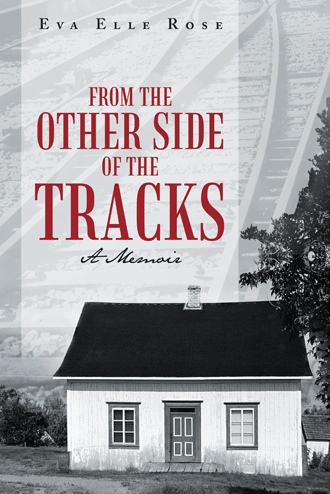
From the Other Side of the Tracks is the true, first-person account of Eva Elle Rose. Abandoned by her mother, beaten by her stepfather, and reared in abject poverty, Eva nevertheless survived to lead an accomplished life of real meaning. For this, she credits a force at work behind the scenes, bringing people and events into her life out of seemingly nowhere that collectively steered her in the right direction, even away from a suicide attempt on the lowest night of her life. For believers and non-believers alike, From the Other Side of the Tracks is a deeply moving, inspirational journey of triumph.
About the Author
Eva Elle Rose is the survivor of a childhood that could easily have crushed her. Abandoned by her mother and reared in abject poverty by an abusive stepfather, she nevertheless found the courage to grow and even triumph. Her true story, From the Other Side of the Tracks, details the misery and misfortunes of her early years – adversity that would impact her severely as an adult, eventually leading her to consider suicide. But a series of events and people, seemingly random, came along to help her find the strength to prevail, making her wonder at what might have been working behind the scenes all along, and inspiring her to pen her extraordinary memoir. Eva currently resides in California.