
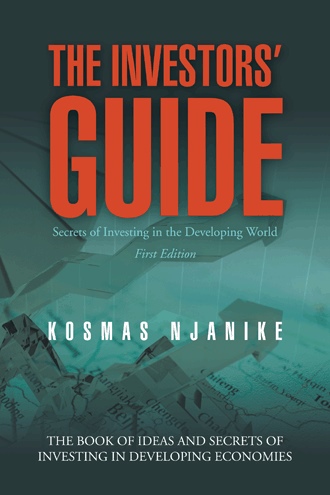
THE INVESTORS' GUIDE
Secrets of Investing in the Developing World
by
Book Cover & Preview Text
Many developing countries have varying capacities to grow their economies. How best can developing nations achieve these economic and social objectives? The growth may be centered on individually which would be the best or favored approach by any nation. Development may as well be achieved in cooperation with one another and, with meaningful assistance from the more developed countries of the world. The majority of developing countries seek to attract investments or foreign investment (FDI) as opportunities exist but capital and expertise may be limiting progress. Some governments may plan to attract investment angels but policies on the ground actually scare away investments. This book seeks to explore the factors that any investor or prospective investor to a developing country ought to consider and analyze in making decisions before and after committing their funds. An investor has to have an insight into the prospects, regulations, policies, risks, and so on of the investment destinations. Being a small or large business an investor cannot afford to lose therefore. It makes it imperative for such an investor to be equipped with knowledge on common factors affecting business in the developing world. The following are common questions in investments that need answers: · What should an investor expect? · What opportunities exist in the developing economy? · How can you exploit and maximize on opportunities available in a market or economy? · What does an investor look for? · What are the common problems encountered by investment angels? · How can these problems or risks be managed? 1.1 What is Investment? Investment has different meanings in finance and economics. For the purpose of this study investment is spending on capital goods by firms and government, which will allow increased production of consumer goods and services in future time periods. Investment may also mean an act of an individual or any entity that involves deployment of money (cash) in securities or assets issued by any financial institution with a view to obtain the target returns over a specified period of time. Without investment there is no economic growth to talk about. Therefore it is imperative for a developing country to create a conducive investment environment with the aid of consistent policies to ensure investment. These policies can also be centred on attracting investment in all sectors or some sectors of the economy. An investor must take into account the impact of a number of factors before committing capital in any investment. One has to ascertain if the venture is worth it considering all factors affecting the business. Most importantly an investor has to be aware of risks that the investment is exposed to. As the world has become a global village it must be easy for funds to flow from one economy to the other. The same goes with investors from one country to invest in another. This book analyses problems and risks that are encountered or common to developing countries. It also gives insight on what investors especially the foreign investor should expect and know how to manage it. This was also meant to assist policymakers in countries or economies that desire to attract investment angels as dos and donts are brought into light. Experiences of individuals, multinational companies (MNCs) and countries has been sought to give a more practical approach to the subject. Some have also been given in form of testimonies for the readers benefit. 1.2 Why invest in developing countries? Recent analysis shows that Africa and some developing countries in other continents have become profitable for foreign direct investment (FDI), delivering significantly higher returns on investments than other developed regions in the world (Ernst & Young, 2012). In fact, the World Bank “Doing Business” indicators show that, in 2011, one third of the economies that had experienced improvements were African. Large Multinational Companies (MNCs) now recognize that Africa could be the next economic frontier. Asia is still offering attractive returns to investments. For example the levels of return on investment in these regions by Japanese multinational corporations have been substantial, outstripping those on investments in Europe, South-East Asia and North America (UNCTAD, 1999). The investments are creating jobs, bringing new technologies, making domestic markets more competitive and generally contributing to rising living standards, disposable income and increasingly sophisticated tastes throughout the developing countries. Due to globalization many developing economies are diversified and established with strong and/or promising business sectors. There are opportunities in agriculture and horticulture, tourism, mining, power generation, ICTs, manufacturing and acquisition of state-owned enterprises. There are also opportunities in international air and sea gateway to some regions or countries. Infrastructural development opportunities are common in many developing economies. These are a few examples as the opportunities are too many to mention that require one to be on the ground for self observation. A trip or holiday to a country you think may present investment opportunities for you will pay dividends. What kinds of business are you involved or interested in? Consideration of investments in a developing economy with plenty of opportunities may earn you more than 100% Return on Equity (ROE). Many governments have adopted strong reform gains to encourage investment: coherent vision for economic development, scouting/luring foreign investors and reinforced investment authorities. The world over provision of services under one roof has become the global best practice to lessen the challenges for would be investors. In Africa, some investment agencies in Rwanda, Kenya, Egypt and Zimbabwe amongst others are providing all the required investment services under one umbrella body. This is to lessen the burden on the investor by dealing with bureaucratic bottlenecks. In most developing countries investors often had to wait for long periods of up to one year in some instances, pay bribes, have to visit relevant offices many times and in some instances have their files lost in the process of applying for investment licenses. The `One Stop Shops' have been adopted as institutional substitutes to bypass or accelerate existing procedures where they are dysfunctional. The arrangement enables one to obtain all the necessary paperwork in one streamlined and coordinated process.
Formats

Book Details
About the Book
Build your knowledge on international investments as you enjoy reading this book. This book is pregnant with secrets and tips for investors and entrepreneurs, as it clears some mysteries often associated with investments in developing countries. The book is useful to those looking for investment opportunities or has interests in Africa, Asia, South America and other developing countries on the globe. It seeks to `open eyes' of the reader on the investment and business opportunities in different countries on the timing, market entrance strategies, risk management strategies and other factors for considerations. After reading this book your fear to invest in some countries and markets will be dealt with as the author explains the opportunities, threats, risk mitigation strategies and steps to be followed for one to make a successful business venture. Many examples and case studies have been utilized to help explain concepts and experiences in foreign direct investments (FDIs) on some parts of the world. The book sought to reveal opportunities in different developing countries and encourage those interested in creating wealth, business opportunities and jobs not to buy time but invest. The Investors' Guide is a book that can be of interest to university students or ambitious young people with an entrepreneurial mind in developed countries who may have access to capital and a desire to create wealth for themselves mainly through technology transfer. Investors or multi-national firms who need to expand their businesses to any developing countries will also benefit from this book. The book reveals the huge returns that can be obtained on investments in different sectors in developing countries and this is a chance that one would not want to miss.
About the Author
Kosmas Njanike started his career with BancABC and worked for CFX Bank for a number of years as a credit and investment analyst. The author also worked for the Reserve Bank of Zimbabwe as a Research Analyst. He has also worked as a consultant for a firm in Botswana.