
Twenty-Twenty Hindsight
Memoirs of the Old and New South Africa
by
Book Cover & Preview Text
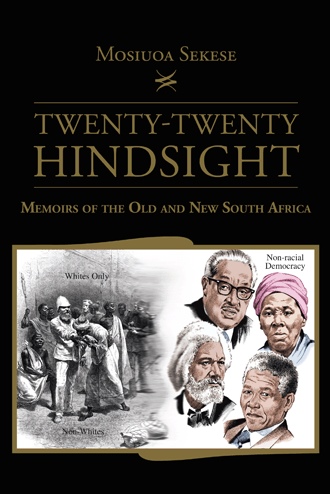
PROLOGUE The birth of the new South Africa has been described as a miracle. It signalled the end of the brutal apartheid era. The inauguration of Mr Nelson Mandela in 1994 as the first president of a democratic South Africa was the culmination of a long and bloody struggle against the apartheid demon that dehumanised Black South Africans for almost a century. Throughout the decades, the struggle for freedom in South Africa was directly and indirectly centred on education institutions. From the 1950s onward, educational institutions spearheaded the war against apartheid. The 1970s and 1980s saw schools literally becoming battlefields for freedom. Even today, schools and students are at the forefront of the fight against any form of social injustice. Many South Africans have, to a greater and lesser extent, been directly and indirectly involved in these struggles; they have experienced the good and the bad days of the old and new South Africa. However, very few South Africans have served as middle-managers in the Department of Education (DoE) in both the old and the new South Africa. At the dawn of the new regime almost all officials of the former Department of Education (Bantu Education), were dismissed as they were considered unfit to be part of the new dispensation. Of these officials, I am the only one who was dismissed and later recalled to assist in the reconstruction and transformation of the education system. I believe this makes my story unique. The majority of Black South Africans suffer from abject poverty. As a result, many talented Black youths never get the opportunity to develop their potential through education. I am one of the many Black South Africans who could not proceed with formal education beyond primary school. Despite this setback, I have occupied a variety of positions in different and contrasting fields. I have been, among other things, a domestic servant (kitchen boy), a gardener, a labourer on a construction site, a gospel evangelist and preacher, an adult educator, a messenger, a clerk, a high school teacher, a university lecturer, a school headmaster, a school inspector, a circuit inspector, an area manager, a chief education specialist, a director and even a chief director in the Department of Education. Furthermore, over the years, I have been privileged to hold several positions in a variety of community organisations, professional organisations, Department of Education task teams, labour unions, charity organisations, boards of directors, church boards and committees. I have also been honoured to present papers at various conferences organised by teacher unions, media clubs, youth and church organisations. As a Christian, I believe that God has guided my destiny. On several occasions I have had doors shut in my face and, whilst despondent and not knowing what to do next, I have seen new doors unexpectedly opening before me. God has placed a number of people in my life’s journey who have been instrumental in my success and achievements. I am indeed grateful to God for helping me progress from a stage of my life when I hardly knew where my next meal would come from, to a stage when I have had the pleasure of driving and owning three German-made executive cars. I often wonder how it all happened. Although my life story is not very different from that of an average Black South African of my time, I am in a unique position to tell the story of South Africa from two different and contrasting perspectives. I have served as an official under the old apartheid regime and the new democratic South Africa. As I tell my story, I will inevitably be telling the story of Black and White South Africans; people in low and high places; the oppressors and the oppressed that have crossed my path in the old and new South Africa. My story does not follow a strict chronological order; neither does it give details of every facet of my life. I prefer to concentrate on certain themes that have featured prominently in my life, such as a triumph against odds and race relations. I address a number of questions that confronted, and still confront South Africans, especially in the field of education. I highlight issues, such as the struggle to transform education, as well as the contradictions and paradoxes that continue to plague this process. One of the most striking features of my story is the realisation that life resembles a turning wheel. More often than not, I finished very close to where I started. Very often I had to deal with the same people that I had met previously; people that I never for a moment thought would cross my path again. Some of the encounters were happy reunions while others were extremely embarrassing. As I get older, I realise that change is often an elusive concept. I am inclined to concur with the saying “The more we think things change, the more they remain the same”. Lastly, I have chosen to use the terms ‘Africans’ and ‘Blacks’ to refer to indigenous black Africans because I have never been comfortable with the way the term is used to include Indians and Coloureds. Although Indians and Coloureds may be darker-skinned than Whites and were classified as non-Whites during the apartheid era, they were treated differently through the strategy of divide and rule. In 1985, they were included in the new Tricameral Government. Under the former regime, we were kept in racial watertight compartments. As a result, I never experienced firsthand what happened in their world. This will become clearer as the story unfolds. “Twenty–Twenty Hindsight” refers to the perfect understanding of events that we can only have after they have happened. This is exactly what has happened to me. As I relate my story, I can now see why things turned out as they did. Thus, I am now in a better position to share my experiences with my readers. .
Formats

Book Details
About the Book
“Twenty-twenty hindsight” means perfect understanding of events only after they have happened. In his book, Mosiuoa Sekese looks back on his life in the old and new South Africa and gives his own perceptive interpretation of the past events. Sekese suffered discrimination and prejudice under the old apartheid government as well as the new, democratic regime. His story is highly personal, but provides the reader with unique insights into the social and educational challenges that South Africa continues to grapple with. “I had a quick read and I fi nd the content heartbreaking but fascinating. Especially as a white South African you are drawing me into a world that I always knew existed, but which few people have the guts and conviction to paint into words.” – Louise Heystek-Emerton: CEO Wordwise/Khuluma Awethu
About the Author
Born to a farm labourer, Mosiuoa Sekese has been a kitchen-boy, an evangelist, a clerk, a teacher, a school principal, an inspector of schools, a subject advisor, a university lecturer and a director. He served in both the old and new South African government departments. He was dismissed from the Department of Education for being unfit to serve in the new dispensation but was recalled by the Minister of Education to manage the committees that developed the post-apartheid school curriculum. With this unique experience, he is able to give the reader a synopsis of the lows and highs of rugged South African history, especially in the field of education. He is now a consultant in education and training.