
Biomythology
The Skeptic’s Guide to Charles Darwin and the Science of Persuasion
by
Book Cover & Preview Text
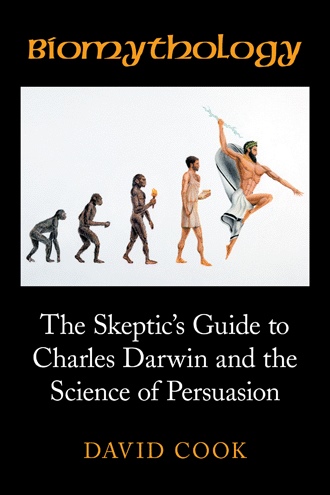
Introduction In this training manual for skeptics, biomythology is the myth that biology can replace the humanities in capturing what it means to be human, the faith that science can do for mind what it did for matter. The myth is told using what philosopher of science Paul Feyerabend has called, “brainwashing by argument,” a special rhetoric of objectivity whose many devices the following chapters will explore and detail under the title of Science of Persuasion. Biomythology is more than an attempt to reduce the fire in a lover’s eyes to atomic theory or paint the human spirit by the numbers of the fMRI. In the eyes of the skeptic, biomythology is the practice of borrowing science to change minds rather than matter. By inventing neuronal mythologies about how skeptics think, biomythology tries to persuade the skeptic on what to think. Readers have every reason to doubt when the miracles of the physical sciences are cited to alter worldviews rather than the world we view. Biomythology: The Skeptic’s Guide to Charles Darwin and the Science of Persuasion argues that, without the humanities along for the ride, science can no more capture the mystery of what it means to be human than a lone child can discover the joy of a seesaw—the soaring, the caress of sky, the transcendence! Biomythology argues that a life unexamined by an fMRI is still worth living. Skepticism Skepticism is doubt, and doubt has lost its balance. Stories of the supernatural monopolize skepticism, leaving little left over for stories of the natural. Hume’s warning, “The most perfect philosophy of the natural kind only staves off our ignorance a little longer…” is ignored. As a result, doubt threatens to topple into the abyss of certainty. In The God Delusion, renowned Darwinian apologist Richard Dawkins proves that, when it comes to skepticism, he is the brightest wavelength on the spectrum. Unable to improve on Delusion’s arguments, we will ignore skepticism about the stories of the supernatural and instead explore skepticism about stories of the natural. Biomythology levels the playing field of the game of skepticism, doing for Darwin and science what Richard Dawkins has done for God and religion. And why not? Science, some might feel, is the art of arranging observations to fit theory. Like big government, big science grows stronger every day, passing laws to constrain every facet of nature. No fact, no observation is above the law. As a result, the prisons of intellectual history are overflowing with scientific facts gone bad. Waves of light break into quantum sand. Time and space genuflect to viewpoint. Pluto lost the vote. If reader’s elementary school science texts already contain errors, where exactly do readers draw the line between theory and myth? “Once upon a time there were nine planets…” Will current facts withstand the ravages of discovery and consensus while only former facts descend into fairytales? Darwin In today’s culture of sales, scientific has come to modify everything from literature to laxative commercials. Physicians borrow scientific to sell botulism injections, Darwinians borrow scientific to sell materialism, and Creationists borrow scientific to sell God. Those who shout the term scientific most loudly are the most suspect. The further one strays from physics and chemistry, the more the word appears. It seems that only when a product sells itself, can scientific be safely dropped. As we will see, the telegraph, telephone, and electric light all appeared in the records of the patient office before they were mentioned in the scientific literature. Edison was an inventor, not a scientist. Today, no one wastes time selling the public on the idea that Smartphones are scientific. When real science is involved, no one has to: a century and a half of continuous promotional efforts are unnecessary. Which brings us to Charles Darwin. If we seldom are reminded that it is the consensus of the scientific community that Einstein’s equations are true, then why must we be repeatedly be told that all reputable biologists agree that evolution is true? Every skeptic should suspect that when the word scientific is wed to the word consensus our only certainty is that we are in the middle of a sales pitch. “It is the consensus of the scientific community that …” means, quite simply, “Buy now!” To the mind of the skeptic, scientific consensus is little more than a euphemism for the same political science that voted away Pluto’s planethood. Charles Darwin was a rhetorical and networking genius. His Origin of the Species sold out on the day of publication. A century and a half later, the Origin remains an astonishing literary success. The skeptic can’t help but admire the achievement. Who can resist Darwin’s universal solvent of reason dissolving all observations at odds with passion for his paradigm? Who can doubt the rhetorical devices that not only sold how nature selected the intricacies of the eye but eliminated any need for a window to the soul? We will, therefore, make no attempt to disprove the stories of natural history told by Darwin or his Disciples. When the stories can predict what natural selection will do next, they may even graduate from historical revisionism to qualify as natural science. In the meantime, we will train skeptics to recognize the rhetorical devices used when borrowing the prestige of science to sell ideology rather than engineer the physical universe, to warn the skeptic that advertising space travel and delivering natural selection is like advertising the Mona Lisa’s smile and delivering a Rorschach test. The guillotine may have been the least pleasant legacy of the Enlightenment, but the skeptic guesses that selling ideology as science proves more persistent, pernicious, and perverse. Today, prenatal test scores determine who can enter our brave new world, build better bell curves, and lend hope that the spirit of eugenics cannot perish. Biomythology will train the skeptic to see how scientific reason and evidence can be as convincing as a serial killer’s smile on your first date.
Formats

Book Details
About the Book
Is the life unexamined by the fMRI not worth living? Can biology replace the humanities in capturing what it means to be human? Biomythology levels the playing field of skepticism, doing for Darwin and science what Richard Dawkins has attempted for God and religion. This irreverent romp reasons:
• "Once upon a time there were nine planets—scientific truth rests on the faith that future discoveries will not turn today's facts into tomorrow's fairytales."
• "Science is the art of arranging observations to fit theory. When applied to alter minds rather than matter, the evidence can be as convincing as a serial killer's smile on your first date."
• "With prenatal testing building better bell curves by controlling the gateway to our brave new world, eugenics is thriving."
Biomythology will teach the skeptic to recognize over twenty rhetorical devices of scientific persuasion that can be borrowed to change our worldviews rather than the world we view.
About the Author
Dr. David Cook is a fellow of the American Academy of Optometry and the College of Optometrists in Vision Development. Entering clinical practice in 1980, he also taught at colleges of optometry, served on national examination boards, published in and reviewed articles for clinical science journals, authored books, and lectured across the world on the use of visual consciousness to alter human performance. His article “Eyesight, Infinity, and the Human Heart” won the Optometric Editor’s Award.