
LAMENT OF AN EXPAT
How I Discovered America And Tried to Mend It.
by
Book Cover & Preview Text
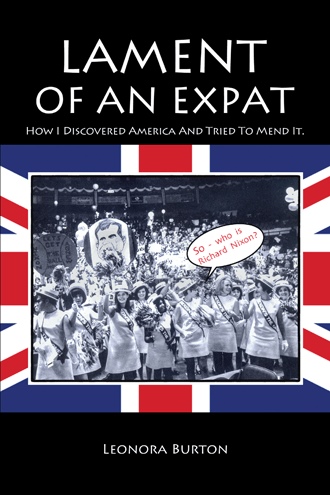
LAMENT OF AN EXPAT How I discovered America and tried to mend it. A witty, rueful examination of America, its culture, its attitudes, its bothersome constitution, through the eyes of a Welsh girl who arrives in New York in her early 20s to work for a film company while looking for adventure. It opens shortly after my arrival with me jumping up and down and shrieking, “Nixon’s the One” after being recruited for 25 dollars to be a Nixon Girl. Roger Ailes, the Fox News chief, may have been responsible and much later will become my foe. Following a description of my slightly aberrant family -- while dining out my father liked to put his false teeth on the table and order a glass of water for them while my mother had a slightly scandalous connection to the acting Barrymores -- it moves on to America where I am dismayed by the crudity of New Yorkers interested only in the frantic pursuit of money. My feelings about America warm a little when I start taking flying lessons, even when, with me flying as a passenger, we crash and survive only through the remarkable skill of our pilot. My leg is gashed but a student pilot is paralyzed. I meet a Brit and we get married in the British Virgin Islands in spite of the disapproval of a U.K. official who complains that we only have 13 days of residency when it should be 14 days. My tears solve that problem. Tony is a reporter who doesn’t want to make a fortune. He just wants to cover big dramatic stories. Still we find enough money to buy a weekend house in Woodstock where we meet one of my favorite people in the world, Nestor Bryant. To me he represents the best of America. He’s lovely, warm, generous-spirited, funny and looks after us and our house as if we’re family. Hard-drinking expat writers from Australia and the U.K. come to Woodstock at weekends and meet countryman Nestor. To them he’s as exotic as they are to him but friendships blossom. Unfortunately, one guest brings a young American heiress who likes to go topless. Riding his tractor, Nestor sees her at his pool and rushes over to say hello. His friendly interest doesn’t help his marriage. At work at Warner Brothers, I encounter stars like Robert Redford, a make-up artist who wants and sadly fails to become a respected film director and a call-girl from Wales that I knew back home. She’s helping Jane Fonda with her role as a call-girl in the movie, “Klute.” And I’m appointed publisher of a magazine, Coronet, which eventually expires from enormous lack of interest. Through Tony, I meet the Happy Hooker, the most infamous madam in Manhattan, and play a part in the writing of her book which makes millions. When she’s deported I arrange a farewell party, hiring a London bus loaded with booze to take guests to a dinner at Umberto’s Clam House in Little Italy where, shortly before, mobster Joey Gallo was killed by a team of bumbling hitmen. It’s an alcoholic disaster, with Italian moms screaming at us because the bus driver won’t turn off his engine, with gun shy waiters hitting the floor when a prankster sends a chair flying with a great crash and with a guest trying to drive off with the bus. I have to keep thrusting money at the driver to persuade him to continue his duties because he’s a Muslim and doesn’t approve of our hijinks fueled by liquor. As the years pass, my bonds with the U.K. remain but I grow fond of this new country in spite of its absurd laws and complacency about its superiority. My widowed father, who claims he was a spy for the British intelligence agency, MI6, comes over and dies in the Bronx apartment of his new love. He’s been working for a British charitable group which says it will pay for his funeral so I see no reason to charge it for the exorbitant bills of a funeral home. In a distasteful development, we pay for a cardboard casket for his cremation and a Volkswagen for the trip to the crematorium. I have twin boys and we move to the pretty upstate village of Cold Spring where I buy a store on Main Street. There I meet a free-spending newly-arrived customer, Beth Ailes, husband of Roger Ailes, the rascally genius of Fox News who has a weekend house just outside the village. When Roger buys the local weekly paper, I disapprove so severely of its new rightward tilt and silly big headlines that I refuse to sell it. As a result Beth stops shopping with me and hostility develops. When Tony, now my researcher for this book, writes seeking an interview with Ailes he turns us down, saying that from word around the village he knows our opinion of him. Admittedly it’s not good. Politics had never played much of a role in quiet, serene Cold Spring but Ailes and his weekly split the village as if with a chain saw. You’re either an Ailes supporter or his enemy. Even so, I still love the village. The book ends
Formats

Book Details
About the Book
Lament of an Expat is the witty, sometimes bemused, chronicle of an expat’s plunge into American culture, with its love of the gun and the sacred dollar, with its rigid constitution and singular laws and with the kindness, generosity and humanity of ordinary Americans. She describes encounters with the Mafia, a plane crash, Robert Redford, a Madam and a call girl from her home town in Wales, a famous author so drunk he couldn’t talk, a cardboard funeral casket, Richard Nixon and a Caribbean wedding that was supposed to exclude God but didn’t. One of her twin boys lives in New York City, she writes, while the other is in London, maintaining her connection with the U.K. Along the way, she makes a foe of Roger Ailes, top earner for Rupert Murdoch’s media empire, and loves every minute of the dispute which continues with this book.
About the Author
LEONORA BURTON was born and grew up in South Wales, the youngest of four daughters in a madcap family led by a father who might or might not have been a spy for the Allies in World War 11. He was a touch eccentric. Her mother had a connection to the Barrymore family of actors. After boarding school in England, Leonora became a hospital nurse in London and then moved on to the film industry in Soho. This led her to New York and a job with American film companies including Warner Brothers which at that time owned a failing magazine, Coronet. Still in her early 30s she was appointed publisher but her efforts to revive it failed. She wrote a dozen Regency romances, married and gave birth to twin boys. She lives in Garrison NY a few miles from Cold Spring where she owns a store on Main St. She is at work on a family saga and a children’s book about her black Lab Tara