
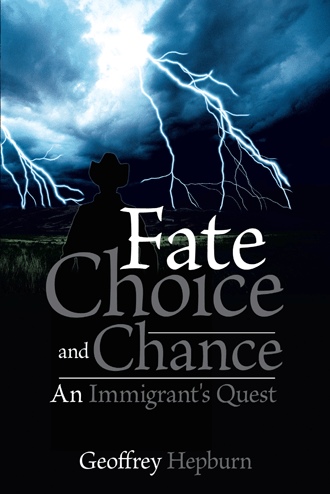
Fate Choice and Chance
An Immigrant's Quest
by
Book Cover & Preview Text
The Man in the Black Hat
Ben Peters eased back in his arm chair and glanced at the other occupants of the Consort Bar, mostly businessmen like himself engaged in animated conversation with colleagues after work over drinks and a light dinner. He ate here whenever he was in Toronto, a city of bitter memories to which he had returned on business only in recent years. He found the bar a peaceful refuge just off the lobby of the King Edward, preferring it over the hotel’s more ornate and formal Victoria restaurant. It reminded him of an English gentlemen’s club – muted colors, leather-bound chairs, a dark mahogany bar, shining brass, high ceilings that hushed the voices of its guests, evening sunlight filtering through the windows facing King Street. The staff was pleasant and unobtrusive, the food reasonably priced and the wine list good.
Three television screens flickered in the bar, two tuned to sports channels and a third offering the evening news. The two sports channels were on mute, and the volume of the news channel was set so low that it was difficult to hear the commentator’s words over the murmur of conversation in the bar.
Suddenly, his attention was riveted to the television screen by the words, “fatal shooting in Taber, Alberta” and “Todd Cameron Smith.” Smith was the young man who on April 28, 1999 at age fourteen had entered W.R. Myers High School in Taber, Alberta with a sawed off .22 caliber rifle, fatally shooting one student in the hallway outside the cafeteria and seriously wounding two others. The shooting was widely believed to have been in imitation of the Columbine High School massacre in Jefferson County, Colorado only eight days earlier.
The commentator reviewed the trial that had followed the murder. Smith had been tried as a juvenile and had been sentenced in 2000 to three years in prison followed by seven years of probation. In March 2005, he had been released to a halfway house in Toronto, but a few months later on August 15 he had escaped, leaving a note that he had been caged too long and would never surrender alive. Because the Toronto police had obtained a court injunction permitting them to publicize Smith’s identity, the news report was able to reveal his name and to provide a photograph. From its archives, the news channel also flashed back to the day of the crime – the familiar outline of W.R. Myers High School, the original red brick building constructed in 1950 and linked to the D.A. Ferguson Middle School in the buff brick building constructed in 1960; scenes of shocked and weeping students and parents – and concluded with a reference to the more horrific Columbine massacre, in which 12 students and one teacher were killed and nearly two dozen others were injured.
The news channel moved on to other stories. The Toronto and New York stock exchanges had had a good day; Prime Minister Paul Martin planned to press President George W. Bush for more talks on the softwood lumber dispute between Canada and the United States; meteorologists were forecasting a severe hurricane season in the Gulf of Mexico; U.S. troops had suffered another bloody month of casualties in Iraq; and pre-trial hearings had resumed in the case of accused serial killer Robert Pickton in Vancouver. August 16 would be fair with a chance of a late-day shower.
Peters sat motionless at his table. W. R. Myers was the school that he had attended for four years from 1958 to 1962. How could this crime have happened? Had Taber changed that much, or had there always been an underlying current of violence? He had left Taber for university at the age of eighteen, and his visits thereafter to see his parents before they moved back to Saskatoon had been rare and brief. His last visit had been in 1968 when he returned from two years of post-graduate studies in England. Family and friends from school had long scattered to other parts of Canada and the United States. There had been little to draw him back. His life had moved on – from an aborted teaching career in Toronto to a financial career on Wall Street in New York. Because of his current job with Borealis, he had begun to rediscover his Canadian roots, but Taber still seemed so remote.
Yet the crime exercised a certain fascination. What if good fortune had not smiled on him, what if he had been a school dropout rather than a star student who had attended elite British and American universities? He had had a troubled youth and could easily have gone the wrong way. Would he have become a drifter, moving aimlessly from one seasonal construction job to another, perhaps committing some crime in an eruption of pent-up rage, evading the law by working at an oil sands project near Fort McMurray, where labor was scarce and background checks were perfunctory? There but for the grace of God go I, he thought.
“Strange, that shooting. A small town in the Alberta Bible Belt is about the last place I would have expected it to happen.”
The gruff voice came from the table to Ben’s left. Ben turned in the direction of the voice to determine whether that comment had been directed at him. He had scarcely taken notice of the man sitting there when he had been shown to his table, but now he saw a middle-aged man in a dark suit, with ruddy complexion, thinning black hair and an expansive waist, gazing in a friendly manner at him.
“Yes, it was remarkable,” Ben responded, expecting the exchange to end there. He was not eager to initiate a conversation with a stranger, preferring the company of his own thoughts.
But the man persisted. “My first job after I graduated with an accounting degree from the University of British Columbia was with Rogers Sugar in Vancouver. They owned the sugar beet refinery in Taber, which I visited every quarter to audit the books. A nice, quiet town with a large Mormon population. Not much going on, but people were always willing to stop and talk to you if you needed directions.”
“Do you still visit Taber?” Ben asked politely.
“Not any more. I left Rogers Sugar some years ago. Too much travel. I developed a drinking problem and my first marriage broke up. After I had sorted out my life, I remarried and joined a small accounting firm in Vancouver, where I am now a partner.” The man’s candor about his private affairs startled Ben. He was accustomed to being reserved with strangers.
The man continued, “On my last visit to Taber, about five years before the high school shooting, there was another murder involving a young man who abducted a woman at gunpoint from the store that she and her husband owned. He raped and killed her. She and her husband had emigrated from Ireland. They had a number of small children. The police caught the killer almost immediately. Let me see, what was his name? Oh, now I remember, Thurston! In Vancouver, this kind of crime would not be shocking. After all, we have this guy Pickton on trial now. But in Taber? I never cease to be amazed by these seemingly placid little towns.”
“Perhaps the town has changed from the way I remember it.” The words escaped from Ben’s mouth before he realized what he had done.
“Remember it? Do you mean that you know Taber?”
“Yes, I grew up there,” Ben confessed, regretting that he had let slip this information about his past.
“Where do you live now?” asked the stranger.
“Just outside New York City.”
“No kidding! How did someone from Taber, Alberta end up in New York City?”
“That is a riddle that I ponder myself from time to time,” Ben replied. “Tell me more about the high school shooting,” he said, eager to shift the discussion away from himself. “Living in the United States, I heard a lot about the Columbine High School shooting in Colorado and almost nothing about the Taber shooting. Was there some connection between the two, occurring as they did only a week apart?”
Formats

Book Details
About the Book
Fate Choice and Chance recounts Ben Peters’ quest to escape his family’s traditions and poverty, the haunting memories of the past, and the limitations of the small town on the Canadian prairies where he lived as a child. His life could have gone in many different directions, but the interplay of fate and chance resulted in choices leading inexorably to the present. In retrospect, his most fateful choice was to marry the woman that he loved. Ultimately he achieves the American dream of financial success in New York City, but this is far removed from his youthful dreams of public service. The path from that small prairie town to New York City was treacherous and crooked, leading through Toronto, a city of broken dreams. His painful break with the past has left emotional scars, and he tries to deal with them by neatly compartmentalizing his life into two halves – the forgotten Canadian past and the American present. But then his chance encounter with a mysterious stranger on a business trip to Toronto and their conversation about a murder that occurred in the high school in that small prairie town of his childhood leads him to embark on a spiritual journey to reconciliation with the past and the healing power of forgiveness.
About the Author
First novels are often partly autobiographical, and Fate Choice and Chance is no exception. Like the main character in the novel, Geoffrey Hepburn grew up in a small prairie town in Canada before coming to the United States to complete his graduate education at Harvard University and the Massachusetts Institute of Technology. Most of his career was spent in the international oil industry and on Wall Street before he retired to become a writer of fiction. This book builds on his experiences accumulated over a lifetime in business and academia and reflects his love of history and travel and his personal journey of faith. He lives with his family in a suburb of New York City. Geoffrey Hepburn is a nom de plume