

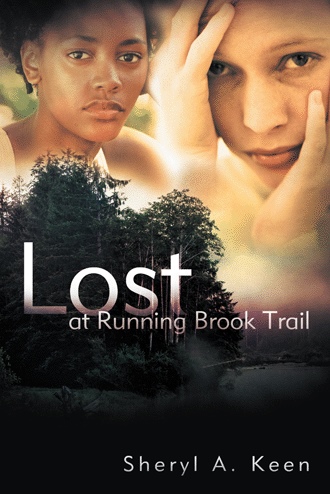
Lost at Running Brook Trail
by
Book Cover & Preview Text
When Susan was sent to the principal’s office, she wasn’t surprised. This was the sixth or seventh time this school year she’d been sent. It had become a habit that she had no inclination to break. This time it was Miss Carter who had sent her for her failure to do her English homework. Apparently, it was imperative to her future that she write pages and pages about justice in To Kill a Mockingbird.
Susan walked slowly, prolonging the inevitable; she could only imagine what Mrs. Hamilton would say to her this time. She knocked on the door and heard “Come in” from the other side.
“Have a seat, Miss Scotti,” Mrs. Hamilton said, pushing her glasses further up her nose.
Susan sat and smoothed her grey pleated skirt in place. She fixed her tie, not sure what to do with her hands.
“What brings you to my office this time?” Mrs. Hamilton wore a sly smile that seemed to say that she knew exactly why Susan was there.
“Like, I don’t—”
The principal held up an open palm that indicated Susan should stop talking. “In this office, at this school, and hopefully outside of here, we never start a sentence with like. It makes absolutely no sense. We use full sentences that are grammatically correct. I know it’s probably cool to you to talk that way, but it really isn’t. Let us start again. Why are you here?”
“Mrs. Carter sent me.” Susan felt like biting her tongue. In fact, she simulated the motion in her mouth. She had been reprimanded in this very office before for using the word like at the beginning of a sentence. There were other words and slang terms too that students were not allowed to use or misuse. Mrs. Hamilton loved to say that some words are legitimate, but how they are used is illegitimate. These illegitimate words and uses were against school rules. But those were soft rules, because everybody used them in their cliques and their groups, so it was hard to keep language separate, depending on the audience.
“Yes, I know who sent you, but I want to know why she sent you.” Mrs. Hamilton leaned back in her high-back leather chair with her fingers clasped across her ample bosom. The office was vast, and the desk the principal was sitting behind was huge. Books and paper piles were neatly stacked up, and a tidy path had been cleared between where Mrs. Hamilton sat and the chair directly in front of her, where Susan now sat.
“I forgot to do my homework.” Susan squirmed as she said the words, just as she had said them on several occasions before this one. Plus, Susan was lying. She hadn’t forgotten; she just didn’t have the energy to write a paper about justice or anything else.
“Maybe,” said Mrs. Hamilton, leaning forward and looking straight at Susan, “you have a memory problem. Maybe we need to have your brain checked out, since you have the recurring problem of forgetting to do what you’re supposed to. What do you think?” She leaned back again, her green-grey eyes piercing behind the black-rimmed spectacles.
“I don’t know.” Susan felt cold. The office was air-conditioned to the max. She wished she had brought the school-issued grey sweater, stamped with its emblem of stars. The blouse she was wearing wasn’t enough to ward off the frigid air.
“You don’t know. You never disappoint me with your answers because you always take the easy way out. Weasel! Well, here’s what I know for sure.” Mrs. Hamilton leaned forward again, picked up a pen and pressed the top every time she made a point. “You don’t have a memory problem.” Click! Click! “You’re in my office every other week.” Click! Click! “You’re one of those students who just does enough to get by.” Click! Click! “I take that back; you don’t even do enough to get by.” Click! Click! “It’s pathetic, really, because you can do so much better. You’re here because you lack diligence.” Click! Click!
Susan watched, as if mesmerized, Mrs. Hamilton’s thumb pressing down on the pen.
“Maybe I, like you, lack the diligence to get the job done.” Mrs. Hamilton threw down the clicking pen onto the desk. Susan couldn’t avoid the grey-green eyes that continued to change colour in the shifting light.
Formats

Book Details
About the Book
Kimberly, Elaine, Susan, and Miriam are no strangers to the principal’s office at Anne Beaumont Private High, where the administrators strongly believe in bending the tree before it becomes too old. Guilty of one too many infractions throughout the school year, the four teenagers are sent, along with other wayward souls, to a wilderness camp in Alberta, Canada.
After a two-day bus ride and a sleepless night, the girls leave the Running Brook Mountain campground to embark on their first day of hiking. But it is not long before they break the most important rule— stay with the group. Now lost, alone, and unprepared for the dangers that lurk within the woods, the girls soon discover every new and terrifying experience brings them face-to-face with their limitations. As they are forced to do whatever it takes to survive, friction builds among the teenagers as they forage for food, sleep in a cave, and fight off a bear. Now the girls only have one choice—to change their ways or die.
In this tale of adventure, endurance, and self-discovery, four teenagers put their survival skills to the test as they come to terms with their fears and tenaciously fight to keep the lives they once took for granted.
About the Author
Sheryl A. Keen is an artist and author of the novel Journal According to John. Her poems have been published in American Poetry Annual and Iliad Press. Sheryl has received an Honorable Mention Award for her poem “Utopia” from Iliad Literary Awards Program. She currently lives in Toronto, Canada.