
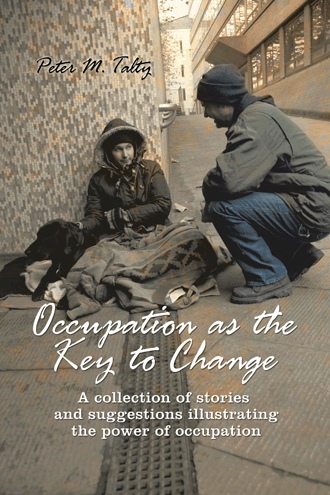
Occupation as the Key to Change
A collection of stories and suggestions illustrating the power of occupation
by
Book Cover & Preview Text
18. A ‘doer’ even while dying “Because I could not stop for Death, He kindly stopped for me. The Carriage held but just ourselves And Immortality” Emily Dickinson (1830-1886) American Poet When working for a home health agency that also provided hospice care, I was assigned a patient, “Sam,” whom I quickly realized had the personality type of a real doer. She was energetic, organized, direct, and was intolerant of time being wasted by others and especially her. Sam had worked as an assistant principal at a large high school when she developed breast cancer. For two years, medical interventions had kept Sam’s cancer in check. Even while undergoing an exhausting treatment regimen, Sam worked full-time and took care of her husband and three children. She scheduled her double lumpectomies during school breaks. Even during chemotherapy, she limited the days she took off from work to rest. In spite of the cancer, Sam made it clear she was the same person. Her co-workers, friends, husband and three teenage kids all knew that to treat her any differently would make her life, and theirs, miserable. With Sam, it seemed that difficult things like one’s cancer should be dealt with as quickly as possible, and should disrupt other people’s lives as little as possible. Of course, I learned all this about Sam after working with her for a month and she is someone I will never forget. Being a change agent for someone who is dying is not any different than with anyone else. Their values, interests, and occupations still have the power to engage and influence life even as it is diminishing. That is probably the biggest difference in that time is limited, and is of course not far away from everyone’s thoughts. By the time I saw her, Sam’s cancer had returned and quickly incapacitated her. After six weeks of aggressive treatment, doctors recommended hospice care. After reading her hospice chart in the office I was not expecting to see someone as vibrant as she was. After I introduced myself as an occupational therapist, she said, “I do not expect to be returning to work and I certainly do not have any developmental delays, so why did they send an OT to see me?” I explained that there are different kinds of OT and the type of OT we do in hospice care is entirely driven by the patient. She then said, “So, if I say I don’t think I need or want OT, you’ll go away?” I said, “Yes, but not quickly or easily because I think we could work well together and that I can help you.” Sam, looked at me closely, was silent for a moment, and then said, “OK, let’s see what your kind of OT can do for me.” I then asked my favorite question, but in a different way, “What is the worst thing about your life right now?” Sam, who was sitting up in bed, slammed her fists into the mattress with more energy than I expected, and with tears in her eyes said, “I’ll tell you. It’s waiting for incompetent people to do the simplest things, and then have to repeatedly remind them to either do it, or how to do it right.” It turned out that she was talking about her husband, her sister, her kids, her minister, her home health aide, and just about anyone else that she had to now rely on. I felt I could easily be added to her list. It has been my experience that people who have led independent lives find accepting help from others absolutely intolerable. They take pride in not being a burden on others. What seems to go along with this lifelong striving for independence are excellent time-management and organizational skills. Friends and relatives see them as the real doers, and this carries over to the world of work as well. These people are usually the stalwarts of families and companies. People depend on them and have come to expect them to effortlessly and quietly carry the greater load. Being thrust out of this role can be almost as difficult as the illness itself. Sam was struggling with this unwanted role that was thrust upon her.. People who always strive for excellence can be both a blessing and a challenge to OTs. I have worked with several people like this and know to look for the blessing in their motivation. They want to return to the life when they were the strong one in the group. However, no matter how motivated, there are times when the disability is just too great, such as with Sam. This is where the challenge comes in: getting them to accept help. I said to Sam, “I can tell you have excellent time-management skills and you know the value of prioritization. So, what bothers you the most around here?” She said, “The bills and endless stream of mail that must be addressed.” I then asked, “What would it be like for you to teach one of your kids to take over this responsibility for now as well as for the future?” She was reluctant, believing they had enough to deal with. After some thought, she said, “Mark could do it, but he is working so hard to get a college scholarship that I would hate to take him away from that.” Then I turned to another tool in my toolkit: reciprocity. I have learned that people who do not like receiving help find it easier to make a deal. I asked, “Do you think reciprocity could work here? You do something for him that he dislikes and he in turn takes over the mail and the bills. What do think?” She quickly said with a smile, “he does hate cutting the lawn and, actually, all outdoor work.” She decided to get estimates from landscapers while appointing her son, the “bills and mail guy.” I was able to document my OT intervention plan under home-management skills. Over the next few weeks, I worked with Sam on other issues, including helping her accept the shower bench when she was determined to stand, though it was no longer safe. This time I used a metaphor, telling her that the captain of the ship (Sam) had to rely on the guy up in the crow’s nest (me) to see a disaster ahead. This reframing made it easier for Sam to accept help. She also liked being viewed in this way. Sometimes patients who adamantly refuse help are the ones who need it most of all. It is easy to become frustrated. But, if the therapist has respect for the patient’s motivation, they can help keep them in their role of a doer, even while they are dying. Everyone wants to remain engaged in their valued occupations as long as possible, and we as OTs can help by adapting the activity or the environment. Of course, a time is always reached in hospice care where the patient’s condition precludes participation, and then the participation becomes more passive. Talking about and viewing pictures of better days and times can still be motivating and engaging for the patient. It also provides a meaningful role for family and friends who don’t often know what to say or do when visiting. This is exactly what I did with Sam and her visitors right up until she died.
Formats

Book Details
About the Book
The way we use time and engage in occupations that support or impede change is the focus of this book. Using stories from his diverse clinical and teaching experiences Peter Talty describes some unique strategies to help peole change. Professor Peter Talty has provided a collection of exceptional stories that have served and will continue to serve as teaching tools for students and professionals. Story telling is an essential part of developing competent professionals. In theoretical terms, storytelling can be described as using narrative to teach tacit professional knowledge and skills within the context of an individual’s environment. The art of using storytelling as a teaching tool provides knowledge beyond books and tests. Storytelling teaches professional skills beyond words in terms of communication skills and the use of a person’s current situation for enhancing their quality of life. The value of these stories cannot be measured. Professor Talty’s story contributions reflect his advanced teaching and clinical skills relating to his knowledge, passion, and dedication to lifelong learning. I am proud to be among the colleagues that have worked and learned from Professor Talty and thank him for his dedication to the profession. Vicki Smith Ed.D, MBA, OTR/L Professor and Chair of Occupational Therapy Keuka College Keuka Park, NY 14478
About the Author
Peter Talty is a practicing occupational therapist with over forty years of experience. He obtained his BS in occupational therapy and MS in Health Sciences Education from the University at Buffalo. He is also an educator having recently retired as professor of occuaptional therapy from Keuka College in upstate New York. As an educator he received the Outstanding Teacher award for the School of Health Related Professions from the University at Buffalo and the Professor of the Year from Keuka College. His clinical intrerests and experiences are diverse and include mental health, pediatrics, hand therapy, rehabilitation, geriatrics, acute care, hospice, ergonomics, and home care. Peter and his wife Janice divide their time between Amherst, New York and North Fort Myers, Florida. He maintains licenses to practice occupational therapy in both New York and Florida and is presently an adjunct instructor at Florida Gulf Coast Univeristy.