
The Obligation
A History of the Order of the Engineer
by
Book Cover & Preview Text
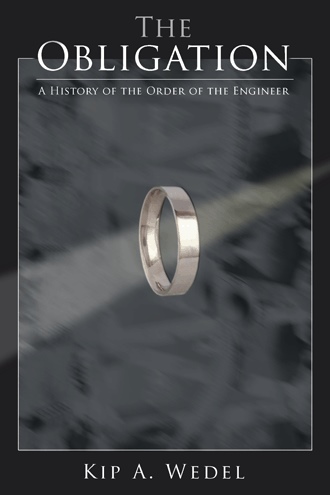
In a 2011 State of the College Address at Cleveland State University’s Fenn College of Engineering, Dean Bahman Gorashi cited John Adams’ observation about the two sides of a well-rounded education. “Both natural sciences and technical knowledge, as required in our contemporary times, and humanities and arts, as required at all times” must be part of “a complete and balanced education,” Ghorashi said.1 His remarks could be applied to more than students. Engineering educators and practicing engineers also must balance technical expertise with an understanding of the role they play in society, and striking that balance—or building what engineer Richard Seely has called a “bridge between technology and the humanities”—lies at the heart of what the Order of the Engineer is all about.2 It would be a mistake, however, to describe the Order only in terms of abstract principles. The Obligation members accept verbally and in writing enunciates the ethical principles for which the Order stands, but it is the personal, flesh-and-blood commitment to those principles that sets the Order of the Engineer apart as an institution. OOE members are not simply asked to affirm the importance of ethical practice in engineering, but to live it. This history of the OOE traces its development from the earliest recorded imaginings of such an organization to its present form. For those unfamiliar with the OOE, a few basic facts should be laid out right away. The OOE describes itself as “the roster of engineers in the United States who have participated in an Engineer’s Ring Ceremony and who have publicly accepted the ‘Obligation of an Engineer.’”3 The Obligation, which has been compared to the Hippocratic Oath taken by physicians, is a written document that defines engineering as a public service and calls for a sense of camaraderie within the community of professional engineers. New members are added to the roster after they have participated in a formal ceremony at which they are presented with stainless steel rings worn on the smallest finger of their working hand. The ceremonies are open to the public, and the rings serve as a public sign that the wearers have accepted the Obligation. There are no membership dues and no meetings of the general membership. The OOE is not a social club like the Rotary Club or Lions Club. It is not a professional guild or trade association, either, though it does seek to improve the engineering profession through personal commitments to excellence and ethical practice. Nevertheless, it does not regulate or license the profession as guilds and trade associations sometimes do. It only operates in the United States, though it is happy to lend a helping hand to organizers of similar associations in other countries. The OOE has been a part of the American engineering profession since 1970 and today adds more than 10,000 new members annually. Approximately 117,000 engineers have been added to the rolls since 2000.4 It is guided by a Board of Governors, who now meets annually at OOE headquarters in Phoenix, Arizona. At the local level, the organization is comprised of 276 chapters, called “links,” which have their own Boards of Governors and administer the ring ceremonies on behalf of the national organization. Typically, links are affiliated with engineering schools, and a long-term goal of the OOE is to establish a link at each school of engineering in the United States. As will be shown in the following pages, many aspects of the Obligation, the ring ceremonies, and the OOE’s governing structure resemble those of the older Corporation of the Seven Wardens in Canada. The Canadian organization provided the inspiration and some of the ideas that were adapted to the United States by the OOE. Preparing a history such as this is not a solitary task. The author gratefully acknowledges the kind assistance of Eugene Klingshirn, Susanne Leckband, J. Derald Morgan, Paula Ostaff, Monte Phillips, Don Rathbone, Bill Rauch, Richard Seely, Leighton E. Sissom, all of the OOE; Keryl Cryer and Maryanne Weiss of ABET; Remy Dussault of the Corporation of the Seven Wardens; and William Becker, Bahman Gorashi, and Joanne Hundt of Cleveland State University. All errors are the author’s own.
Formats

Book Details
About the Book
A History of the Order of the Engineer Engineering is more than number crunching. It is a matter of life and death. In 1907, when engineering errors led to a Canadian bridge collapse that killed seventy-five men, the profession's moral obligations were stark and obvious. Engineers increasingly realized that technical expertise was not enough, and in 1925, a group of Canadian engineers formally and publicly promised to uphold the highest ethical standards. To remind themselves of their pledge, they fashioned iron rings to be worn on the outer finger. Unfortunately, for decades engineers in the United States had no similar institution. Then, on a summer day in 1970, 170 engineers, students, and teachers met on the campus of Cleveland State University for the first ceremony of what would become the Order of the Engineer. Today, the stainless steel rings worn by the Order’s members are recognized throughout the world as the outward sign of an inward commitment to ethical engineering. This is the story of the Order’s origins and expansion.
About the Author
Kip A. Wedel teaches history and sociology at Bethel College in North Newton, Kansas. He holds a Ph.D. in history from Kansas State University and has research interests in history of American capitalism and labor as well as the social history of American technology and American economic and religious history, Canadian history, and the history of mass communications. His articles have appeared in scholarly journals in the United States and Europe. Prior to his academic career, Kip worked as a journalist in three Midwestern and Western states. An entrepreneur and former business owner he owned and published a weekly newspaper in Iowa from 1997 to 2003. "Journalists could use something like the Order of the Engineer's Obligation," he said. "Personal commitment to the highest ethical standards would not exactly hurt them." When not teaching and writing, Kip and his wife look after two unruly cats.