
The Darkness Within
by
Book Cover & Preview Text
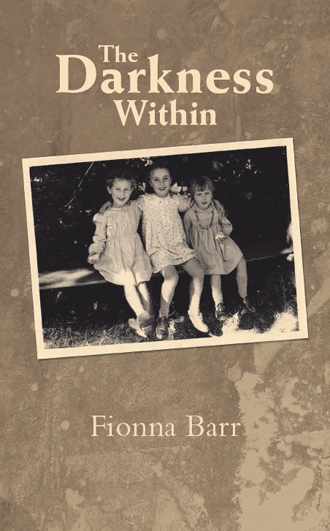
I realized when I was four years old that Mummy would suddenly disappear for long periods of time, often without any explanation. I got into the habit of checking behind the bathroom door for her dressing gown each morning as I got up. If it had gone then so had Mummy. The blue dressing gown, I can see it still, feel the fabric, smell her sleep scent pungent in its creases. I remember holding it to my face and inhaling it deep into my being. I treasure this memory. It is all my own. I turn it over in my mind and examine it carefully. It is mine and mine alone. Millie doesn’t know. Another memory, however, is etched deep into the minds of all three of us, Angela, my eldest sister and Millie, the youngest. Holland, 1951 We were five, four, and three years old respectively. The three of us were sitting on the stairs. It was late and we should have long been in bed, but no one was minding us. We could hear Mummy crying. Daddy and the nurse were with her. “The baby is dead.” Angela always knew everything. “They’ve taken it away.” “Mummy will be so sad,” Millie said, “will they take her away too?” I started to cry. “Be quiet,” shushed Angela, “Mummy is always sad. Go to bed, it’s late. Bea, you’ve wet yourself again. There’s nothing to be scared of. Why do you keep doing that? You’re much too old now. Get up, I’ll fetch a cloth.” Angela pushed me of the bottom step and I landed in a heap. I got up and disappeared off to bed. I snuggled under the bedclothes with my head under the pillow. I always slept like that, although Mummy begged me not to, afraid that I would suffocate in my sleep. I heard the clock strike the hours and its resonant chime sounded reassuring. Tomorrow Mummy would be gone. The next morning at breakfast Daddy pulled us onto his lap and explained; “Girls, I’m so sorry, Mummy lost the baby and has gone away to rest. It was a little girl and we named her Henrietta, but she came before she was ready and God has taken her back.” “Will he give her back when she’s ready?” Millie asked. “Maybe, another time,” Daddy answered vaguely. “You be good girls now for Nanny.” And with that he left the room. Sometime later, I can’t remember how long, Mummy was back again. We came back from school and there she was, her grey eyes looking tired with that crying look in them. She smiled at me and I could see the little chip in her front tooth that made her look different from other mothers, special. I have a picture of her with that smile. “Bea-kins,” she said to me, “what have you got to tell me?” But there was nothing in my mind but her smile and her arms around me and the smell of soap. With her re-appearance, however, also came the scenes of violence between her and my father Hans. He tried to stem her stream of hysterical ranting with loud, desperate words; “Anna,” he would say, “please, don’t. Think of the girls. What do you want? What can I do?” We would hear her run upstairs and slam the bedroom door. Millie and I would crouch by the door and listen to her sobbing till Daddy pulled us away and shushed us down the stairs. At night, when we were in bed and all inhibitions were cast aside, they threatened and screamed; “Are you completely mad?” We could hear Daddy bellow and then; “Put that down,” in reasonable, quiet voice. “I’ll bloody kill you,” loudly, hysterically from Mummy. “Put the knife down, or someone is going to get hurt,” calm and measured, and then the usual running up the stairs, the slamming of the door, the sobbing. The next morning we would wake up to the smell of whiskey in the kitchen, two parents not talking and looking grey and dishevelled. Daddy would go off to work without a backward glance, sighing as he left and Mummy would throw the dishes in the sink and sit, shoulders hunched, at the kitchen table. Millie and I would quietly get out of her way. Angela would tiptoe to the sink to do the washing up. Holland 1954 It was August and it had been scorching hot for weeks on end. The grass had gone brown in the relentless sun and the dust swirled and choked as people hurried along the burning tarmac. Mummy didn’t cope well with the heat and spent long afternoons in a darkened room. She came out with her eyes all swollen and her nose red and shiny. When Daddy came home from work he prepared the evening meal while Mummy sat by the open window vacantly fanning herself. “It’s the war, you know,” the doctors said. “Mental exhaustion, depression,” they said. “But the war has been over for years,” Daddy argued, not really wanting to look at an alternative explanation. “Your wife is depressed, do the best you can,” they said. So we did our best, Daddy and us. We tiptoed through the maze that was Mummy; her mood-swings, her torpor, her losing her grip on reality. And life somehow happened; school and shopping and swimming lessons. Once a week Millie and I cycled to the improvised open air swimming baths. Our route took us through the industrial estate of town and out into the open fields where the pool lay amongst the ditches. It looked like a waterhole where animals might come and drink at nightfall. It smelled like a sewer. The natural gasses, that bubbled up in the ditches and threw up dark clouds of sulphurous mud, permeated through the bottom of the pool. Concrete slabs bordered its edge, which occasionally gave way so that a stone slid into the water and had to be hauled out with ropes. Sophistication had not yet reached rural Holland. People were still struggling with shortages and the building of modern swimming pools was the last thing on their mind. But all children needed to be competent swimmers by the time they reached the age of ten, government rules, and therefore any means were acceptable. I was seven years old, Millie was six. I was riding Mummy’s bike which was too big for me and I wasn’t able to sit on the seat but had to propel myself along standing up on the pedals. Millie still had her little girl’s bike, grey with a wicker basket attached to the front in which she carried her favourite doll. Its long, yellow-nylon hair was hanging down dangerously near the spokes of the front wheel. Millie pedalled furiously to keep up. When we reached the scariest part of our journey I waited for Millie to catch up so that we could race through it together, cycling so close to each other that we were in danger of becoming entangled. The doll rocked in its basket through the violent motion of Millie’s little bike bouncing over the uneven surface. We were entering the site of the paint factory. It was very hot. The walls were saturated with a rusty secretion that left streaks of red all along the brickwork and spilled out onto the pavement like pools of blood. The air smelled of iron, above our heads pipes hissed and clanged. Now and then drops of moisture fell onto our shoulders as we raced along. Puddles had formed in the rutted road, blood-red water splashing up at us as we cycled through them. Millie and I were bent over our handlebars pedalling as if the devil was on our heels. This was the pit of hell. Not a living soul was in sight, just noise; hissing, dripping, clanging and that smell. We had to find our way across a maze of buildings connected by narrow alleyways, the bricks dripping with ochre streaks of liquid like running sores. “I hate this place. It’s full of ghosts. Just think what it would be like at night.” Millie nearly fell of her bike in fright. “Millie, don’t fall, they’ll get you,” I shrieked as we raced along faster and faster. The doll tipped out of Millie’s basket and she slowed down to try and retrieve it. “Leave her, Millie, don’t stop.” “I must get her,” Millie started to cry. “No, we’ll be late, come on!” I was shouting now. “We’ll pick her up on the way back.” I raced on, forcing Millie to follow me. “I hate you, Bea,” Millie cried, “and I hate swimming,” she panted beside me.
Formats

Book Details
About the Book
Angela, Beatrice and Millie are three little girls living in Holland in the 1950’s. Their mother is a manic depressive making life frightening and traumatic for them. When their father leaves, Mummy takes fate into her own hands with near-tragic result. The girls are taken away from her and go to live with Daddy and his new wife Aunt Agatha. Aunt Agatha treats them cruelly while Daddy, unable to cope with any more domestic upset, refuses to get involved to protect his daughters. Then Mummy dies in suspicious circumstances. Angela, Beatrice and Millie all escape in their own way through jobs, marriage and even moving abroad. For a while all seems well till Millie is diagnosed with a brain tumour. Angela and Beatrice look after her as best they can and she recovers only to be diagnosed with early-onset dementia as a result. Again Angela and Beatrice unite in their care for Millie but while they try to stimulate her mind through pictures and stories of the past they unearth many unanswered questions about the fate of Mummy: What motivated her? How did she die? Have any of them inherited her disturbed mind-set? Will they ever find the answers and finally have peace of mind and closure? When Daddy dies he leaves no clues and it is up to the girls to find out what really happened. But has time erased vital evidence? The reason Fionna is writing this book is that it is a fictionalised account of true events. For her the writing was cathartic and gave her a better understanding of the circumstances of the past. It also gave her a better insight into the psyche of her sisters. Fionna is a published author (short stories) and is well-qualified to write a comprehensive novel.
About the Author
I am qualified to write this book because it is based on autobiographical detail which is, naturally, familiar to me. I have qualifications in creative writing and I have done a lot of research for this novel in the fields of dementia, Down Syndrome, and why parents want to harm their children. Biography of Fionna Barr Fionna was born on the first of April 1947. She is a Dutch national who has lived in England since 1968. She is a retired language teacher and now works for Oxfam as a volunteer. Fionna is married to a man she first fell in love with in 1968 at the age of 21 while in his employ. She left after one year and had no contact with him for 37 years. They met up again in 2006 and were married three months later when she was 58. She has brought up nine children. Fionna speaks Dutch, English, French, German and Russian, but is most fluent in Dutch and English. Her hobbies are walking, dog breeding and amateur dramatics. Fionna has written this novel to come to a better understanding of the motives of parents wanting to harm their children and the effect this trauma has on the lives of all involved. Fionna is a published author, having won six prizes with short stories in various competitions in the last two years (Woman & Home runner-up for the Costa Award, WritersDesk 2nd prize, StoryFeedback.com 2nd prize, StoryFeedback.com 2nd prize, Dark Tales 3rd prize, WritersDesk 1st prize.) She has recently passed her MA in Creative writing and Authorship with merit at the University of Sussex. Her dissertation was based on a section of her novel The Darkness Within. Her next novel is about volunteers in a charity shop and the stories behind the second-hand garments they prepare for sale in the shop. She is also putting together a collection of short stories for publication. I live in East Sussex/ England with my husband and four terriers. We live right out into the country and spend our time walking, gardening and, in my case, writing. We have seven grown-up children between us and nine grandchildren.