
My Family's Other Recipes
I Didn't Wanna Do It
by
Book Cover & Preview Text
There was always something to do at Thorpeness, for all that it was a sleepy little seaside village. Sleepy as it was in the 1950's and early 1960's, like the vast majority of rural Suffolk, it seemed that when I returned there after a space of some twenty-five years, there was less to do to fill the day. I put this down to the increase in popularity of the motor car and the need these days for immediate gratification. No one is prepared to wait or take time to enjoy themselves. The Meare had always attracted me like any expanse of water does to a small boy who does not have to wash in it and one morning in 1956 (I remember the year because I was a grown-up kid of 5) before breakfast, I had dressed and wandered down to the Meare. The sun was up, there was not a breath of wind which was unusual for that part of the east coast and I fancied myself as some sort of master mariner. The boatman, Albert, lived his life in the boathouse with his wife and a selection of pets which ranged from the tame to feral. Living on the job, as it were, ensured that he was always about and ever ready to agree the hire of an appropriate vessel at most reasonable times of the day. In my case, I asked to hire a kayak - I knew I could not sail and I was probably too small to row a dinghy. Canoes were life-threatening in their vulnerability and what the hell was a punt? These were the five classes of craft for hire on Captain Ogilvie's Meare. The Meare was an artificially created boating lake, the like of which I have never experienced elsewhere, extending over an area in excess of 100 acres. There are numerous islands, open stretches of water to attract the wind for the sailor; long, quiet and murky loops of still water where, it was said, crocodiles would hide and dragons made their lairs; dense areas of bullrushes which could swallow up a small boat and overall an Arthur Ransomesque sense of adventure, except that you could not camp on One Tree Island, nor stay at Peggoty's Cottage. You could, however, spend all day defending and counterattacking your castle against desperate pirates and you could hire a boat for as long as your money (or Dad's credit) held good. I chose my kayak with care, a sleek white plywood craft with red flashings, and got in while Albert held the craft against the quay. I took the paddle and allowed Albert to push me out into the still waters. There were a number of craft moored offshore which needed to be avoided but I believe I hit one or two because I could almost feel Albert's stare boring into the back of my head as he correctly defined me as `landlubber' who might reward having an eye kept on him. I had never paddled a kayak before and I had a great propensity for going round in circles and being pushed by the occasional wisp of wind inexhorably towards about twenty feet of thick bulrushes some 150 yards from the quayside. The idea of using the paddle in the opposite direction to get myself out did not occur to this five-year-old and I arrowed my way ten feet into the rushes with unerring accuracy. As they closed about me I had no idea what to do but at the same time, I could not swim and I did not know how deep the water was (about a metre at its deepest in fact) so I stayed put and hoped someone would come and rescue me. After a few minutes I heard the squeak of old rowlocks as Albert, with his short sailor's stroke, was rowing towards the rushes. I swear there was a twinkle in his eye as he gave me a proper telling-off for going out on the water when I had no more idea what to do than a dead weasel. He followed me into the rushes and tied his painter to my kayak and rowed steadily out into clear water and back to the quay. On the way back, my father made an appearance on the bank and walked slowly round to where Albert delivered young Nunn, and more importantly his undamaged boat. I tried to appear nonchalant in the light of this rescue, one which, I later thought, Albert probably had undertaken hundreds of time before with other idiots like me. “How much?” my Dad asked. “Ninepence, please”. “Almost worth letting him drown.” Taking my hand in a grip a lot less fierce than I deserved it to be, my father turned to retrace his steps back to the bungalow where we were staying, some 300 yards from the Meare. It transpired he had got up to find me missing, but it being 1956 and nobody having heard of paedophiles or traffic, there was no sense of danger. I had gone for a walk. I would be back soon. But I wasn't because I was somewhere I could not get back from. My Dad was as sharp as a tack and he had a pretty good idea where I might have gone and he had made his way to the Meare. Slowly. As I blasted into the reeds with Olympic speed and Titanic stupidity, I later discovered that Albert had not turned away from the water, despite thoughts of his own breakfast. He had mounted the stairs to his home in the boathouse but then turned, on the off chance, just in time to see me disappear towards Aldeburgh. Experience told Albert I was not going to get out of there without help, being only five years old and an idiot as well, so he came out to rescue me. “The little blighter cost me ninepence,” recalled my father to my mother with a sense of relief. My mother was clearly more annoyed than my father, probably because he had seen what had happened and she had not and so had had to use her overactive imagination. I went and sat in the garden.
Formats

Book Details
About the Book
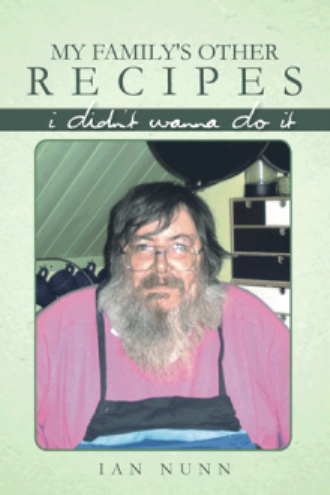
Bullied by his second daughter into putting the family's favourite recipes into book form, this subject became a sub-theme in what turned out to be an autobiography, but one written about an ordinary life although with an ability to find the humorous side of most events. For serious foodies this book may be a little thin on content but there are some interesting pieces of food history and it is very much a personal view of the last sixty years. The book is set out in four sections, based loosely on four periods of the author's life, and given titles based on a four course meal of hors d'oeuvres, fish, meat and dessert entitled "horses doovers, fishy tales, butcher's meat and just desserts". If you want a relaxing read on an inconsequential life which may make you smile, buy this book. If you want a serious cookery book or autobiography of someone famous or important, then you will have to look elsewhere. What does come through is here is a book written by a guy with a love of life, a beard more appropriate to a mad badger and a slightly quirky sense of humour who writes for his own enjoyment but with a warmth others may find undemanding.