
Barbara's Death - 1976
Memories and Reflections
by
Book Cover & Preview Text
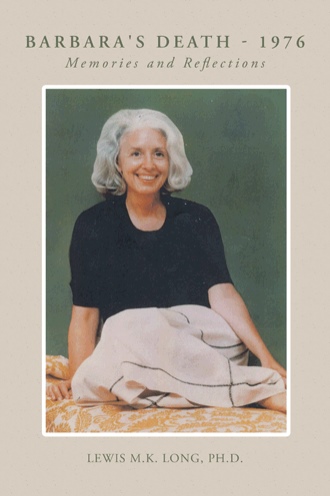
Summer was always a more relaxed time for us as parents. Barbara was without her school work, meaning we had time to go into Washington to see the museums, go to Wolf Trap at least once, visit friends, and have friends over for dinner. The children had their summer jobs -- Susan and David working as life guards at local pools, Mark as a night manager at a seedy motel, and Steve off for a YMCA canoeing adventure in Maine.
On Sundays, we attended the programs of the Mt. Vernon Unitarian Church, where we had become members in the mid-sixties. It was during one of these Sunday mornings when I first realized, now in retrospect, that Barbara was having “head” problems. While walking form the car to our chapel one Sunday morning, Barbara said she felt dizzy and wanted to hold my arm in order to balance herself. After a minute or two she seemed okay, but I did express my concern. She had mentioned dizziness before, but this was the first time I had seen its effect. We spoke about her going to a doctor. Looking back, I cannot remember whether she had been to one before this period or went to one for the first time after this episode. Perhaps this dizziness was an indication of the toxic fluid they finally removed from Barbara’s brain in December. But for now it was just a mystery, maybe a natural process, or possibly a minor deviance that can arise as one grows older and one incorporates as part of the living process, like gray hair, sore muscles, a tolerance for pain, or an acceptance of unrealized dreams.
The summer of ’75 seemed a very calm and serene period, one filled with problems that were being solved and with vistas of a future that would reap the joys one had cultivated throughout the previous years. The children were growing into adults and expressing and realizing their own talents and interests, especially Susan and Mark, now ready for their junior and senior years at Sarah Lawrence College (Susan) and Earlham College (Mark). Barb and I had already discussed plans for our future when the children were gone. We talked about trips overseas, a house at the beach. We even enjoyed musing about the kinds of in-laws we would have when our kids got married, and how we would be as grandparents. The years ahead promised to be ones that would bring us much happiness, though we were concerned about the course our country was taking and about international relations in general. America, to us, was not being sensitive to the role we envisioned for it as a leader in helping other countries become more democratic. Nor was America generous enough in sharing freely the abundance of its resources.
Our house seemed very quiet that fall in 1975, with only Steve at home and our other three children in college.
It was a Tuesday in late September when Barbara first passed out. I remember that Tuesday well, because it was our usual custom every other Tuesday for me to deposit my government check at the bank at our local shopping center and then be picked up by Barbara. It was crucial in those days to get the money deposited, in order to cover checks written the previous weekend to cover bills that needed to be paid. Like so many parents then and today, we lived from paycheck to paycheck. In fact, with three children going to college, we owed several thousand dollars to our “banker,” my father-in-law, Merritt Dietterich.
I deposited the check and waited for Barbara. No Barbara. The minutes passed. My car-pool friend, Al Brevard, came by and chatted. He was also waiting to be picked up by his wife at the shopping center. I surmised Al was going through the same financial process as I was. I phoned home – no answer. I knew Steve was probably still at football practice, but where was Barb? After several more calls, my irritation grew. Where was she?
About a half an hour passed, and I was both puzzled and angry. Al came by again and offered me a ride home which I accepted. As I got out of Al’s car at our house, there was my neighbor Jeff Kelley standing on our front lawn. He ran hurriedly towards me, saying he had been waiting for me to give me a message. “Mrs Long has been taken to the hospital.” He seemed quite upset, but all he could tell me was that Mrs. Long, while talking to his mother on the phone, had apparently passed out. The Rescue Squad had been called, and Barb had been taken to the Alexandria Hospital.
I wasn’t especially worried about Barbara that evening. Over the years, Barbara had seldom been sick. At times, she had felt bad and gone to bed early, or, infrequently, had stayed in bed for half a day of rest when I was home. Headaches, yes. Getting tired, yes. But Barb came from good genetic stock and seldom was down; moreover, being a mother meant to her that such the luxury of actually being sick could not be afforded, nor did I give much attention or sympathy to anyone becoming physically ill. I must admit that the Long family attitude towards physical illness was neither kindly nor compassionate. We were very considerate and aware about psychological disturbances and spiritual dilemmas, but we just didn’t believe people should get sick. So that Tuesday evening, I picked up the mail, left a note for Steve, and was off to the Alexandria Hospital eight miles away. I was not overly concerned.
The wait in the Emergency Room dragged on. As I waited, I could get no information about Barbara’s status. I read lengthy letters from my sisters Edith and Eulalee, picked up a magazine to read, and still there was no word about what was going on. After an hour or more, a nurse came out to tell me Barbara was having difficulty breathing, and they wanted me to sign a release for a tracheotomy in case one might become necessary. The signing of this document alerted me that something was awry, but what? I tried to protest, saying how could I sign such a document without knowing what was going on. Yet I realized that, if I didn’t sign, worse things might happen. What a quandary. What a powerless position to be put in. What to do? Underneath it all, I knew Barbara would not like to be cut, to have a scar that would eventually show. In many ways, Barbara was vain and very self-conscious about her body, but it was a concern kept well-hidden from others. I was not vain at all, none of us Longs were! (Or, at least I could not admit my vanity at that time.) But I had to make a decision. I signed the paper. It turned out that the tracheotomy was not done.
Formats

Book Details
About the Book
In the late summer of 1975, Barbara Long – highschool teacher, mother of four children, political activist, and the wife of psychologist Lewis Long, showed the first signs of an illness (cancer of the brain) that would lead to her death seven months later in the early spring of 1976. “Barbara’s Death-1976” is the story of Lewis Long’s painful journey through those seven months and the weeks immediately thereafter. The author’s descriptions of the events of that journey, and his responses, sometimes irrational, to the many things he faced are etched with a clarity, insight, and awareness born from years of experience as a husband, a father, a teacher, and a psychologist. Clearly Dr. Long was supported greatly by his own convictions and strengths, but he was buttressed even more strongly by the loving support and care he received from relatives, friends, co-workers, neighbors, and members of his church. After the death of Barbara (and after the eerily similar death of his second wife, Alice, also from brain cancer), Dr. Long found himself far more aware of the sufferings of his fellow human beings, and much more willing to respond to and help those in need.
About the Author
Lewis Long is a senior psychologist, who, with his wife Barbara and their four children, first came to the Washington, D.C. area in 1963. His rich and varied professional life has included stints at the National Institute of Mental Health in Bethesda, Maryland and at St. Elizabeth's Hospital in Washington, D.C., together with a small, ongoing private practice. Dr. Long also worked for VISTA, Teacher Corps, the Peace Corps, and the D.C. Prison System. In his private life, Dr. Long has had a wide range of interests, including politics, sports, cards (especially poker), jogging (he has run several marathons, and still jogs occasionally and goes to the gym), theology, and ever increasingly, spirituality. The first ten years of his life (he is the fourth of five children born to American parents) were spent in Brazil, and he is a member of what has now become a very large extended family, with relatives living in various parts of the world. He helped to raise four children, and has lost two wives to brain cancer. Dr. Long is currently working on another book, "Bugiganga," which is the story of a magical country on the west coast of Africa.