
PURE PRESSURE
by
Book Cover & Preview Text
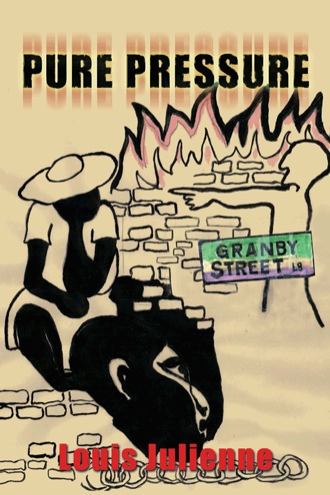
Nobby the plasterer was passing by and dropped in for a moan about times being hard and his missus was still spending money like water. He also told Paul and African Henry there were burning buildings, looted shops and barricades everywhere. “The people have taken over the streets,” Nobby said with trepidation. When Nobby added that the Racquet Club was also on fire, immediately Paul jumped into his car and drove off with no explanation. Paul felt it was too good a chance to miss, thinking that he might be able to salvage something from the fire, something nice to put into his above-the-shop abode. Within minutes of leaving his garage, he had parked his car outside the large grey stone building. Paul had been inside the Racquet Club once before, albeit very briefly. The only person he knew that had ever gone inside its august portals. Paul was astonished by the lavishness or gob-smacked, as he put it when recounting his discovery to others, the otherworldliness of it all with its sweeping staircase, large paintings of the upper classes at play from bygone days, leather chairs and chandeliers and acres of polished wood. Paul was putting a leaflet advertising his business through the letterbox when he noticed the front door was open. He went inside and had time to look briefly at most of the ground floor rooms until someone came and quickly ushered him out. The Racquet Club opened in 1877 as a `Gentlemen's' Club with a sporting twist (Racquets Courts and American Bowling) on Upper Parliament Street, right in the middle of the ghetto, yet close to the grand town houses of the Georgian quarter a few of hundred yards away. With a membership drawn from all over the North West and beyond, there had never been a black member, not even the great John Archer in his prime could have got in. Upper Parliament Street was full of people, like a carnival but quieter and more sinister. The Racquet Club was indeed on fire, flames fanning out of the shattered downstairs windows. Down the road, the copper cupola roof of the Rialto building was glowing with the flames that surrounded it. Paul walked gingerly towards the Club trying to avoid the debris strewn all over the street. He saw Bobby Harrison creep up behind Lewis Green and crash a piece of limestone on the back of his head. That was probably for Lewis sleeping with Bobby's wife while he was in jail. Lewis staggered to the floor blood streaming from the wound. In normal circumstances, Paul would have intervened or at least come to Lewis's rescue but he had bigger fish to fry and time was short. Paul looked down at his feet to see he was walking across one of those large canvas paintings he had spotted s few years ago on that first brief visit, but shorn of its frame and ripped across the middle. What a waste, probably worth thousands, he thought, as he climbed the small railings fronting the building and peeped through the broken window into the large dining room. He knocked the rest of the glass from a window pane and scrambled through the window, reckoning he probably had a couple of minutes to get in and out safely before the flames overwhelmed the room. Only one of the three chandeliers was still hanging from the ornate ceiling, the rest were lying shattered across the floor. The long table with the white cloth and been turned over and chairs thrown on top of it to look like a Bonfire Night pyre, hissing and spitting threateningly and discharging clouds of black smoke . The heat was so fierce and the smoke so dense that Paul had to retreat. However, determined not to leave empty-handed, he grabbed two mahogany chairs with dark green leather seats and backrests and placed them carefully, one at a time, outside the window. He ordered one of the young lads standing around to help him load the chairs into the back seat of his car. Paul heard a familiar two-tone whistle and turned to see Alan outside the next door building, the old people's hospital (known locally as the home of the incurables because apparently nobody came out of there alive) as it was being evacuated by ambulance and police personnel with Alan and others escorting them through. “That's ar' kid, the community leader,” thought Paul proudly, as he waved to him. A groggy and bloodied Lewis Green was among the procession of older people escorted to the two ambulances as he staggered onto one of the ambulances before they sped off with blue lights flashing.
Formats

Book Details
About the Book
Set in Liverpool at the start of the Liverpool 1981 uprisings, PURE PRESSURE tells the story of matriarch Lizzie Leung and her extended family during that turbulent period and beyond. A widow and a born survivor who has raised her family against the odds, Lizzie Leung has overcome tragedy and guilt that prepares her for the turmoil that follows. This compelling saga is interspersed with rich and brilliant vignettes of an ethnically diverse community under attack from within and outside its boundaries, captured with keen wit and a knowing eye. Brutal murders, violent confrontations, a heart-rending funeral, a lively christening, a forbidden love affair and political tensions acted out by characters that will stay long in your memory.
About the Author
Louis Julienne is a freelance journalist and management consultant. As fifth generation Black British and more particularly Black Liverpudlian, he brings a unique perspective to story-telling. His work is influenced also by his life-long civil rights activism and his many years work in the voluntary sector, where his work for project development earned him national recognition. He has published many articles and reports, and edited several publications, but this is his first novel.