
The Shepherd
by
Book Cover & Preview Text
Harrison Wild Hose had never been out of Nebraska and now he was ten thousand miles away on a remote island he had never heard about, Iwo Jima. Merely a dot on the ocean full of similar dots, Harrison could not understand the significance of holding a small island. And to make it seem even more insignificant, he was posted at a location not even worthy of a name, Airfield Number One. Nevertheless, Harrison was eager to begin his assignment of transmitting secret information over the airwaves in his native tongue. At least there, he felt equal to his fellow soldiers. Despite being of equal rank and sometimes outranking others, he was also fighting a personal war, the war of prejudice. His own platoon did not fully accept him and openly made crude Indian references. There were references to calling him a savage. Ironically, he knew that the one long lasting characteristic that “qualified” Indians as savages was the taking of scalps. He wondered to himself if anyone really new that Indians adopted that practice from the white man. It was the French in Canada who took scalps to collect a bounty on the number of Indians killed. It was easier than bringing in a wagon load of bodies. It brought to the forefront the still standing and hard-hearted belief that the only good Indian was a dead Indian. Harrison never felt so isolated. The Cherokee language was not easily learned or understood. Most words had multiple syllables while certain phrases translated into a single letter. The word for “violent” had ten syllables while the phrase “keen sighted” translated to “u”. Then there were the subtleties of each word. There were four meanings for the word “all”. When to use any version was dependent upon its position in a sentence and the inflection in the speaker's voice. It was not an easy language to memorize much less to master. Therefore it was a general practice to have a native speaker assigned to each communications team, one to transmit, the other to receive. Despite this seemingly elevated level of importance, the Indian soldiers received no respect from their fellow Americans. In fact, some were even accused of being spies for the enemy based solely on their looks which sometimes resembled the Japanese. Being Native American carried no privilege and they received none. ***** The Italian countryside was a sight to behold with its cypress tree lined roads and gently sloping hills. It was an explosion of green with a myriad of colors blended in just to tease the senses of the onlooker. It was sad that there were as many bomb related holes in the ground as there were natural wonders. It was a shame the effects of war on people, terrain and things of beauty. Unfortunately, war and its perpetrators had no conscience and those who conducted it were less concerned of the terrain as they were of winning the day. Allan waited for orders to move ahead He was camped outside of Naples with Mount Vesuvius protecting their rear flanks. There was some semblance of protection. Allan was startled to attention when he heard a voice yell out, “MAIL CALL!” With anticipation, Allan gravitated towards the voice and, to his surprise there was a letter for him. It was from Ephram White, his father. It said: Dear Allan: How are you Son? I am fine. You don't know how much I enjoyed your letters from Grand Island then from Messina. You are like a local celebrity here in North Platte. I read your letters over and over and I have shared them with the grocer, my barber, the banker and the neighbors. You are our eyes to the world. Many of us have never been out of Nebraska, much less the States. We are proud of you. I am proud of you. I love you! Dad. Allan's eyes welled up with tears. He turned away from his fellow troopers so as not to be seen showing any signs of emotion, lest he be thought of as being weak. He faced the ground as if something of great importance demanded his attention. He looked around and his fellow soldiers all seemed to be focusing on something important on the ground. *****
Formats



Book Details
About the Book
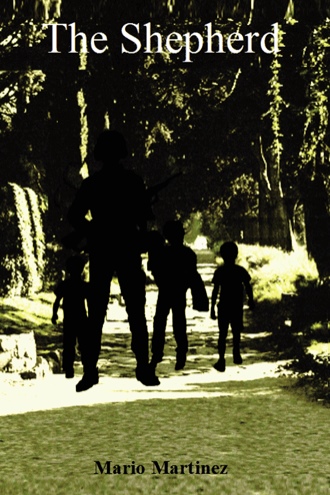
Allan Thomas White, a soldier unable to cope with the atrocities of war becomes a deserter. Along the way on his flight to freedom, he encounters the smallest victims of war: children. Unable to merely abandon them, he strings them along on his journey until he can find a safe and suitable drop-off point. In war-torn Italy, that soon becomes unlikely and he decides to take them with him until he feels he can safely separate from the children. As his journey continues, he finds more displaced children whom he also cannot abandon. They soon total eighteen! Faced with a dilemma not of his choice, he must decide how to handle his growing brood. Read “The Shepherd” to discover the fate of the children and how he solves his problem of desertion which has come to the attention of the military's upper brass.
About the Author
Mario Martinez is a unique writer who has the ability to put the reader in a position to experience what the characters are experiencing. As you read his work, you will feel as if you are next to the individual characters and his descriptions of his characters allows you to see them as he sees them, whether you like them or not. In his book, "The Obituary", a villain named Miguel Obregon is the type of character about whom you cannot wait until he is eluded or killed and you find yourself wondering what you would do. As you read "The Shepherd" you will empathize with the main character as you find yourself imagining what you would do in a similar situation. Mr.Martinez will weave you in an out of danger as you become one with his characters.