
Secular and Religious
An American Quest for Coexistence
by
Book Cover & Preview Text
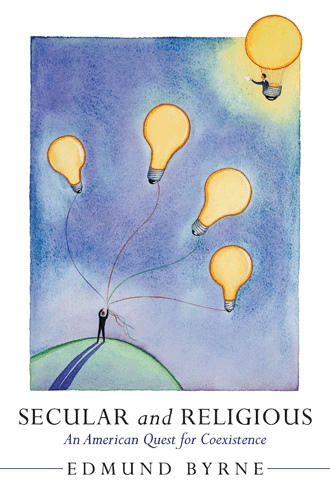
In the United States, the lodestone of state/religion border control is the First Amendment, especially via its free exercise (of religion) and its nonestablishment clauses. Favoring the former is called accommodationism. Favoring the latter is called separationism. In practice, the Court long assigned preeminence to separation, but recently it has been shifting towards accommodation. Particularly as regards education, this change in constitutional jurisprudence marks the denouement of a period during which secularism prevailed in public schools and American Catholics chose alternative schooling to facilitate maintenance of their religious values. Throughout most of the twentieth century the U.S. Supreme Court consistently handed down separationist rulings with regard to K-12 public education. Meanwhile, it opposed accommodating state support of most but not all secular functions of religion-oriented schools . A key exception to separation involved the “child benefit” theory, e.g., to fund schoolbooks. . . . Such exceptions may become more typical as religion-sponsored schools face financial problems that risk adding thousands of students to the public school rosters. The gorilla in the room in this regard is the American Catholic parochial school system. It began early in the nineteenth century as an antidote to Protestant influences in the public schools. Then it blossomed as secularism became the prevailing though often tested worldview in public schools. Its financial base consisted of an abundance of minimally paid nuns and some lay teachers, the vast majority of whom have no successors as women find many more employment opportunities in the wider world. Assuming students’ maturity on the college level, the Court seldom felt a need to address state-religion issues on this level. Secularism was commonly the norm among academics. Where it was not, e.g., mandatory chapel, such religion favoring practices gradually died out. Meanwhile, the Catholic hierarchy sought value maintenance via clerical presence on secular campuses and touting Catholic institutions of higher learning. These efforts have been of limited avail as Catholic youth persist in attending whatever college offers the programs that best fit their career aspirations. As the preceding chapter in alternative education comes to an end, unprecedented stresses to public sector budgets require opening a new chapter. This new chapter may well take the form of more state-religion collaboration to limit costs to state and local governments. To succeed, though, this new chapter will require government to be a partner in support of alternative education, especially as provided by charter schools. These state-supported K-12 schools will have various sponsors that agree only on the inadequacy of a standard public school education. . . . Their programs will challenge the flexibility of the Court, to be sure. But having recently busied itself with rulings that bolster federalism, i.e., empowering non-federal governmental actors, it has already laid the juridical groundwork for needed accommodations. This speculation on my part about the future of state/religion relations in education is put forth on a strictly “time will tell” basis. The same could no doubt be done with regard to state-religion relations in the politics of the public sphere. In lieu of such a daring venture, I merely developed a philosophical argument for why religion should have a place in such political activity. This argument consists of a three-step application of group rights theory to religious groups. This involves showing that interest groups are politically important, groups as such are morally important, and accordingly that religious groups are both politically and morally important. To bring out the political importance of groups I drew on the views of various political theorists . . . . Taken together, these and other like-minded scholars challenge liberals’ reliance on individual initiative in favor of collective action. To further dissipate liberals’ individualist outlook, I next argued that because individuals are responsible for the world around them it is morally necessary for them to participate in one or another group for the sake of the common good. To this end I showed how the absence of such moral collaboration in Kew Gardens contributed to the death of Kitty Genovese. With these reflections in the background, I then considered various difficulties that weaken the case for collective responsibility. These difficulties involve various anti-egalitarian arrangements, such as an overarching decision-maker not treating all petitioning groups fairly. Other challenges arise if people who are organized are favored over people who are not, or if some groups enjoy higher status or are otherwise more effective than is true of other groups, or if some groups have access to more resources than do others, or if a group however effective mistreats its own members, or if groups become so numerous as to impede their separate or combined effectiveness. Equipped with these thoughts about politically active groups, I then addressed the thorny question of religious toleration, i.e, how a government goes about accommodating religious groups that seek fair treatment and as need be a fair hearing before that government. For many centuries such openness, if exercised at all, was selective. Only much later was pluralism taken to be a given that requires a more flexible response. In particular, diverse religious groups should have the ability to function as or (to safeguard relevant tax exempt status) to form or contribute to an interest group in order to bring its concerns before a governing jurisdiction. De facto there are many such religion-based interest groups at work in the United States. The causes for which they seek a favorable political response are varied, some being generally palatable to the public at large, others perhaps less so. Especially troubling to many outsiders are the calls of ultra-conservative religious interest groups for a ban on all abortions or for open-ended support of any cause dear to the Israeli government. One’s opposition to such controversial quests should not be based, I maintain, on the fact that the questing group has religious ties. Rather should it be based as with any other interest group on arguments in opposition to the specific public policy that the group espouses.
Formats

Book Details
About the Book
In the United States, separation of church and state is maintained to avoid religion-centered controversy. In recent decades, though, a politically active religious right has sought to return government to what they claim are its Christian origins. By contrast, many American philosophers favor an unwavering secularism to keep church and state duly separate. Byrne responds in this book by seeking a more nuanced and open-ended relationship between religious groups and secular processes. Granting there have been religion-based excesses in the United States, he qualifies their significance by reminding readers that unconstrained secularism often engenders an intolerant civil religion. Next he discusses how US courts have gone about setting legal limits to religious influence, especially in publicly funded schools. Calling this a matter of “border control,” he indicates that US courts are now somewhat accommodating of religious groups in K-12 settings. But in the past, he shows, they required public schools to be quite rigorously secular; so religious groups, in particular the Roman Catholics, founded schools that could include religious instruction. Finally, drawing on group rights theory, he argues that a commitment to church/state separation need not preclude religious groups from participating in public sector processes. To make his case for religious groups he (1) shows the need to operate in and through groups to influence government; (2) addresses moral difficulties that a political system faces if it is open to group-generated input; (3) recognizes that worthy causes can be better advanced by organized groups than by unconnected individuals; and (4) claims this is so whether the cause is advanced by religious or non-religious groups. His conclusion: a group organized around a religious motif should neither be summarily excluded from nor exceptionally favored in secular deliberations as to public policy and practice.
About the Author
Edmund Byrne, a retired philosophy professor, edits articles in business ethics and writes in that field and in social and political philosophy, focusing on flaws in just war theory (see www://rethinkjustwar.info). After B.A. and M.A. degrees in philosophy, he studied for and spent a few years as a parish priest. Then as a Fulbright scholar he obtained his doctorate in philosophy at the Catholic University of Louvain in Belgium. He then taught philosophy for 32 years, mostly at Indiana University-Purdue University at Indianapolis, where he earned a J.D. degree.