
The Pattern of Life
A Study of Man’s Place in Evolution
by
Book Cover & Preview Text
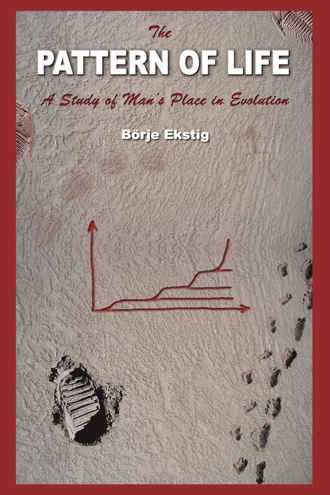
What a wonderful world
On our small and seemingly insignificant planet in the vastness of the universe, there is something truly remarkable going on, a phenomenon making our planet the most outstanding, most wonderful place in the universe at least as far as we now can judge. This phenomenon is life. Still more remarkable, on this very planet, with its countless forms of life, there is an organism endowed with the ability to take in, contemplate on, and enjoy all this. This extraordinary organism is man.
A prominent feature of our intellectual talents is our eager desire for understanding. And the greatest question of all is, of course, how to understand our own existence. The attempts at answering this challenging question have been widely diverse—we may find them in mythologies and religions as well as in philosophy and science. A long-lasting notion, nourished in mythologies and religions, has been that the universe, life, and mankind once upon a time were created by a divine being, either in its present form, having not changed over time, or, after the alleged creation, running through a sequence of changes being planned in advance. According to this view, mankind forms a kind of entity of its own amongst all other living things.
The scientific standpoint, on the other hand, is that life on Earth came into being by natural processes long ago in a most primitive form, and that during the eons of bygone time, it has been experiencing profound changes, described and explained by the evolutionary theory. According to this view, mankind is a species amongst the multitude of all others.
Some questions about evolution
There are several ways to approach the broad issue of evolution, and I begin by stimulating the curiosity by means of some provoking questions:
- Is there some kind of purpose or goal in evolution?
- Is evolution proceeding in a certain direction? Is it progressive? Is it speeding up?
- Are all species evolving?
- Why haven’t all living things raised themselves to the same level as man?
- Is mankind just one amongst the great amount of species, or are we of a special kind?
- Does human culture form an integral part of evolution? Are Darwinian principles applicable to cultural evolution?
- What does the developmental process of an individual organism have to do with evolution? Does an embryo recapitulate evolution?
- How can knowledge of evolution contribute to people’s readiness to take more efficient responsibility for the alarming overpopulation and other environmental hazards?
It’s my intention to discuss these questions during the course of the book.
The aim of the book
My aim with this book is to investigate an integrated view of the three parts of the evolutionary process—biological life, human culture, and science. The investigation is based on my discovery of a conspicuous pattern, fusing the three processes in a common temporal scheme, the combining link of which is the developmental process of an individual human being. I suggest this scheme be interpreted in terms of the enigmatic concept of complexity, found to be growing gradually and cumulatively in an accelerating pace all over the three manifestations of the evolutionary process. According to the suggested analysis, the human species has reached the position of having the highest level of complexity.
My investigations result in a new form of the tree of life, called the “Pattern of Life,” the construction and rationale of which forms my overarching aim with the book.
Living things—the substance of evolution
Life on Earth consists of individual living creatures, each of which starts as a single cell. By means of a heredity mechanism, all these creatures, except of course the very first ones, make use of the experiences of their ancestors, laid down as predetermined programs for their growth. These programs of growth are changing over time due to the action of natural selection, discovered by Charles Darwin. Therefore, a creature living today is the result of long-lasting, continuous changes in its ancestors’ developmental programs. This view brings me to introduce my concept of evolution. A central point of departure of my thesis is that what we call evolution is the total result of gradual modifications in the developmental programs of individual living organisms. This view of evolution is by no means a new one. I just want to highlight the close relationship between the developmental programs and the evolutionary process, a view forming a vital part of my discussions.
It must be emphasized that when talking about modifications in the developmental programs, such modifications are not, except in rare cases, taking place during each individual’s growth process; rather they occur as gradual changes at the population level.
The contents of the book
Much of human understanding of natural phenomena is built on patterns. In chapter 2, I discuss the explanatory power of such patterns for the understanding of evolutionary processes.
It’s my conviction that life cannot be properly understood without knowledge of its history—that is, its evolutionary history. “Nothing in biology makes sense except in the light of evolution” is a frequently quoted maxim formulated by a legendary biologist. But the knowledge of evolution has itself been developed and is still developing, and to understand its present stage, it is of value to also have some insight into the historic growth of this knowledge. Therefore, in chapters 3 and 4, I give a historic survey of the growth of knowledge of evolution with special emphasis on the enigmatic coupling between the developmental and evolutionary processes because this coupling is forming the empirical basis of my investigation.
In chapter 5, I put forward arguments for a unification of the three evolutionary processes: those of biology, culture, and science.
In chapter 6, I introduce a conspicuously regular temporal pattern, fusing the biological, cultural, and scientific evolutionary processes in a common scheme in which also the developmental process of individual creatures makes a decisive contribution.
The challenging concept of complexity has initiated comprehensive discussions in wide fields of the scientific literature. A pervasive notion amongst experts as well as laymen is that evolution follows a trend of increasing degrees of complexity. I review these discussions in chapter 7 as a background for the discussion in chapter 8, in which I suggest a method for a quantitative measurement of the growth of complexity in the lineage of man. The result of the measurement is supported by the widespread intuitive notion of a general, even accelerating, growth of complexity in the evolutionary process. By also including the contributions to complexity from cultural and scientific evolution, I find that man is the creature endowed with the highest level of complexity. The measurement of complexity is based on a publication of mine in Foundations of Science.
As a result of this endeavour, I suggest in chapter 9 a general pattern for the totality of life on our planet, a kind of a tree of life that I suggest be called the Pattern of Life. This discussion is based on an article of mine in World Futures.
Finally, in chapter 10, I try to summarize my discussions and point out the applications of my conception of evolution. Thus I discuss the consequences of the view of mankind as the exclusive species that can be held responsible for its actions. This ability of responsibility is, as I suggest, of special importance when considering the worrying environmental conditions on our planet.
Formats

Book Details
About the Book
Our planet is crowded with a spectacular diversity of living creatures. As a most peculiar fact, the oldest of these are in general the most primitive whereas the most recent are the most advanced. How can evolution be working in order to bring about such a counterintuitive result? This raises the challenging question of a direction of evolution. Is it proceeding in a certain direction, is it improving, is it even accelerating?
By introducing the concept of complexity, the author suggests a new way of describing the process of evolution. In this conception, the human cultural evolution is found to be a continuous extension of biological evolution in a common process of ever increasing complexity, characterized as a stepwise, cumulative progression.
What is man’s place in this process? Is it meaningful to reflect upon this at all? In fact, in asking this very question we have at the same time answered it. No other creature would. Our brains provide us with a fantastic range of exclusive cognitive abilities and in this respect we are unique.
In this book, we embark on an innovative, exploratory and inter-disciplinary adventure, step by step following the author towards his quest of investigating evolution, its direction and the place of ourselves in it.
About the Author
Börje Ekstig is a Ph.D. of physics at the University of Uppsala, Sweden. He is now retired but has most of his professional time worked with teacher training. In addition, he has long been interested in the evolutionary process, an interest that was reinforced by his discovery of a regular pattern in evolution, the analysis of which forms the topic of the present book.